
Nanto City, Toyama Prefecture
Winter (snow & lantern festivals) / Autumn
1–2 days (overnight in a farmhouse inn)
~1 hr 20 min by bus from Kanazawa
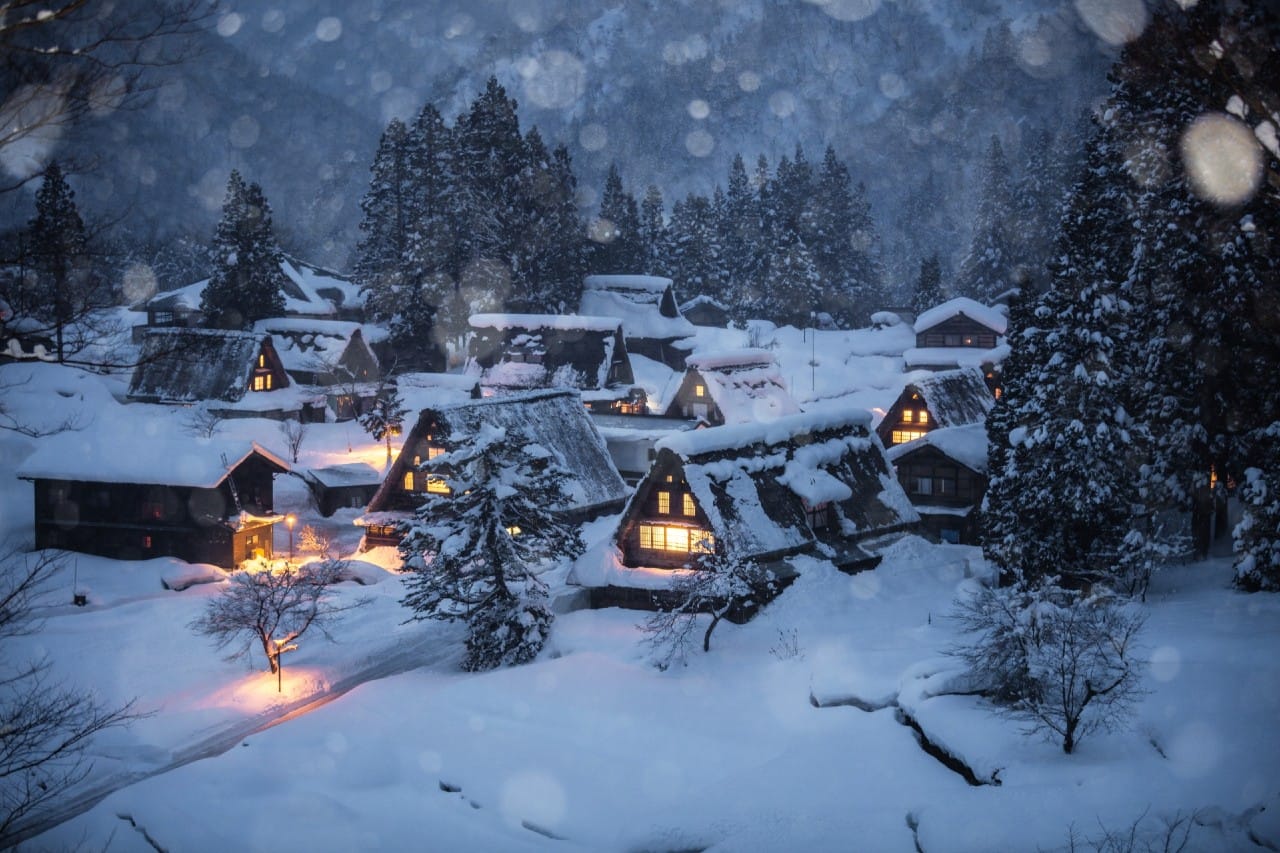
When the snow is deep enough — a metre or more is not unusual — the gassho-zukuri farmhouses of Gokayama sink quietly into white, and the only sign of life is the smoke threading upward from a chimney. This scene is not a reconstruction or a heritage park. People still live here, still heat their homes with irori hearths, and still wake up to the same valley walls their great-grandparents knew. That, more than any UNESCO designation, is why so many travellers come away from Gokayama feeling like they’ve found something genuinely rare.
Gokayama (五箇山) sits along the Shogawa River gorge in Nanto City, Toyama Prefecture — a landscape so hemmed in by cliffs that until the modern road was cut through, the villages were almost entirely cut off from the outside world. That isolation is precisely what preserved the gassho-zukuri architecture: steep thatched roofs, two to five storeys tall, built to shed the enormous snowfall of this inland mountain zone. In 1995, Gokayama’s two main hamlets, Ainokura and Suganuma, were inscribed as a UNESCO World Heritage Site alongside the more famous Shirakawa-go across the prefectural border.
Japan Pocket Wifi Rental
Japan eSIM : Fast & Easy & UNLIMTED
Japan Travel eSIM
Unlike Shirakawa-go, which fills with tour buses and souvenir shops on almost any given day, Gokayama has stayed quiet. Walk into Ainokura on a weekday morning and you may be among a handful of visitors, if that. The farmhouses don’t perform their age — they simply continue living it.
Ainokura & Suganuma: Two Hamlets, One UNESCO Heritage Site

The two hamlets have distinct characters worth understanding before you go. Ainokura (相倉集落) is the larger of the pair, with over 20 gassho-zukuri farmhouses clustered on a hillside above a valley floor. Several are still inhabited; a few operate as farmhouse inns (minshuku) or small restaurants. Standing at the entrance and looking up at the layered thatched rooflines against a backdrop of cedar forest, you get a clear sense of why people use the word “timeless” — with the quiet caveat that it actually means “time is moving very slowly here, not that it has stopped.” The hamlet changes genuinely with every season: pale green shoots in spring, deep shadow and cicada noise in summer, fiery colour in autumn, and the particular silence of heavy snow in winter.
Suganuma (菅沼集落) is smaller and even more secluded — just nine gassho-zukuri farmhouses, most of them pressed close to the Shogawa riverbank. Tourist infrastructure is minimal, which is part of the appeal. The Gokayama Folklore Museum occupies one of the farmhouses and gives a thorough look at mountain village life: sericulture tools, the traditional irori hearth, and exhibits on the surprising local industry of saltpetre production — the raw material for gunpowder, which Gokayama secretly supplied to the Kaga Domain during the Edo period under strict secrecy.
The two hamlets are about 10 to 15 minutes apart by bus. Many visitors cover both in a single day; if you have to choose one, Ainokura offers the fuller visual experience, while Suganuma rewards those who want to feel genuinely off the beaten path.
In late January and early February, both Ainokura and Suganuma hold their annual yukidōrō matsuri (snow lantern festivals). At dusk, hand-built snow lanterns are lit throughout the hamlets while the farmhouses themselves glow softly from within — a combination that is, by most accounts, one of the most quietly beautiful sights in rural Japan. The exact dates shift each year; check the Gokayama Tourism Association website before you travel. Illumination typically runs from just after sunset until around 9 p.m.
Festival nights draw noticeably more visitors than usual. Staying overnight in a farmhouse inn means you can experience the lanterns after day-trippers have left, and wake up the next morning to an empty, snow-covered hamlet.
Best Time to Visit
Gokayama is worth visiting in any season, but each one offers a fundamentally different experience. Ask anyone who has been in winter — specifically on the morning after a heavy snowfall — and they will probably tell you that no photograph prepares you for the real thing.
| Season | Dates | Highlights | Things to Note |
|---|---|---|---|
| Spring | Late Mar – May | Fresh greenery on the valley slopes; lowest tourist numbers of any non-winter season | Residual snow possible into late March; some facilities observe a brief off-season closure in early March |
| Summer | Jun – Sep | Deep mountain green; noticeably cooler than Japan’s lowland cities; occasional folk events in mid-August | Heavy rain during the rainy season (mid-June to mid-July); summer humidity is real even at elevation |
| ★ Autumn | Oct – Nov | Maple and beech foliage turns the valley walls brilliant red and gold; peak colour usually in early November | Temperatures drop sharply after late November; popular dates book out quickly at farmhouse inns |
| ★ Winter | Dec – Feb | Snow-buried farmhouses at their most iconic; snow lantern festivals in Jan–Feb; eerie blue-hour mornings | Heavy snowfall can disrupt bus services; always confirm schedules in advance; dress for deep cold |
Getting to Gokayama
There is no train to Gokayama — buses are the only public transport option, and schedules are limited outside peak seasons. IC cards like Suica or ICOCA are not accepted on most of these routes; bring cash and confirm timetables before you leave your base city. The main gateways are Kanazawa, Takaoka, and Nagoya, each with different tradeoffs.
| From | Recommended Route | Journey Time | Notes / Approx. Cost |
|---|---|---|---|
| Kanazawa | Kaetsu-no Bus “Sekai Isan Bus” (seasonal) or regular route bus to Ainokura-guchi | ~1 hr 20 min | The Sekai Isan Bus runs on specific dates and holidays only; the regular route operates year-round but less frequently. Check Kaetsu-no Bus timetables in advance. Approx. ¥1,500 |
| Takaoka | JR Johana Line to Johana Station, then Kaetsu-no Bus to Ainokura or Suganuma | ~1 hr 40 min | Buses from Johana are infrequent; the whole journey requires careful timetable coordination. Combined approx. ¥1,200 |
| Nagoya | Gifu Bus highway service to Shirakawa-go, then Kaetsu-no Bus to Gokayama | ~3.5–4 hrs | Shirakawa-go to Ainokura is ~30 min; easily combined in one trip. Highway bus from Nagoya should be booked ahead. Approx. ¥2,600 Nagoya–Shirakawa-go |
| Osaka / Kyoto | Highway bus (WILLER or similar) to Shirakawa-go, then Kaetsu-no Bus | ~5–6 hrs | More bus options from Osaka than Kyoto; consider breaking the journey with a night in Shirakawa-go or Kanazawa |
| Hida-Furukawa | JR Takayama Line to Toyama, then Kaetsu-no Bus (or drive Route 156) | ~2–3 hrs (public transport) | Self-driving is far more practical between these two destinations; see the Hida-Furukawa guide for details |
What to See and Do
Ainokura: The Hamlet That Defines Gokayama

A small toll booth at Ainokura’s entrance collects a modest entry fee — around ¥300 per adult — that goes directly toward the ongoing cost of re-thatching the farmhouse roofs, which must be replaced on a rotating schedule every 20 to 30 years. It is one of the more transparent heritage maintenance fees you will encounter in Japan, and the farmhouses are clearly well cared for.
The hamlet has a small observation deck at its upper end, accessible via a short uphill path, that gives the kind of overhead view that doesn’t compress as badly as a telephoto lens. In autumn you can see the full layering of thatched roofs against the coloured hillside; in winter, the same angle shows the improbable depths of snow resting on those rooftops. At ground level, the lanes between the farmhouses are narrow and quiet. A few buildings have small signs offering local products — Gokayama tofu, dried mountain vegetables — but the commercial presence is so light it barely registers.
Suganuma: Nine Farmhouses by the River

Suganuma is so small that a thorough walk-through takes under half an hour, but the things worth lingering on are easy to miss if you’re moving quickly. The Gokayama Folklore Museum inside one of the farmhouses is the more informative of the two hamlet museums, covering everything from the mechanics of gassho-zukuri construction (the joints are lashed rather than nailed, allowing for flexibility under snow load) to the saltpetre production that kept the Gokayama villages economically viable despite their isolation. The exhibits are modest but the content is genuinely interesting.
From the northern edge of the hamlet there is an elevated viewing point above the Shogawa; looking back down at the nine farmhouses compressed against the river, with forested slopes rising on all sides, it is one of those views that makes you understand why UNESCO bothered.
Kokiriko: Japan’s Oldest Folk Dance
Kokiriko (こきりこ) is a folk song and dance tradition that scholars believe to be among the oldest surviving in Japan, with roots stretching back well over a thousand years. The instruments are unusual: a set of bamboo clappers called sasara, small drums, and a flute. The melodies are simple and slightly haunting — the kind of music that sounds like it was composed for long winters indoors.
The grandest public performance is the annual Kokiriko Festival in early October, centred on Suganuma and drawing visitors specifically for the folk arts. Outside of festival season, the Ainokura Folklore Hall and some farmhouse inns offer occasional performances; check ahead if this is a priority for your visit. Even a brief performance tends to reframe the rest of the trip — it adds a dimension of time to a place that already feels removed from the present.
Gokayama Washi: Handmade Paper to Take Home
Gokayama has produced high-grade handmade paper (washi) since the Edo period, when it served as an official supplier to the Kaga Domain. The craft continues today, and some workshops offer hands-on papermaking sessions where visitors pull a frame through a vat of mulberry-fibre pulp and watch a sheet form in real time. The finished sheet, once dried, makes for a more considered souvenir than anything sold in a convenience store — the texture is immediately recognisable as something made slowly, by hand. Sessions generally require advance booking; the Gokayama Tourism Association can point you toward current offerings.
What to Eat in Gokayama

The single most talked-about food in Gokayama is its tofu, and the reason is immediately obvious when you hold a piece: ordinary tofu disintegrates under light pressure; Gokayama tofu can be tied with a rope and hung from a ceiling. This is not marketing copy — it is a reflection of the original purpose, which was to produce tofu dense enough to be stored and transported during deep-winter months when the hamlets were largely snowbound. The standard preparation is to thread cubes onto bamboo skewers and grill them over charcoal until the outside turns golden, then brush with soy sauce; a simpler alternative is to pan-fry thick slices in a little oil with mountain pepper salt. Either way, the texture holds even after heat — firm and slightly chewy in a way that is difficult to describe to anyone who has only eaten the supermarket variety.
Iwana (岩魚), the mountain char of Gokayama’s streams, is the other dish worth seeking out. The fish is mild, with clean flesh and almost no muddy undertone — a quality that comes from the cold, clear mountain water. Salt-grilling over charcoal is the classic treatment; the skin crisps while the inside stays moist. Many farmhouse inn dinners include iwana as a central dish alongside mountain vegetable tempura and miso soup made with local ingredients.
Seasonal sansai (mountain vegetables) appear in various forms depending on the time of year — braised fiddlehead ferns in spring, pickled red turnip (aka-kabu) in winter, wild udo shoots in early summer. These ingredients are not exotic in the way that novelty foods are exotic; they are simply the things that grew here, prepared the way they have always been prepared, and they taste better in context than they would anywhere else.
Where to Stay
The case for staying overnight in Gokayama rests on a simple argument: the best of what the place offers — the early morning quiet, the farmhouse atmosphere after dark, the way the valley looks before day-trip buses arrive — is only available to people who sleep here. A handful of farmhouse inns (nōka minshuku) within Ainokura hamlet operate inside genuine gassho-zukuri buildings, typically with a communal irori hearth on the ground floor, tatami rooms on the upper floors, and a set dinner and breakfast made from local ingredients. The experience is deliberately low-tech and unhurried; that is the point.
For travellers who prefer more conventional hotel amenities, Kanazawa and Takaoka both work as base cities for day trips. Kanazawa is the more comfortable choice — it has a wide range of accommodation, excellent dining, and its own reasons to linger — and the bus connection to Gokayama, while requiring attention to timetables, is manageable. Takaoka offers a slower, more local feel, and its own heritage temples (Zuiryuji, one of Japan’s finest Zen temple complexes) give it more substance than a pure transit hub.
Practical Travel Tips
Gokayama runs almost entirely on cash. There are no ATMs inside the hamlets, and card payment is not reliable even at farmhouse inns. Before heading into the valley, withdraw enough yen in Kanazawa, Takaoka, or Nagoya to cover bus fares, entry fees, meals, and accommodation. A practical per-person daily budget for spending inside the hamlets — excluding accommodation — is around ¥3,000 to ¥5,000. For context on how much cash to carry throughout a Japan trip, see our guide on how much cash to bring to Japan.
English signage in Gokayama is sparse by the standards of Japan’s better-known destinations, though not absent. The hamlets are small enough that getting genuinely lost is difficult, and farmhouse inn hosts are accustomed to foreign guests even without a shared language. Offline maps downloaded before arrival are more useful than relying on mobile data, since the valley’s topography can weaken signals — though a good eSIM on a reliable network handles this better than a roaming SIM. PayPay and other QR payment apps have limited usefulness here; budget on cash for everything.
There are no convenience stores within the hamlets, and the nearest ones are a 20-minute drive toward Johana. In winter, this matters more than it sounds: bring any medication, snacks, or gear you might need before the bus drops you off. If the weather deteriorates after your arrival, the next bus may be hours away.
Gokayama’s gorge terrain and limited infrastructure mean that weak or patchy mobile coverage is a real possibility with budget SIMs or carriers with thin rural networks. CDJapan Rental’s eSIM runs on docomo — Japan’s most extensive network, with the strongest coverage in rural Toyama Prefecture. Buy online before you leave home, scan the QR code on arrival, and you’re connected without swapping a physical SIM. Particularly useful for checking live bus timetables and navigating between hamlets.
Nearby Destinations Worth Combining
Gokayama sits at a useful geographic junction between several compelling destinations in Toyama and Gifu prefectures. Any of the following can be combined with a Gokayama trip without excessive backtracking.
The natural pairing. Also UNESCO-listed, larger, better served, and more crowded. Only 20–30 min by bus. A logical single-day combination: start at Shirakawa-go, end at Gokayama — or the reverse, if you want to arrive somewhere quieter.
Also in this series. A beautifully preserved Edo-period merchant town with whitewashed earthen storehouses and almost no tourist crowds. Public transport connection is indirect; self-driving via Route 156 is the most practical approach.
The most convenient base city for Gokayama, and one that rewards a night or two on its own terms — Kenroku-en garden, the Higashi Chaya geisha district, and a serious food scene. Best combined at the start or end of a Gokayama itinerary.
A quieter city 1 hr 40 min from Gokayama that most itineraries overlook. Zuiryuji temple is one of Japan’s most complete Zen temple complexes; the Great Buddha (Takaoka Daibutsu) is one of Japan’s three largest bronze Buddhas. Good for a half-day on the way in or out.
Frequently Asked Questions
What is Gokayama?
How do I get to Gokayama from Kanazawa, Nagoya, or Osaka?
What’s the difference between Gokayama and Shirakawa-go — is it worth visiting both?
What is the best time of year to visit Gokayama?
What should I eat and see in Gokayama?
Short trip or long stay — we've got you covered
Best for Travelers
Japan eSIM
From ¥2,800 — activate before you land
- Cheaper than airport & convenience store SIMs
- 5-day to 135-day plans; unlimited or data-capped
- No SIM swap needed — ready in 2 minutes
Best for Long Stays
Monthly Pocket WiFi
From ¥5,500/mo — unlimited, no throttle
- Choose WiMAX 5G or SoftBank 4G coverage
- 3 to 12-month contracts — longer means cheaper
- Delivered to your hotel or airport post office


