
Shimokitazawa
The building that turned Shimokitazawa into a secondhand-clothing town came down in March 2025. The town is still here.

For twenty-one years, if you asked anyone in Tokyo where to buy secondhand clothes, the answer involved a low building two minutes north of Shimokitazawa Station. Toyo Hyakkaten — the name means Oriental Department Store, and the joke was that it had no chandeliers, no floor staff and no departments. It opened in 2004 and packed about twenty independent stalls onto a single floor. Vintage denim next to handmade jewellery next to remade bric-a-brac, arranged with no obvious logic, in a space that felt less like a shopping centre than a postwar market that had never been cleared away. It closed on 30 March 2025. The site is a construction hoarding now, and the notice bolted to it gives a completion date of 31 May 2027.
That is the first thing to know if you are arriving with an older guide in your hand: a good deal of what is written in English about shopping here is now describing a building that no longer exists. The second thing to know is that it barely matters. Toyo Hyakkaten was the most famous address in the district, not the district itself. Within a ten-minute walk of the station there are still well over thirty shops selling secondhand clothing, and the closure has pushed some of the best stalls out onto the street rather than out of business.
Japan Pocket Wifi Rental
Japan eSIM : Fast & Easy & UNLIMTED
Japan Travel eSIM
What follows is not a list of every shop — that list would be out of date before you landed. It is how the district is laid out, how to read a shopfront before you walk in, what things cost, and where the good stuff went.
| Area | What it holds | From the station |
|---|---|---|
| Ichibangai (north) | The main vein. Highest density, widest price range, the big names | 2–6 min |
| Kitazawa 2-chome side streets | Multi-tenant buildings, designer resale, niche specialists | 3–5 min |
| Mikan Shimokita (station) | Toyo Hyakkaten’s surviving annexe, under the railway arches | 1 min |
| South exit shopping street | Fewer clothes, more theatres and food. Where you eat afterwards | 2–4 min |
Start on the Street That Runs North
One lane, thirty-odd shops, and a converted bathhouse
Ichibangai runs north from the station and is the closest thing the district has to a main artery. It is not wide — two people with shopping bags constitute traffic — and the shops sit at ground level on both sides with their doors open, so you can survey most of a shopfront’s stock without breaking stride. This is the practical argument for starting here: you can cover a lot of ground fast, mark the two or three worth a proper look, and come back.

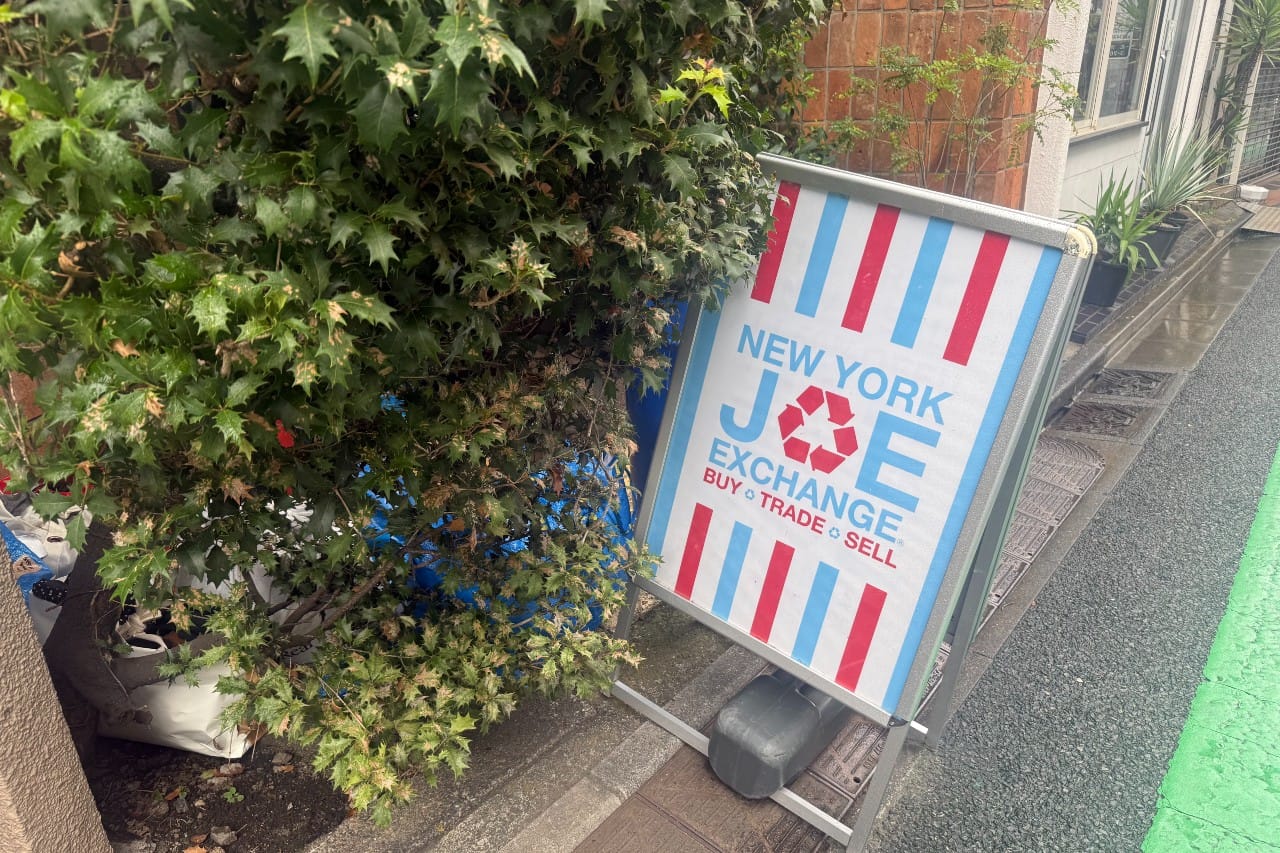
New York Joe Exchange
A public bathhouse that never quite stopped being one
Exchange shopWide rangeEnglish spokenBuy & sell
The name is a pun, and it takes a moment. Say it in Japanese, nyū-yōku-jō, and you have nyūyokujō, a bathhouse. That is exactly what this building was. Hachiman-yu, the last sento on this side of the station, closed in October 2009; the following year a vintage dealer took the shell and opened a shop in it without undoing very much.
You notice the floor first. The original tiling is still down, which means the surface is not flat and there are drainage channels cut into it — the clothing racks stand directly over them, so a rail of jackets will be sitting in what used to be a run-off gutter. The ceiling is bathhouse-high. Watch your footing; the reviews that complain about the uneven floor are not wrong, they are just missing the point.
The old division of the building is harder to see, and we would not have spotted it unaided. A member of staff explained it: the bathhouse was split down the middle into a men’s side and a women’s side, and the shop still occupies both halves — but the clothing has been laid out the other way round. Walk in and head towards the back, and the right-hand side, which used to be the men’s bath, now holds the women’s stock. The men’s rails are on the old women’s side. Once you know, you cannot stop reading the room as two rooms.
On stock: this is an exchange, not a curated vintage dealer. Anything can turn up, nothing is guaranteed, and prices are kept deliberately accessible. The tags we read in August 2026 ran from about ¥2,000 to ¥11,000. It also buys, which is worth knowing if you are travelling long-term and want to shed a coat. Staff here speak good English, and were happy to explain the building’s history unprompted.


Nobody took the bathhouse out. They just hung clothes in it.
Secondhand clothing shops are noticeably less relaxed about interior photos than bookshops or cafés. The stock is single-item, and a clear photo of a rack is a clear photo of someone else’s pricing. Ask — shashin, daijobu desu ka? — and expect a yes at the bigger shops and a no at some of the small ones. Shopfronts and the street are never an issue.
The Building That Made This a Vintage Town
Closed 2025, hoarded until 2027, still trading under the tracks
Walk two minutes north of the station and you reach a long white construction hoarding on Kitazawa 2-chome. Behind it there is nothing. We read the demolition notice bolted to the fence. It covers two buildings — the Shimokitazawa Station-front joint building and the Toyo Kogyo building, five and four storeys respectively, both with basements, 10,534 square metres of floor area between them. Work started on 16 July 2025 and is scheduled to run until 31 May 2027. The notice also records asbestos on site, which is standard for buildings of that vintage and explains some of the timeline. It is labelled Phase 1, so more will follow.

It is worth being clear about what was lost, because it explains why Shimokitazawa looks the way it does. Toyo Hyakkaten did not sell clothes. It rented small units to about twenty people who sold clothes, jewellery, remade objects and assorted junk, and it charged little enough that the units could be strange. That model — many tiny operators under one roof, low rent, no editorial control — is what allowed a generation of one-person shops to start here, and it is the reason the district accumulated the density it has. The name went up in 2004; the reputation followed within a few years.
The annexe survives, and it is closer to the station than the original ever was. Toyo Hyakkaten Bekkan sits on the first floor of Mikan Shimokita, the complex built into the Keio Inokashira Line’s elevated arches, and it opened in 2022 — three years before the main building closed, as it happens. It is smaller: a handful of tenants rather than twenty, including shops that were in the original. It is also open every day of the year, 11:00 to 20:00, which none of the independents can say.
Press coverage in 2026 has reported that a project to bring back the main building is underway for some years hence. Treat that as a plan rather than a date.

Beyond the Names You Already Know
Buildings that hold four shops, and a shop that sells only football shirts
The useful skill here is not knowing which shops to visit. It is being able to tell, from the pavement, what kind of shop you are looking at — because the range in Shimokitazawa is much wider than the word “vintage” suggests, and three doors on the same street can be three completely different propositions.
The multi-tenant building. Toyo Hyakkaten’s model did not die with the building. Look for a stairway with several signs stacked beside it: one address, four businesses, usually on two floors. One such building on the north side carries signs for a luxury and designer resale shop, a vintage store, a Native American jewellery specialist and a fourth trader — and we copied the board by the door as we passed: Dior, Margiela, Balenciaga, Rick Owens, Comme des Garçons. This is the end of the market where a single item can cost more than a night’s accommodation, and where the buying is genuinely expert.

The single-obsession shop. At the other end, shops that do exactly one thing. A banner above a doorway near the station reads furugi × football, with a red England shirt pegged up beside it; inside is secondhand football kit and nothing else. There are equivalents for band tees, for military surplus, for 1960s and 70s American, for workwear. If you have a specific obsession, someone here is running a shop for it, and the shopfront will usually tell you so in one word.

The exchange. New York Joe is the model: high volume, uncurated, buys from the public, priced to move. Good for browsing without a plan, poor for finding a specific thing.
Prices track these categories closely. An exchange will put a T-shirt at ¥2,000–3,000 and a jacket at ¥6,000–11,000. A dedicated vintage dealer with a point of view charges several times that for a piece with provenance, and the designer resellers are priced against the secondhand market for those labels, not against the neighbourhood. None of this is a bargain district in the way it was twenty years ago. What it still is, reliably, is a place where all three tiers are on the same street.
How Much Does Vintage Clothing Cost in Shimokitazawa?
What we actually saw on the tags, by tier rather than by shop
There is no single answer, and any guide that gives you one is describing a single shop. Shimokitazawa holds three quite separate price tiers within the same few streets, and the gap between the bottom and the top is a factor of ten or more. What follows is what we read on tags in August 2026.
| Tier | What it is | What we saw |
|---|---|---|
| Exchange shops | Uncurated, high turnover, buys stock from the public over the counter | ¥2,000 for a T-shirt up to about ¥11,000 for a jacket, most stock in between |
| Vintage dealers | Curated by era, country or genre. One person’s eye, applied consistently | Several times the exchange price for a comparable garment, and no ceiling on a good piece |
| Designer resale | Dior, Margiela, Balenciaga, Rick Owens, Comme des Garçons and similar | Priced against the global secondhand market for those labels, not against the neighbourhood |
A useful planning figure: ¥5,000 to ¥15,000 buys one good thing here, and that is the bracket most visitors end up spending in. Below ¥5,000 you are shopping the exchanges, which is a perfectly good way to spend an afternoon but relies on luck. Above ¥15,000 you are into dealer and designer territory, where the question stops being what things cost and starts being whether the piece is right.
You can usually read the tier from the pavement before you commit, and the tell is spacing. Rails packed so tight you have to lever garments apart mean volume, turnover and low prices. Garments hung with space between them, or laid flat, or sleeved in plastic, mean somebody is asking you to look at each one, and the tags will say so. This holds more reliably than shopfront styling does.
Shimokitazawa stopped being cheap at least a decade ago. What it offers instead is range: three price tiers standing on the same street, and better hunting than anywhere in Tokyo at this density. If your budget is the first constraint rather than the fourth, Koenji will stretch it further.
Do Shimokitazawa Vintage Shops Take Cards, and Can You Shop Tax-Free?
Two questions with different answers, and only one of them is good news
Cards first, because that is the reassuring half. Card acceptance across the district is now broad, including at single-room independents that would have been cash-only five years ago, and every shop we bought from in August 2026 took both. Contactless and QR payment are common. What still catches people out is the smallest end of the market: a one-person stall, a shop with a handwritten sign, an older dealer who has never seen a reason to change. Carry enough cash to cover one purchase and you will not be stuck. Our guide to how much cash to bring to Japan has the general picture, and convenience-store ATMs on the main streets accept foreign cards if you run short.
Tax-free is the disappointing half. The scheme is not a discount you can claim anywhere; it only operates at shops that have registered as tax-free retailers with the tax office, and registration involves paperwork and a minimum spend threshold that a single-unit vintage shop has little reason to take on. In practice, most of the independent shops in Shimokitazawa are not registered, and you should assume you are paying the consumption tax unless a shop displays the tax-free logo at the door or the till.
The exceptions cluster where you would expect: the larger operators, the multi-tenant buildings with a shared till, and the shops inside the station complex. If tax-free matters to your budget, ask before you fall in love with something. The phrase is menzei dekimasu ka, and a shop that is registered will answer immediately, because they get asked constantly. Bring your passport, since the process cannot be done without it. Our tax-free shopping guide covers what qualifies and what the current procedure looks like.
One thing worth being clear about: a shop that cannot do tax-free is not overcharging you. Secondhand goods in Japan are sold tax-inclusive at a price the shop set, and the ten per cent is already inside the number on the tag. You are not losing a discount you were entitled to.
Shimokitazawa Vintage Shopping for First-Timers
Sizing, fitting rooms, condition and the things nobody tells you
Sizing is the real constraint, not price. Most stock here is Japanese domestic secondhand, cut for Japanese frames, and the label says whatever the original market said. A Japanese M usually sits somewhere near an international S. American and European imports run larger and are normally flagged as such, sometimes with a handwritten note on the tag. Ignore the letter and read the measurements, which many shops write on the tag in centimetres: shoulder, chest, length, sleeve. Shoes are sized in centimetres throughout.
Fitting rooms exist, but the definition is loose. Some shops have a proper room; plenty have a curtain across a corner, and a few have neither and will let you pull something over your clothes in front of a mirror. Ask rather than assume: shichaku shite mo ii desu ka is enough, and the answer is usually yes for outerwear and often no for anything that goes over your head. Wear something you can layer over, and it stops being a problem.
Assume final sale. Single-item secondhand does not come back. Returns and exchanges are not a normal part of the transaction here, and nobody will offer you a receipt with a returns window on it. Check hems, cuffs, underarms and zips while you are still in the shop. Many dealers mark faults on the tag with a note reading damage or repair, which is a sign of care rather than a warning.
Nothing here is negotiable. If your reference point for secondhand shopping is a flea market or a bazaar, adjust it. Japanese vintage shops price single items deliberately and do not expect to be haggled with, and asking for a discount will get you a polite no and an awkward thirty seconds. The one exception is volume at the exchanges, where staff sometimes round a large basket down of their own accord. Let them offer.
Bring a bag, and think about the flight home. Vintage denim and outerwear are heavy, several shops do not offer bags at all, and a coat bought at four in the afternoon has to be carried through the rest of your day. If you are shopping seriously, do it on a day you are not moving hotels.
When to Come, and How to Get Here
Timing decides this visit more than any shortlist does
Come in the afternoon. Almost nothing opens before midday, and most shops run until 20:00 or 21:00. Shimokitazawa is a bad morning and an excellent late afternoon. Arrive at one, shop until seven, eat where you stand. If you are combining it with anything else in the day, put Shimokitazawa second.
Closing days are irregular and vary shop by shop; the multi-tenant buildings and the annexe are the safe bets, since they open daily. Small independents post short-notice closures to Instagram rather than updating Google, so a shop showing “open” on a map may not be. Wednesday to Saturday is the reliable window.
Getting there: Odakyu Odawara Line from Shinjuku, about eight minutes on a rapid express, or Keio Inokashira Line from Shibuya, about three to four on an express. Neither is JR, so no rail pass applies. Ichibangai starts a couple of minutes from the north side of the station.
Clothes are one thread through this neighbourhood, not the whole of it. The same few streets hold eight small theatres run by a single company and a cluster of independent bookshops built on a buried railway line — including one that serves beer and one that sells nothing but diaries. Our guide to Shimokitazawa’s bookshops covers those, and our full guide to the neighbourhood covers how it all fits together.
Half of what makes this district workable is being able to look things up on the spot — checking a brand you don’t recognise, running a camera translation over a care label, or seeing whether the shop you’re standing outside posted a closure to Instagram this morning. CDJapan Rental’s eSIM runs on the docomo network, which holds up in the narrow blocks north of the station. Buy it online before you fly, scan the QR code, and leave your SIM tray alone.
Frequently Asked Questions
Is Shimokitazawa still worth it now that Toyo Hyakkaten has closed?
Yes. The main building closed on 30 March 2025 and the site is hoarding until at least 2027, but it was one venue among dozens. Ichibangai and the streets running off it still hold the densest concentration of secondhand clothing shops in Tokyo, and Toyo Hyakkaten itself continues as a smaller annexe inside Mikan Shimokita at the station. What you lose is one very good building. What remains is the neighbourhood.
How much does vintage clothing cost in Shimokitazawa?
At an exchange-style shop like New York Joe, tags observed in 2026 ran from around ¥2,000 for a T-shirt to roughly ¥11,000 for a jacket, with most stock in between. Dedicated vintage dealers and designer resellers run considerably higher — a curated 1970s piece or a secondhand designer item can reach several times that. Shimokitazawa is not a bargain-bin district; it is one where the range is wide and the hunting is good.
Can I take photos inside the shops?
Ask first. Many secondhand clothing shops discourage interior photography, because single-item stock is easy to photograph and price-compare elsewhere. Some will say yes readily, especially the larger shops with English-speaking staff. Shopfronts, signage and the street are not a problem. The phrase you want is shashin, daijobu desu ka?
What time do the shops open?
Most open at midday and close between 20:00 and 21:00. Almost nothing is open before noon, which makes Shimokitazawa a poor morning stop and a good long afternoon. Closing days vary and are often irregular; smaller shops post short-notice closures to Instagram rather than to Google.
Do the shops take cards, and can I shop tax-free?
Cards are widely accepted now, including at the small independents, but carrying some cash is still sensible. Tax-free shopping is a different matter: the scheme requires the shop to be a registered tax-free retailer, and most single-unit vintage shops are not. Assume you are paying the consumption tax unless a shop displays the tax-free logo.
Short trip or long stay — we've got you covered
Best for Travelers
Japan eSIM
From ¥2,800 — activate before you land
- Cheaper than airport & convenience store SIMs
- 5-day to 135-day plans; unlimited or data-capped
- No SIM swap needed — ready in 2 minutes
Best for Long Stays
Monthly Pocket WiFi
From ¥5,500/mo — unlimited, no throttle
- Choose WiMAX 5G or SoftBank 4G coverage
- 3 to 12-month contracts — longer means cheaper
- Delivered to your hotel or airport post office


