
Hida City, Gifu Prefecture
Spring (Festival) / Autumn (Foliage)
1 day (best paired with Takayama)
~2 hr 40 min by limited express from Nagoya
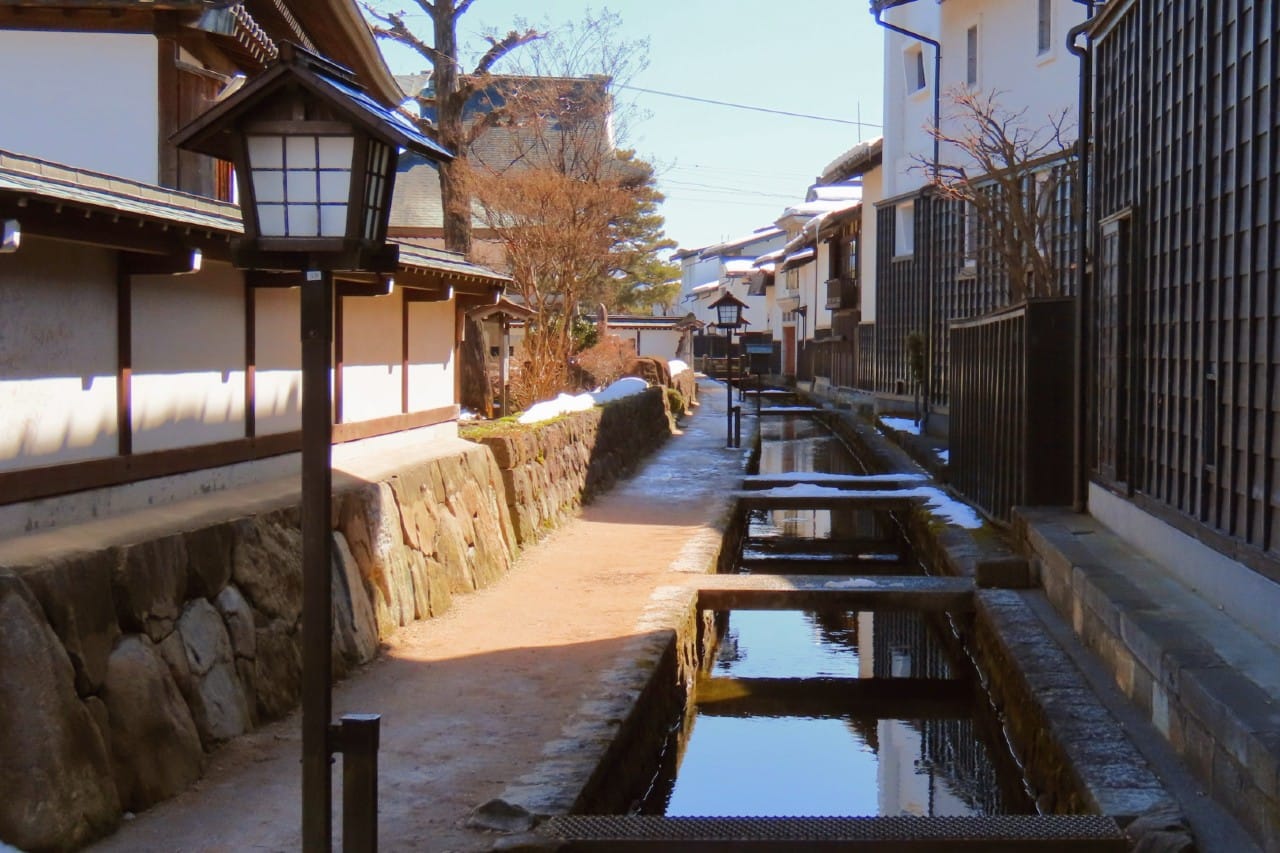
Most visitors to Japan’s Hida highlands get off at Takayama and stay there. Sixteen kilometres up the same railway line, Hida-Furukawa sits quietly waiting for the handful of travellers who bother to stay on the train a little longer. A whitewashed sake-warehouse district lines the Seto River canal, where hundreds of koi drift between the reflections of Edo-era walls. The town has been left largely to its own devices—there’s no souvenir-shop strip, no queues, and no particular effort to perform itself for tourists.
Takayama draws over a million visitors a year. Furukawa, just fifteen minutes away by rail, draws a fraction of that. The two towns share much the same architectural vocabulary—preserved merchant townhouses, cedar-scented sake breweries, narrow stone-paved lanes—but the atmosphere in Furukawa is measurably different. You hear the clank of a shop shutter opening in the morning, not the hiss of a matcha soft-serve machine. Locals actually live here, and it shows.
Then, every April 19th at midnight, all that quietness is shattered. The Furukawa Festival’s Okoshi-daiko drum procession tears through the main street, a one-ton drum carried on a wooden frame by dozens of half-naked men while spectators try to climb it in the dark. It is one of Japan’s most visceral festival experiences, and it is the single biggest reason Western travellers make the detour to Furukawa. Even if you miss the festival, though, the koi-filled canal will hold you for an afternoon—and that’s usually enough.
The Furukawa Festival: Drums in the Mountain Dark

出典:”古川祭(起し太鼓)” , by 飛騨市, CC BY 4.0, via 飛騨市画像オープンデータ.
Japan Pocket Wifi Rental
Japan eSIM : Fast & Easy & UNLIMTED
Japan Travel eSIM
The Furukawa Festival is one of Japan’s great spring matsuri, and one of few that reward the effort of actually planning your trip around it. In 2016, it was inscribed as part of UNESCO’s Intangible Cultural Heritage list alongside thirty-three other Japanese float-and-drum festivals — a formal acknowledgment of a tradition that has continued for centuries.
The festival runs across two very different days. On the night of April 19th, the Okoshi-daiko (“rousing drum”) procession begins. A massive drum — nearly a metre in diameter, weighing roughly a ton — is mounted on a wooden frame and paraded through the main street, flanked by men in traditional dress beating smaller drums. Running alongside the procession are dozens of half-naked men (the “suhada”) who attempt to clamber onto the frame and strike the central drum. The crowd presses in from both sides. The noise is genuinely overwhelming. The procession continues until well past midnight, and the English term “naked festival” that sometimes appears in travel writing is not much of an exaggeration.
April 20th is an entirely different register: stately and considered. Six yatai — enormously elaborate festival floats — are paraded through the town accompanied by traditional hayashi musicians. Each float belongs to a different neighbourhood district and is a centuries-old object of local pride, its lacquerwork, metalwork, and embroidery maintained with painstaking care. Up close, they’re more like mobile temples than parade decorations.
Furukawa Festival — Dates & Key InformationOkoshi-daiko (night procession): April 19, from approximately 10pm, continuing until after midnight
Yatai float parade: April 20, approximately 9am–4pm
Status: UNESCO Intangible Cultural Heritage (inscribed 2016)
Accommodation: Festival-period rooms sell out 3–6 months in advance — book early or plan a day trip from Takayama
Best Time to Visit
Hida-Furukawa has a genuine four-season character, and choosing your timing makes a real difference to what you’ll experience. Spring and autumn are the headline seasons, but the town rewards visits in all seasons for different reasons.
| Season | Dates | Highlights | Things to Note |
|---|---|---|---|
| ★ Spring | Late March — early May | Furukawa Festival (Apr 19–20, UNESCO); weeping cherry trees along the Seto River | Festival-period accommodation sells out 3–6 months ahead; Golden Week brings more visitors |
| Summer | June — August | Lush mountain scenery; very low tourist numbers; quiet streets | Heat and humidity; occasional afternoon mountain thunderstorms |
| ★ Autumn | October — November | Autumn foliage against white-walled storehouses; mountain morning mist | Busiest autumn weekends; temperatures drop sharply after mid-November |
| Winter | December — February | Snow-covered storehouses; fairy-tale atmosphere; almost no other tourists | Mountain roads may ice; some businesses reduce hours or close |
Getting to Hida-Furukawa
Hida-Furukawa sits deep in Gifu’s mountain interior, but the JR Takayama Main Line’s Wide View Hida limited express makes the journey from Nagoya surprisingly comfortable — and the ride itself, as the train snakes through river gorges and mountain tunnels, is one of the better train journeys in central Japan. If you have a JR Pass or IC card, the infrastructure is straightforward to navigate.
| From | Route | Journey Time | Cost / Notes |
|---|---|---|---|
| Nagoya | JR Wide View Hida (direct) | ~2 hr 40 min | ~¥5,720; JR Pass accepted |
| Osaka | Shinkansen to Nagoya + Hida express | ~3 hr 50 min | From ~¥12,000; transfer at Nagoya Station |
| Tokyo | Shinkansen to Nagoya + Hida express | ~4 hours | From ~¥15,000 |
| Takayama | JR Takayama Main Line (local or express) | ~15–16 min | ~¥330; the natural partner day-trip |
| Gokayama area | Gokayama → Takayama (bus) → Furukawa (JR) | ~2.5–3 hours | Pairs well with Gokayama for a 2–3 day mountain loop |
Top Sights & Experiences
Seto River Canal & White Storehouse District

The centrepiece of Furukawa is a 500-metre canal flanked by white-walled dozō storehouses — Edo-period buildings that originally housed the raw materials for the town’s sake breweries and soy sauce producers. The lime-plastered walls, dark timber latticework, and stone foundations are all very much intact. This is not a reconstruction or a preserved “heritage zone” in the managed sense; people actually live and work in the buildings along this street.
In the 1960s, local residents cleaned up the Seto River and released koi into the canal as a marker of the restored water quality — a tradition that stuck. More than a thousand carp now move through the clear water beneath the storehouse reflections. The best time to visit is early morning, before tour groups arrive from Takayama: the streets are empty, a tofu vendor might pass on a bicycle, and the canal holds the white walls perfectly. That image — white walls, dark water, koi moving slowly beneath the surface — is the reason most people come to Furukawa, and it doesn’t disappoint.
Furukawa Festival Hall (Matsuri Kaikan)
Even if April is out of the question, the Furukawa Festival Hall (matsuri kaikan) offers a year-round encounter with the festival’s scale and craft. All six of the town’s yatai floats are displayed in full inside the hall — these are the real objects, not replicas, and standing next to one makes it clear why each float takes months to prepare and represents a century of accumulated neighbourhood pride. The metalwork details and lacquered panels would belong in any serious craft museum. A replica of the Okoshi-daiko drum is also on display, and short films of the festival play on a loop with narration available in English.
The hall is generally open daily 9am–5pm, with adult admission around ¥700. A good strategy is to visit here first, before walking the streets — understanding the festival context changes how you read the rest of the town. The tourist information office next to the festival hall stocks English maps and can assist with accommodation questions.
Keta Wakamiya Shrine — The Real Miyamizu Shrine from Your Name

Keta Wakamiya Shrine (気多若宮神社, Keta Wakamiya-jinja) carries two distinct identities, and both matter to visitors for different reasons. The first: it is the home shrine of the Furukawa Festival — the Okoshi-daiko drum procession and yatai float parade each April are this shrine’s annual matsuri, rooted here for centuries. The second: it is one of the primary real-world models for the Miyamizu Shrine in Makoto Shinkai’s 2016 anime film Your Name (Kimi no Na wa). The shrine’s stone staircase approach, lined with torii gates and flanked by tall trees, appears in scenes where the protagonist Taki walks through Furukawa searching for the fictional town of Itomori.
For fans of the film, standing on that staircase produces a distinctive double-vision — the landscape you’re looking at is the landscape the film was built from. Even setting aside the Your Name connection, the shrine grounds are well worth a visit on their own terms: the path climbs a forested hillside above the town, the main hall is a handsome example of traditional Hida shrine architecture, and the site is genuinely quiet. The shrine is open around the clock and admission is free. One practical note: it’s not easily walkable from the station — it sits on a hillside at the edge of the town, and a taxi takes about 3–5 minutes. The Hida City Library (飛騨市図書館), another Your Name filming reference (the library where Taki researches Itomori), is a 10-minute walk from the station and pairs naturally as a half-day pilgrimage loop.
Ichi-no-machi Street & Mishima Wax Candles

出典:”三嶋和ろうそく店” , by 飛騨市, CC BY 4.0, via 飛騨市画像オープンデータ.
Furukawa’s main merchant street, Ichi-no-machi-dori, runs parallel to the canal and retains several intact Edo-period commercial townhouses. Walking its length doesn’t take long, but the details reward attention — the proportions of the facades, the stone water troughs, the occasional glimpse through an open shoji screen into a working interior. Among the businesses on the street, Mishima Wax Candles (Mishima Warosoku) stands out as one of Japan’s oldest surviving traditional candle workshops.
Mishima has been making Japanese washi candles — crafted by hand, layering plant-based wax onto rush-wick cores — for several centuries. The process is entirely different from modern paraffin candles, and the flame produced burns steadily and cleanly, which is why these candles have been specified by Shinto shrines and Buddhist temples for generations. You can watch the craftsmen through the shop window without any formality or reservation. The finished candles are a genuinely unusual souvenir: light, compact, beautifully made, and carrying more local meaning than anything sold in Takayama’s souvenir shops.
Food in Hida-Furukawa

出典:”飛騨牛” , by 飛騨市, CC BY 4.0, via 飛騨市画像オープンデータ.
Hida beef (Hida-gyu) is the region’s flagship ingredient, and for good reason: this A4–A5 wagyu, raised in the cold mountain climate of Gifu’s Hida highlands, has an extraordinarily fine fat distribution that results in a texture closer to butter than to conventional beef. In Furukawa, the price point tends to be more accessible than in Takayama or Nagoya city — small stalls near the canal district sell Hida beef nigiri sushi and croquettes (korokke) for a few hundred yen, letting you eat well without committing to a sit-down restaurant. For a fuller meal, a few local restaurants serve Hida beef set menus at reasonable prices.
The region’s other essential dish is hoba miso (hoba miso teishoku): a dried magnolia leaf used as a cooking vessel on a small brazier, piled with Hida’s distinctive combined miso paste and seasonal mountain vegetables — mushrooms, spring onions, grilled tofu. The leaf chars slightly as the miso bubbles, adding a faint woody smokiness to the already earthy flavour. Served alongside a bowl of Hida soba (buckwheat noodles milled from grain grown in the cold highland climate), it constitutes the most authentically local lunch available in the area.
For street eating, look for mitarashi dango stalls. The Hida version differs from Kyoto’s: less sweet, more savoury, with a lightly charred exterior and chewy rice cake inside. One skewer and a can of hot green tea from a vending machine — it’s a cliché of the Hida countryside in the best possible sense. If you’re visiting in the early morning, the small street market near the station occasionally has local farmers selling seasonal produce and homemade pickles; not a destination in itself, but a pleasant way to see the town before it fully wakes up.
Where to Stay
Accommodation options in Furukawa are limited but varied. The most practical choice for those arriving late or leaving early is one of the small business hotels clustered near the station — functional, well-located, and a reasonable base for the morning walk to the canal. For a more immersive stay, a number of machiya guesthouses (renovated traditional merchant townhouses) operate in and around the historic district, and some are positioned close enough to the Seto River that you can hear the water from the window. These tend to book up quickly; early reservation is essential.
A worthwhile planning approach is to pair Furukawa with Takayama as a two-day itinerary: spend the first day in Takayama, take the early train to Furukawa on day two, spend the morning on the canal and streets, then continue onward — either back to Nagoya or further afield toward Gokayama. This framing positions Furukawa as the quieter, more contemplative complement to Takayama’s busier charms, which is exactly what it is.
Practical Tips
Furukawa is cash-heavy. The Festival Hall and a handful of the newer cafés accept cards, but the majority of traditional shops, food stalls, and smaller restaurants operate on cash only. Withdraw yen before arriving — the ATM options in Furukawa itself are limited, and Japan Post and 7-Eleven ATMs in Nagoya or Takayama are the reliable options.
PayPay works at a handful of the more modern establishments, but coverage is patchy compared to larger cities. IC cards like Suica work normally at JR station gates along the Takayama Main Line, and are a convenient way to handle short-hop train fares. For Hida express ticket purchases, however, advance seat reservations are recommended (available at JR windows or online).
The town is entirely walkable from the station — the storehouse district, festival hall, and Honkoji are all within a 10–15 minute walk of each other, and nothing in the historic core requires transportation. English signage is noticeably thinner than in Takayama; download an offline Google Maps area before you arrive. The Hida highlands also experience weak signal in places, particularly in valley areas and on the train route through the mountain tunnels.
Connected even in the mountain valleysThe Hida region sits in deep mountain terrain, and the train journey from Nagoya passes through numerous tunnels and gorges where signal drops. CDJapan Rental’s eSIM runs on docomo — Japan’s largest and most geographically comprehensive network — keeping you online for maps, recommendations, and photos throughout. Buy before you travel, scan to activate on arrival: no physical SIM swap required.
Nearby Destinations Worth Combining
Hida-Furukawa sits within easy reach of several outstanding destinations — and its position in the Hida mountain corridor makes it a natural hub for a multi-day loop through one of Japan’s most undervisited highland regions.
Gokayama (Gassho-zukuri Villages)UNESCO World Heritage thatched-roof farmhouses, at their most atmospheric under snow. About 2.5–3 hours from Furukawa via Takayama by bus — ideal for a 2–3 day Hida mountain itinerary.
Gujo Hachiman (River Town & Bon Dance Festival)Famous for its clear rivers and summer Bon Odori festival, which runs for 33 nights. A natural stop on the route toward Nagoya — the festivals at Gujo and Furukawa make a compelling pairing in summer and spring respectively.
Takayama (Hida’s Little Kyoto)Furukawa’s larger, busier neighbour — 16 minutes by train. Sanmachi preserved district, morning markets, and the Hida Folk Village are the main draws. Best paired with Furukawa as a two-day combination.
Shirakawa-go (UNESCO Gassho Farmhouses)Japan’s most iconic thatched-roof village, about 50 minutes from Takayama by bus. The winter illumination event is one of Japan’s most popular seasonal attractions; advance booking essential.
Frequently Asked Questions
What is Hida-Furukawa, and how is it different from Takayama?
How do I get to Hida-Furukawa from Nagoya or Osaka?
What are the must-see sights in Hida-Furukawa?
When is the best time to visit Hida-Furukawa?
What should I know before visiting Hida-Furukawa?
Short trip or long stay — we've got you covered
Best for Travelers
Japan eSIM
From ¥2,800 — activate before you land
- Cheaper than airport & convenience store SIMs
- 5-day to 135-day plans; unlimited or data-capped
- No SIM swap needed — ready in 2 minutes
Best for Long Stays
Monthly Pocket WiFi
From ¥5,500/mo — unlimited, no throttle
- Choose WiMAX 5G or SoftBank 4G coverage
- 3 to 12-month contracts — longer means cheaper
- Delivered to your hotel or airport post office


