
Shimokitazawa
Walk out of the station and the first thing you notice is what isn’t there: a main road.
No arterial road, no department store, no famous crossing. Shimokitazawa (下北沢) has roughly four hundred metres of lanes in every direction from the ticket gates, packed with secondhand clothing shops, small theatres, curry counters and bookshops, plus 1.7 kilometres of new development laid along the ground where the Odakyu trains used to run. The whole area is walkable end to end in twenty minutes. The question was never what is here. It is where to start, which lanes repay the time, and why coming before noon is close to a wasted trip.
Is Shimokitazawa Worth Visiting?
Japan Pocket Wifi Rental
Japan eSIM : Fast & Easy & UNLIMTED
Japan Travel eSIM
Who the neighbourhood suits, and who it will disappoint.
Come here if you like walking without a destination, buying clothes somebody else has already worn, or sitting outside with a coffee. Those three things are what Shimokitazawa does best, all of them inside four hundred metres of the ticket gates. It happens to be eight minutes from Shinjuku and five from Shibuya. On a five-day Tokyo trip it earns half a day comfortably.
Skip it if your list is built around temples, gardens, observation decks and museums. There is no famous shrine here, no garden worth the trip, nothing that works as a sight the way Senso-ji works as a sight. A visitor ticking off landmarks will come out the other end wondering what the fuss was about, and they will be right to.
On a two-day trip it probably does not earn its slot, and we would not argue with anyone who cut it.
One thing outweighs all of the above: the shops open at midday. A morning here is close to a wasted journey, and that single fact ruins more visits than anything to do with taste.
The Best Time of Day to Visit Shimokitazawa
This section decides how the visit goes.
Most visits go wrong in one specific way: people come in the morning. The independent shops here open at noon — not ten, noon — and closing days cluster on Monday and Tuesday. We tried a ten o’clock start once and got shutters, a delivery van and an empty street.
Arrive at one instead and you get the neighbourhood at full strength, with the option of staying through dinner.
| Hour | What is actually open |
|---|---|
| 08:00–11:00 | Bonus Track’s courtyard, the diary shop Nikkiya Tsukihi from 9:00, chains and the station complex. The lanes are shuttered |
| 11:00–13:00 | Shutters go up in waves. Curry counters are at their busiest and their most local |
| 13:00–18:00 | Everything. This is the window, and the only part of the day we would build a plan around |
| 18:00–21:00 | Most secondhand shops still trading. Performances running. Streets quieter than you expect |
| 21:00–22:00 | Curtain calls. The bars south and east of the station fill in about ten minutes |
For days of the week: Wednesday to Saturday is safe. Sunday works but several shops shorten their hours. Monday and Tuesday between them close a good proportion of the interesting doors.
One habit worth adopting: the smallest shops here post irregular closures to Instagram and never touch their Google listing. We checked a handful of listings against the shutters in August 2026 and found several still showing normal hours for places that had closed months or years earlier. Check the shop’s own account the morning you go, and if a listing shows no hours at all, treat that as a warning rather than an oversight.
Half of navigating Shimokitazawa happens on your phone: checking an Instagram story for a same-day closure, or working out which lane you’re in when the map drifts between buildings. CDJapan Rental’s eSIM runs on the docomo network, and you buy it online, scan a QR code and keep your existing SIM in place — no card swapping on arrival.
How to Get to Shimokitazawa from Shinjuku and Shibuya
Two private lines, no transfers, under ten minutes either way.

Two companies serve Shimokitazawa and neither is JR. If you are travelling on a rail pass, settle this first: no JR product of any kind will get you here. The Odakyu Odawara Line arrives from Shinjuku and runs underneath the neighbourhood; the Keio Inokashira Line arrives from Shibuya and runs on the viaduct above. Both are direct, both are short, and both take Suica, Pasmo and every other national IC card at the gate.
| From | Line | IC fare | Journey |
|---|---|---|---|
| Shinjuku新宿 | Odakyu Odawara Line小田急小田原線 | ¥167 | 7–8 min rapid express, 11 min local |
| Shibuya渋谷 | Keio Inokashira Line京王井の頭線 | ¥140 | 3–4 min express, 7 min local |
Fares checked August 2026. IC fares are charged to the yen; paper tickets round up to the nearest ten.
From Shinjuku, follow signs for the Odakyu line rather than the JR platforms, and take anything that is not a Romancecar. The rapid express and the express both stop at Shimokitazawa, and so does everything slower, so the train on the platform is almost always the right one.
From Shibuya, the Keio Inokashira platforms sit inside Shibuya Mark City, a few minutes’ walk from the JR gates and signed the whole way. Every train on this line stops at Shimokitazawa, which makes it the simpler approach if you are not confident reading Japanese destination boards.
One thing to know before you arrive: the station has more than one central gate, and the two companies do not share them. Note which line you rode in on before following any exit sign, or you will surface on the wrong side of a neighbourhood where nothing looks like anything else. If you do not have an IC card yet, our guide to the Welcome Suica explains the visitor options.
Five Pockets, All Within Ten Minutes
Navigate by area, not by address.
Addresses are close to useless here. The lanes bend, buildings sit at odd angles to the street, and phone navigation drifts by a building or two once you leave the main shopping streets. What works instead is holding five rough pockets in your head and knowing which one you are standing in.
| Area | What it’s for | From the gates |
|---|---|---|
| South exit shopping street南口商店街 | Theatres, izakaya, curry. Where the neighbourhood eats, and where it gets busy after a curtain call | 2–4 min |
| Ichibangai一番街商店街 | The densest run of secondhand clothing and used books. Low buildings, green cycle lane painted down the middle | 2–6 min |
| Mikan Shimokitaミカン下北 | Under and beside the Keio viaduct. Bookstore, vintage annexe, a row of foreign-food restaurants | 1 min |
| reloadnorth, towards Higashi-kitazawa | Twenty-four separate low buildings with lanes between them. Coffee, tea, small design shops, terraces | 4–7 min |
| Shimokita Senrogai下北線路街 | The 1.7 km strip on the old railway land, running southwest. Bonus Track, plazas, a wild-planted rain garden | 3–12 min |
The split that matters most is old versus new. Ichibangai and the south exit streets are largely inherited — small frontages, hand-painted signs, buildings repurposed four or five times since the 1970s. Mikan, reload and the railway street are all less than five years old and were designed, deliberately, to look like they were not. Walking from one to the other takes four minutes and covers about fifty years.

The 1.7 Kilometres That Used to Be Railway
Buried in 2013. It took another nine years to become a street.
Until 2013 the Odakyu line ran through Shimokitazawa at ground level, cutting the neighbourhood in half. When the tracks went underground, they left a strip roughly 1.7 kilometres long and about 27,500 square metres in area. Rather than build a tower, the operator filled the land with thirteen separate facilities: shops, but also a hot-spring inn, a nursery, a student dormitory and a long stretch of planted footpath. It opened in pieces between 2016 and 2022. If you have an English guide older than 2020, none of it is in there.
The trains went underground in 2013. The street above them took another nine years to arrive.

Bonus Track
ボーナストラック — the one most visitors walk to
Low two-storey buildings around an open courtyard, with a bookshop, a coffee stand, a fermented-foods shop and a handful of others. The name is a double joke: the bonus space left over on a track bed, and the hidden last song on a record. People sit on the steps for an hour without buying anything, and nobody moves them on. Current tenants and events are on the Bonus Track site.

reload
north of the station, towards Higashi-kitazawa
Twenty-four separate small buildings — not one building divided into twenty-four units. Lanes between the blocks, decks connecting the upper floors, no interior corridor at any point. You browse it the way you browse a street rather than a mall. White walls, a lot of planting, and on the weekday afternoon we walked it, genuinely quiet.
NANSEI PLUS and the rain garden
南西プラス/シモキタ雨庭広場
The last piece to be completed, which is what finally made the strip continuous. Just across the road, the ward built Shimokita Rain Garden Plaza (シモキタ雨庭広場), a rainwater-absorbing garden planted with grasses left to grow long and go over. Against the usual standard of Tokyo park maintenance it looks abandoned. It is not. It is doing its job, and it was one of the few places we stood in all afternoon where the insects were louder than the traffic.

Mikan Shimokita is not part of it
ミカン下北 — a different railway, a different company
This is the single most common mistake in English writing about the area. Mikan Shimokita sits under the Keio Inokashira Line viaduct, was developed by a different railway company, and has nothing to do with the Odakyu strip beyond opening in the same period. The name comes from mikan as in 未完, unfinished — the stated idea being that Shimokitazawa is permanently a work in progress. Inside: about twenty tenants across five blocks, including a bookstore with a lounge, the surviving annexe of the old vintage market, a ward library counter and a run of foreign kitchens that stay open late.
Shimokita Senrogai = Odakyu, on buried track land, 13 facilities, fully open May 2022. Mikan Shimokita = Keio, under an elevated viaduct, opened March 2022. Two projects, often merged into one by guides and AI summaries alike.
Add the station plaza, finished only this year, and the result is this: if you last came here before 2020, you will not recognise the exits, and roughly a third of what is now worth walking did not exist.
Two Things This Neighbourhood Is Actually Known For
Covered properly elsewhere — here is where they sit on the map.
Secondhand clothing is the main reason most people come. Ichibangai and the lanes running off it hold the densest concentration of it in Tokyo, over thirty shops inside a ten-minute walk, from exchange-style stores where the stock turns weekly to dealers pricing single 1970s pieces at several times retail. One thing to update: Toyo Hyakkaten’s main building, for twenty-one years the anchor of the trade, closed on 30 March 2025 and the site is now hoarding. Its annexe continues inside Mikan Shimokita. The full picture is in our guide to vintage shopping in Shimokitazawa.

Books are the quieter half. Independents on the railway street, secondhand dealers on the Kitazawa side, and a literary footnote most visitors miss: the poet Sakutaro Hagiwara (萩原朔太郎) moved here in 1931, died in the neighbourhood in 1942, and his only work of fiction, The Town of Cats, belongs to those years. Details are in our Shimokitazawa bookshop guide, part of a wider guide to Tokyo’s bookstores.
Curry, Coffee, and What Happens at Nine
Where each kind of eating clusters.

Shimokitazawa’s food reputation rests on curry. The annual curry festival, held each October, involves around a hundred participating restaurants inside a few hundred metres. They are not on one street — they are in second floors and basements across the area, which is why the festival needs a map.
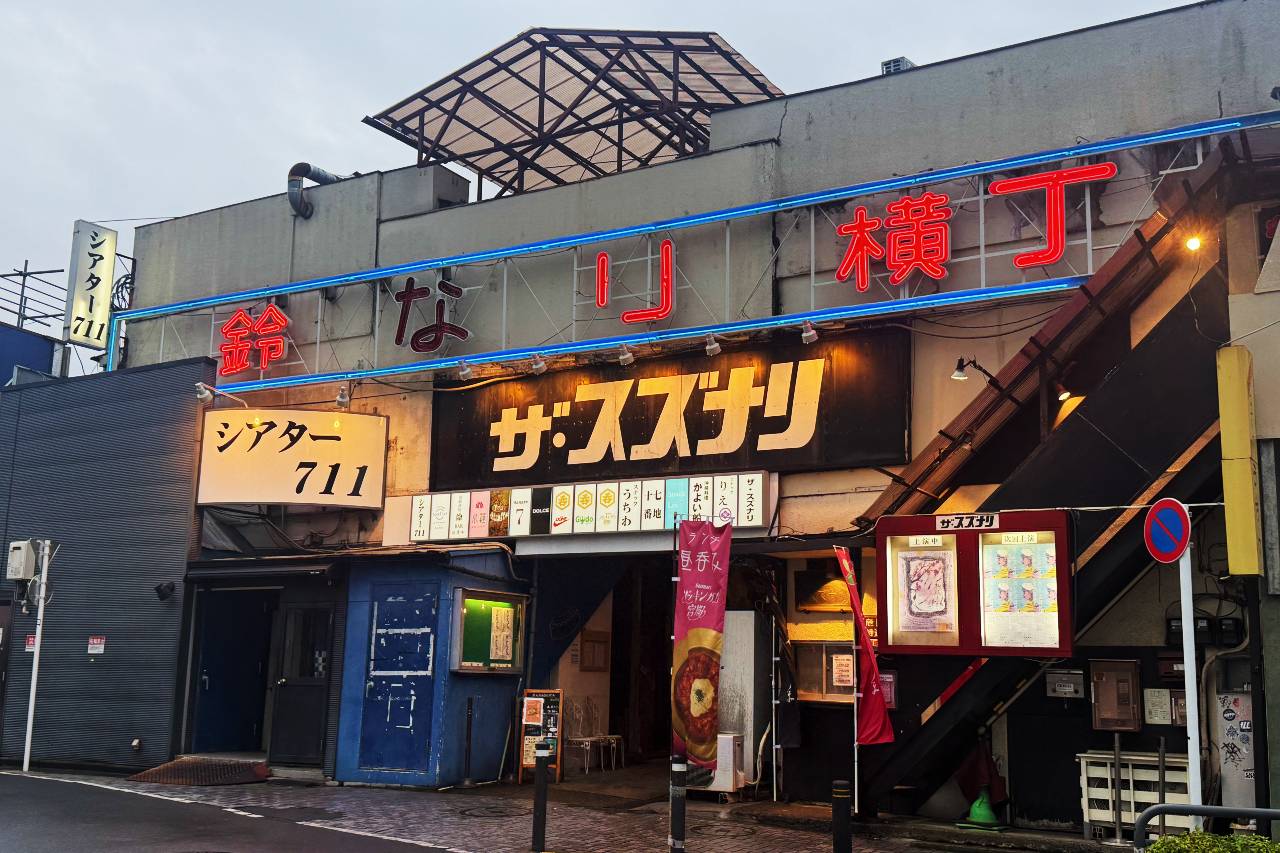
Beyond curry, the pattern is geographic. Daytime coffee is on the railway street and at reload, where there is somewhere to sit outside. Late foreign food is under the viaduct at Mikan. Drinking is south and east of the station, densest in the row of tiny bars under the Suzunari, where a dozen signs stack on top of one another beside the theatre entrance. Between 21:00 and 22:00, when the evening performances let out, that section gets abruptly busy.

Card acceptance is broad even among small independents, but a few counters and older bars remain cash-only, and some have minimum charges easier to settle in cash. Our guide to how much cash to carry in Japan covers the general rule.
A Half-Day Shimokitazawa Itinerary: Three to Four Hours
The order we would walk it in, with the times that actually work.
Half a day is the right unit for Shimokitazawa. The constraint is never distance — it is that browsing secondhand shops is slow by nature and the good hours do not start until one. What follows is the north-side route, for a first visit where clothes are part of the appeal.
13:00 — arrive, north exit. Come out on the north side and go straight up Ichibangai. Do one pass without stopping properly, marking the two or three shopfronts you want to come back to. About fifteen minutes. This stops you spending your first hour in the first shop you see.
13:30 — the side streets off Ichibangai. This is where the multi-tenant buildings are: one stairway, four traders, designer resale next to a jewellery specialist. Also where the Toyo Hyakkaten hoarding is, worth two minutes of standing still if you have read anything about the district written before 2025.
14:30 — north to reload, or up to Claris Books. A ten-minute walk to reload, where you can sit down with a coffee outdoors on a quieter street. If you would rather have books than coffee, Claris Books is roughly the same distance in the same direction, on a second floor above a gallery.
15:30 — back down to Mikan Shimokita. Under the Keio viaduct at the station: the surviving Toyo Hyakkaten annexe, a bookstore with a lounge, and a run of Thai and Vietnamese kitchens. It is indoors, which matters in July and in February.
16:30 — curry, then the south side. Eat, then walk the south exit shopping street to see the theatres from the outside. If you are staying for the evening, this is where you will be at nine.
Three hours instead of four? Cut reload and stay on the north side. Four hours or more, and the extension worth making is west along the railway street to Bonus Track — a completely different kind of walking, closer to a park. Budget ninety minutes for it, or start from the other end: get off the Odakyu one stop early at Setagaya-Daita, walk Bonus Track first, and arrive at the station from the west with the whole neighbourhood still ahead of you.
That is the version we would choose on a second visit.
The Small Stages That Set the Rent
Why a quiet residential district filled up with secondhand shops.
In the lobby of the Honda Theatre (本多劇場), a board carries the current flyers for every house in the group except the one you are standing in. We counted eight. Add the Honda Theatre itself and the total is nine: eight within a few minutes’ walk of that lobby, the ninth in Shinjuku.


The Honda Theatre (top) and Geki Shogekijo (bottom), each shot from the same spot in the afternoon and again in the evening. In daylight this reads as ordinary mixed-use blocks; the theatres only announce themselves once the signs come on.
The man behind them, Kazuo Honda, arrived from Hokkaido as an actor, didn’t make it, and went into the bar business in Shimokitazawa — at one point running dozens of them. He put the proceeds into stages for the young performers he kept meeting. The Suzunari opened in 1981; the Honda Theatre itself, 386 seats, followed in 1982. Six more over the next three decades.
What that did to the neighbourhood is the part worth understanding. A two-hundred-seat theatre needs cheap space near a station, and it brings an audience that arrives early, stays late and is not, on the whole, wealthy. The businesses that survive alongside it open at noon and are still open at nine — which is exactly the trading pattern of a secondhand clothing shop. The vintage trade did not create Shimokitazawa. It moved in behind the audiences.
Can you actually attend? Performances are in Japanese, without subtitles, and Japan’s main ticketing platforms require a domestic mobile number for SMS verification. For nearly all overseas visitors these venues are architecture, not an itinerary. The Suzunari is a wooden building whose ground floor is a row of tiny bars. Ekimae Gekijo and OFF・OFF share one floor of one building. Theatre 711 shares an address with the Suzunari. None of it looks like a cultural institution.
Schedules for all nine are on the Honda Theatre Group site, in Japanese. Even if you cannot attend, it tells you which nights the streets around the south exit will be busy.
Shimokitazawa vs Koenji: Which Should You Choose?
If you only have one afternoon for secondhand Tokyo.
These two get mentioned together so often that people assume they are interchangeable. They are not, and the difference is mostly shape. Shimokitazawa is dense and tangled: a few hundred metres of lanes in every direction from one station, with clothes, theatres, curry and bookshops interleaved so tightly that you cannot walk two minutes without crossing categories. Koenji is linear. It runs along shopping streets and covered arcades stretching south of the station, and you can spend an afternoon there doing nothing but clothes.
| Shimokitazawa | Koenji | |
|---|---|---|
| Line | Odakyu / Keio Inokashirano JR, no rail pass | JR Chuo and Chuo–Soburail pass valid |
| Layout | Dense grid, roughly 400 m in every direction | Long shopping streets and arcades running south |
| Prices | Wide range, mid to high at the curated end | Lower on average, more volume per yen |
| Also has | Eight small theatres, a 1.7 km railway park, curry | Live houses, standing bars, a very large August festival |
| Best for | One afternoon that mixes everything | A dedicated secondhand hunt with a big bag |
One practical trap on the Koenji side: on Saturdays, Sundays and holidays the Chuo Line Rapid runs straight through Koenji without stopping. Take the Chuo–Sobu local, or you will end up at Nakano and have to come back.
If you are choosing rather than doing both: Shimokitazawa on a first trip, Koenji on a second. Shimokitazawa gives you more different things per hour, it is easier to reach from where visitors actually stay, and the redevelopment of the last decade has left it more legible than it was. Koenji rewards a specific appetite. If you already know what era, cut and price band you are hunting for, and you would rather see two hundred rails than forty, go to Koenji and give it the whole day.
Daikanyama sometimes gets thrown into the same list, but it belongs to a different conversation: designed, expensive, low-density. Nothing about it is secondhand in the sense meant here.
What keeps people in Shimokitazawa, though, has less to do with any of these comparisons than with the thing the lede mentioned: there is no main road. No cars cutting through at speed, no arterial noise, no crossing to wait at. The whole neighbourhood moves at walking pace, and what you end up remembering is not a particular shop but the few seconds of quiet at a corner you turned without planning to.
Frequently Asked Questions
Is Shimokitazawa worth visiting?
It depends what the rest of your Tokyo list looks like. Go if you like secondhand clothing, walking without a destination, sitting outside with a coffee, or seeing how a city rebuilds itself; Shimokitazawa does all four inside four hundred metres of the station. Skip it if your trip is built around temples, gardens, observation decks and museums, because there is nothing here that works as a landmark. On a five-day Tokyo trip it comfortably earns half a day. On a two-day trip it probably does not. One caveat outweighs the rest: the shops open at midday, so a morning visit is close to a wasted journey.
How do I get to Shimokitazawa from Shinjuku or Shibuya?
From Shinjuku, take the Odakyu Odawara Line — about eight minutes on an express. From Shibuya, take the Keio Inokashira Line — about five. Both accept Suica, Pasmo and other IC cards at the gate, so there is no need to buy a ticket in advance. The two lines use different exits and the station has more than one central gate, so check which line you arrived on before following the signs.
What is the best day to visit?
Wednesday to Sunday, arriving after midday. Most independent shops open at noon rather than in the morning, and closing days cluster on Monday and Tuesday. Weekends are busier but never unmanageable. What you want to avoid is a morning visit — at ten the lanes are almost entirely shuttered, and the neighbourhood reads as empty rather than quiet.
Is half a day enough?
Half a day covers one side of the station properly. The whole area is walkable in about twenty minutes end to end, but the interest is in the density, and browsing secondhand shops is slow by nature. A workable half day is Ichibangai and the lanes off it, then Mikan Shimokita at the station. A full afternoon lets you add the railway street to the west, which is a completely different kind of walking.
Can foreign visitors watch a play at the Shimokitazawa theatres?
In practice, no. Performances are in Japanese without subtitles, and the major Japanese ticketing platforms require a domestic mobile number for SMS verification, which rules out most overseas visitors. Treat the theatres as architecture and neighbourhood history rather than as an evening plan — the buildings, signboards and flyer walls are all visible from the street.
How is Shimokitazawa different from Koenji or Daikanyama?
Koenji is the closest comparison — rougher, cheaper, and spread along a longer shopping street. Daikanyama is the opposite end of the scale: designed, expensive, low-density, built around a few anchor buildings. Shimokitazawa is denser than either, mixes secondhand shops with theatres, curry counters and bookshops in the same few hundred metres, and is the only one of the three where a decade of railway redevelopment has visibly rewritten the map.
Short trip or long stay — we've got you covered
Best for Travelers
Japan eSIM
From ¥2,800 — activate before you land
- Cheaper than airport & convenience store SIMs
- 5-day to 135-day plans; unlimited or data-capped
- No SIM swap needed — ready in 2 minutes
Best for Long Stays
Monthly Pocket WiFi
From ¥5,500/mo — unlimited, no throttle
- Choose WiMAX 5G or SoftBank 4G coverage
- 3 to 12-month contracts — longer means cheaper
- Delivered to your hotel or airport post office


