
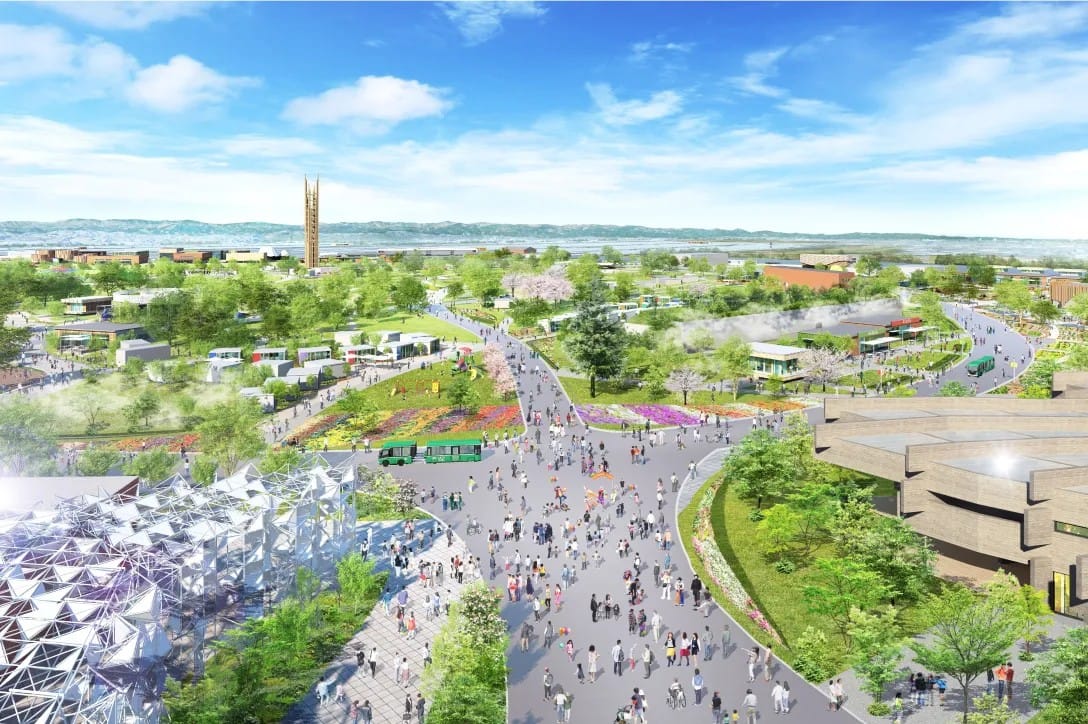
19 Mar – 26 Sep 2027|Yokohama, former Kamiseya Communication Facility
On the morning of 19 March 2027, a stretch of land on Yokohama’s western edge that spent seventy years behind a military fence opens to the public for the first time — and it opens with roughly 600 cherry trees, across about 40 varieties, in bloom. That timing is not an accident. The organisers set opening day squarely inside the Kanto cherry blossom window, which effectively poses a question to anyone travelling to Japan in spring 2027: does one of your hanami days belong here?
The event’s formal name is the International Horticultural Exhibition 2027, Yokohama; the brand you’ll see everywhere is GREEN×EXPO 2027. It carries AIPH’s top A1 classification, the highest tier of international horticultural exposition — and Japan hasn’t hosted one at this level since the 1990 Osaka Flower Expo, thirty-seven years earlier.
192 days
last entry 21:00
one-day
shuttle from 4 stations
One thing shapes your whole plan, so it goes near the top: this is an expo built around reservations. Entry needs a date and time booking, the shuttle bus needs booking, and so does parking if you drive. All of those opened on 18 September 2026, first-come first-served — and the opening weekend was largely gone within hours. Below: what to see, when to go, which ticket to buy, how to book without tripping over the system, and which of the four stations to use.
What’s actually on show
The site sits on the border of Yokohama’s Asahi and Seya wards, on the former Kamiseya Communication Facility — a 242-hectare former US military installation, of which the expo occupies about 100 hectares. Decades of restricted access left it largely undeveloped, so it still holds farmland, grassland, river headwaters and the valley terrain locals call yato. For an expo about plants, that’s a genuine stage rather than turf rolled out for the occasion.
Japan Pocket Wifi Rental
Japan eSIM : Fast & Easy & UNLIMTED
Japan Travel eSIM
The theme translates as “Scenery of the Future for Happiness,” with the English brand line “Bloom of Future.” If you went to the 2025 Osaka-Kansai Expo, reset your expectations: that was fast, queue-heavy and technology-forward. This one is slow — gardens, flower fields, horticultural craft, food and farming. The closest honest comparison is spending a day inside an enormous, unusually ambitious botanical garden.
The exhibit zones here are called Villages, and there are five: Urban GX, Craft, Farm & Food, Kids and SATOYAMA. Twelve companies plus a range of organisations build them out as whole streetscapes rather than one building each. The organisers’ own flagship is the Horticultural Pavilion, named “IROHA-GARDEN” in September 2026, with design supervised by architect Kengo Kuma. Inside are traditional Japanese ornamental plants and bonsai handed down since the Edo period — thirty-seven varieties rotated through the seasons — alongside a recreation of the working life of Edo-era nurserymen. For an overseas visitor, that’s the part of the site you can’t see anywhere else.
There’s also a quieter thread worth watching: material reuse. Timber from the Grand Ring at the Osaka-Kansai Expo has been brought to Yokohama for reuse, and structural material from the Japan Pavilion at Dubai 2020 and Osaka’s Women’s Pavilion is being worked into indoor exhibition buildings. Some of what you’ll walk through is the skeleton of a previous world’s fair.

When you go changes what you see
The opening fortnight is the single most distinctive window
Around 40 cherry varieties and roughly 600 trees are planned to bloom across the site during the opening period, and 19 March lands right as the blossom front reaches Kanto. April then brings tulips and spring bedding at their peak. If you’re already coming to Japan for cherry blossoms in spring 2027, this is one of very few places where large-scale hanami and world-class garden design sit in the same field. Bloom timing shifts with temperature, rain and wind, so don’t stake the trip on a single date.
The run covers spring, summer and early autumn, and planting is rotated deliberately through the traditional seasonal calendar. Which month you pick is the main variable in what you’ll actually see.
| Period | What’s blooming | What it’s like |
|---|---|---|
| Late Mar – Apr | Cherry blossom, tulips, spring bedding; international gardens revealed | The visual peak of the whole run, and also the busiest. Accommodation across Kanto tightens sharply. Book early or pick another month. |
| May – Jun | Fresh green, early-summer flowers, gardens at full maturity | Comfortable temperatures and thinner crowds than opening. The best month if your priority is actually enjoying the walk. Expect rain from mid-June. |
| Jul – Aug | Bold summer planting, family workshops, evening hours | Kanto summers are brutally hot and the site is largely grass and unpaved paths with limited shade. Pair with a night ticket or a late-afternoon entry. |
| Sep | Autumn flowers, harvest themes, closing programme | Heat eases but doesn’t vanish. September weekends and holidays are classed as peak, and parking costs more. |
How crowded will it be?
The organisers sort the 192-day run into four bands as the basis for their transport planning: 50,000 to 56,000 visitors on weekdays, 79,000 on ordinary weekends and holidays, and 105,000 on peak days. There are nineteen peak days, clustered around Golden Week and September weekends and holidays. These are planning assumptions rather than forecasts, but they’re enough to judge relative pressure.
The gap between a weekday and a peak day is more than double. If your dates are flexible, a weekday is a materially different experience. If a weekend is unavoidable, avoiding Golden Week and the September holidays is the practical move. Because entry runs on timed slots, arrivals are already spread out to a degree, so the real bottlenecks are more likely to be the single entrance gate and the shuttle buses than the grounds themselves.
GREEN×EXPO 2027 tickets: prices and how to buy
An adult advance one-day ticket is ¥4,900, on sale until 18 March 2027. There are more ticket types than you need — in practice an overseas visitor is choosing between three.
Prices below are in yen, tax included. Age is counted as of 1 April 2027, or as of 1 April 2026 for visits during March; children aged three and under enter free and need no ticket. One rule catches people out: you may enter on a ticket priced above your own age band, so a child can use a youth or adult ticket, but never the other way round.
| Ticket | Adult 18+ | Youth 12–17 | Child 4–11 | On sale / notes |
|---|---|---|---|---|
| One-day, advance | ¥4,900 | ¥3,000 | ¥1,400 | Until 18 Mar 2027. One entry on any day of the run. |
| One-day, regular | ¥5,500 | ¥3,300 | ¥1,500 | From 19 Mar 2027. |
| Night ticket | ¥3,500 | ¥1,900 | ¥900 | From 19 Mar 2027. Entry after 17:00, stay until 21:30 close. |
| Summer pass | ¥12,000 | ¥7,000 | ¥3,000 | On sale now. Unlimited 1 Jul – 31 Aug, up to 3 dates booked at once. |
| Season pass | ¥28,000 | ¥16,000 | ¥6,500 | On sale now. Unlimited across the run, up to 4 dates booked at once. |
Which one to buy
Going once, buy the advance one-day ticket. It saves an adult ¥600 against the price after opening, and it stays on sale right up to 18 March 2027.
The night ticket deserves more attention than it gets. At ¥3,500 you get four and a half hours, which suits anyone already spending the day in central Yokohama and wanting only the illuminated gardens in the evening. In midsummer it is arguably the only comfortable way to visit. Note that it does not go on sale until opening day, so you cannot buy one in advance.
The passes only pay off with heavy use, and the organisers say so themselves: the season pass is marked as worthwhile from six visits, the summer pass from three. Short-trip visitors will struggle to reach either unless they live in Kanto. Both passes also carry an extra step — you must register a photograph of your face on the ticket site, your face is checked against it at the gate, it cannot be edited afterwards, and the pass works only for that person. One-day tickets have no such requirement.
Two discount tickets exist that most international visitors cannot use. The special discount ticket (¥2,800 adult) requires a Japanese disability certificate or equivalent, so certificates issued abroad do not qualify. School group tickets, however, do accept overseas schools — ¥1,700 for high-school students and ¥900 for younger pupils — which is worth knowing if you are organising a study trip. General group tickets need 15 people or more, at ¥5,200 per adult.
Buying from outside Japan
You can. The official ticket site works from overseas, has a full English interface and sells electronic tickets. Authorised resellers are the other route: KKday lists the expo in English with instant e-ticket confirmation, and the organisers maintain a list of contracted sellers. Prices at resellers may differ from face value, so compare against the ¥4,900 advance price before you commit. Whichever route you use, the ticket ID has to be registered on the official site, and once it is bound to your account it cannot be moved to someone else’s.
Payment on the official site is by credit card or by convenience store payment inside Japan, which leaves card payment as the only practical option from abroad. VISA, Mastercard, JCB, AMEX and Diners are accepted, single instalment only. The most common reason a payment fails is that the card is not enrolled in 3-D Secure — the step where your bank asks for a password or sends a code. Check with your issuer before you sit down to buy.
A few other limits worth knowing. Under-16s cannot buy on the official site and need an adult to purchase for them. One order tops out at 14 tickets, and one account can hold 100 unused ones. Once you enter the payment flow you have fifteen minutes to finish, or you start again. If you are entering together, one phone and one account can display everyone’s QR codes, so you do not each need to register. If your group is arriving separately, the site has a transfer function that sends an unused ticket by link — but the recipient needs their own account, and the link expires after 24 hours. The commemorative ticket (¥1,980 plus ¥990 shipping) is delivered inside Japan only, and switching to it applies to every ticket in your cart at once.
Before you buy, two things. The organisers do not refund tickets as a rule, including unused ones, except where they cancel the event themselves. And you cannot exchange one ticket type for another — a one-day ticket cannot become a night ticket or a pass. With more than a year until opening, plans change; weigh both of these before locking in the advance price.
Dates, at least, are flexible. Your entry date and time can be changed up to three times, and switching to a different time band on the same day does not count against that. Even after the three changes are used, if you cannot make it you can still book same-day entry from midnight on the day itself, provided slots remain.
Buying and booking: the efficient way
Most people assume a ticket gets you through the gate. Not here. Entry needs a date and time reservation, shuttle buses need booking, and so does parking if you drive. All three opened on 18 September 2026, first-come first-served across the whole run.
One choice removes an entire step. The official ticket site’s front page offers two buttons: buy with a date and time specified, or buy without. Take the first and the purchase and the reservation happen together — the calendar appears first, you pick your date and slot, and only then choose ticket type and quantity. Only the season and summer passes have to use the second route, because they book several days at once.

So for a one-day ticket, there are really only three steps.
Pick your date and slot, and buy at the same time
Go in through “purchase with visit date and time specified”. The calendar marks the status of every day. There are seven slots: 9:30, 10:30, 11:30, 12:30, 13:30, 14:30, and a 17:00 band for evenings. What you book is the earliest time you may enter — arrive any time after it on that day. Night tickets can only take 17:00. No account is needed until payment, so you can walk the whole flow first to see how it works.
Book the shuttle bus
No railway reaches the site. The only public transport is a shuttle from one of four stations, and it runs on a separate system with a separate account, reservation-only — turning up at the stop on the day won’t work. Outbound and return are two separate tickets and must be booked individually.
Book parking, if you’re driving
The north and west car parks on site, and the park-and-ride lots further out, all require advance booking; without one you can’t enter. If you’re renting a car, treat this as compulsory rather than a fallback.
When would you buy without a date? When you want to lock in the advance price before your itinerary is settled. Tickets bought that way need the ticket ID registered on the site and the reservation added later, and the cart warns you about it on the way out. Paper tickets from travel agents work the same way. Convenience stores are the exception: from 18 September 2026, 7-Eleven, FamilyMart and Lawson sell paper tickets with the date and time already attached, which go straight through the gate with no online step at all. Initially that covers the advance one-day ticket and the special discount ticket for visits between 19 March and 30 June 2027, widening to the full run from 9 December.

Reading the calendar
Each day carries one of three marks: a blue circle for availability, a yellow triangle for expected crowding, a red cross for full. There’s a catch worth knowing — the mark on the date is a summary for the whole day, and only opening it shows what each slot actually looks like.

A concrete example: on the afternoon of 18 September 2026, the day bookings opened, opening day itself still showed a blue circle. Open it and the 9:30 and 10:30 slots were already marked full, 11:30 and 12:30 carried crowding warnings, and only the afternoon and evening slots were clear. That was within hours of the system going live.

Nor was it only opening day. At the same moment, the earliest slots on 20 and 21 March had gone too, 22 March carried a crowding warning on its first slot, and only from 23 March was the first slot of the day clear again.
Why does the pattern stop on the 22nd? Two things stack up across those four days. Friday 19 March is opening day, in demand for its own sake, and 20–22 March is a three-day weekend in Japan: the vernal equinox holiday falls on Sunday the 21st, making Monday the 22nd a substitute holiday. Opening day and the long weekend run together into one block, and past it the pressure eases.
That’s useful if your dates are flexible. Shifting two or three days later puts you past both, which means morning slots are available and the grounds are quieter. If you have to travel during that window, book the slot now — the early bands always go first.
The shuttle booking has a timing rule worth flagging. A booking made more than 180 days before travel counts as provisional only, and payment by card must be completed in the window between 180 and 31 days before the travel date, or the booking is cancelled automatically. With the expo opening in March 2027, every shuttle booking made now sits in that provisional state — don’t book and forget. On the other hand the shuttle is refundable: cancel before 17:00 the day before travel and you get everything back with no fee; after that, up to five minutes before departure, a 50% fee applies. Entry tickets, by contrast, are not refunded at all.
Getting to the site
This is the part worth three minutes of your attention. The venue sits inland, roughly ten kilometres west of Yokohama Station, with no train line running into it. Everyone takes a train to one of four nearby stations, then transfers to a shuttle bus. Those four stations belong to three different railway companies, so the site is approachable from the Sotetsu, Tokyu and JR networks alike — you simply pick whichever suits the line you’re already on.
Where the venue is
The site straddles the boundary of Asahi and Seya wards in Yokohama, addressed as Kamiseya-cho, Asahi-ku. It is about ten kilometres due west of Yokohama Station, further inland than most people expect, surrounded by housing and farmland and on no existing tourist route.
A single entrance gate is currently planned, on the south side of the site, where the shuttle drop-off and the walking route both converge. Whichever station you come from, everyone funnels through the same entrance, which is why the first hour after opening concentrates people so heavily. The detailed site map and the positions of individual exhibits are still being released, so check the official venue map again before you travel.
| Transfer station | Line | Shuttle time | Best if you’re coming from |
|---|---|---|---|
| Seya (瀬谷) | Sotetsu Main Line | approx. 10 min (approx. 2 km) | Yokohama. Roughly 20–29 minutes from Yokohama Station depending on the service — the shortest route, and the only one of the four with an official walking route to the venue. |
| Mitsukyo (三ツ境) | Sotetsu Main Line | approx. 15 min (approx. 4 km) | Yokohama. About 20 minutes from Yokohama Station. A useful alternative when Seya is congested. |
| Tokaichiba (十日市場) | JR Yokohama Line | approx. 25 min (approx. 6 km) | Anyone arriving by shinkansen. About 12 minutes from Shin-Yokohama, the smoothest option on JR tickets, though the shuttle ride is the longest of the four. |
| Minami-machida Grandberry Park | Tokyu Den-en-toshi Line | approx. 20 min (approx. 4 km) | Central Tokyo. About 35 min from Shibuya by express — the obvious choice if you’re staying around Shibuya or Futako-tamagawa. |
The shuttle costs ¥200 for adults and ¥100 for children each way, running roughly 8:30–22:30 (from an hour before opening to an hour after close). Children here means ages 1 to 11; under-1s ride free, and preschool children aged 1 to 6 travel free at up to two per paying passenger, with no reservation needed for those free places. Minami-machida and Mitsukyo are both about four kilometres out, yet the ride differs by five minutes because of routing and traffic lights, so closer doesn’t always mean faster. Buses from Minami-machida and Tokaichiba use the north terminal at the venue; Seya and Mitsukyo use the south. The number that actually matters is how long it takes to reach your chosen station from where you’re staying.
From Tokyo, Narita and Haneda
Staying in central Tokyo, the cleanest run is the Tokyu Den-en-toshi Line straight to Minami-machida Grandberry Park. Staying in Yokohama or anywhere on the Sotetsu line, Seya is barely a decision. From Haneda, go to Yokohama Station and change to Sotetsu; from Narita, take the Narita Express or a limousine bus to Yokohama Station (YCAT) and change there. Arriving from Kansai or Nagoya on the day, get off at Shin-Yokohama and take the JR Yokohama Line to Tokaichiba — our shinkansen guide and guide to reserving shinkansen seats cover the booking side.
All three railways accept IC cards, and the shuttles use standard route-bus vehicles. If you don’t have a card yet, see our guide to Welcome Suica. One thing to plan for: shops and restaurants inside the venue are entirely cashless and will not take cash. The only exception is one coin-accepting vending machine at each of fourteen spots around the site. Make sure a card or digital payment works before you go — our note on how much cash to bring to Japan covers the rest of the trip. Those same fourteen spots also have water fountains, so an empty bottle is worth carrying.
Walking, cycling and driving
An official walking route exists only from Seya Station, about two kilometres, and the city plans shade and misting along it. The other three stations expect you to take the shuttle. In summer, or with children or older travellers, don’t be a hero even from Seya. There’s parking for around 1,700 bicycles beside the venue plus expanded share-cycle ports, which suits anyone staying locally. If you drive, on-site parking runs about ¥5,000 on weekdays and ¥7,000 on weekends and peak dates, with park-and-ride lots at about ¥3,000 during peak periods only. Add the mandatory reservation, and driving rarely wins unless you’re splitting it several ways.

The organisers advise saving a screenshot of your entry QR code or printing it, because reception can struggle once crowds build on site. Everything else still needs a connection though — shuttle bookings, the site map, same-day announcements, and the same-day exhibit reservations below. CDJapan Rental’s eSIM runs on the docomo network and activates by QR scan when you land, with no card swap, which holds up better than most options at a large venue on the edge of the suburbs.
On the day
Gates are open 9:30 to 21:30, with last entry at 21:00 — twelve hours, though you don’t need all of them. The site runs to about a hundred hectares and walking every zone is genuine work, so it’s more useful to decide in advance whether you’re here for the exhibits or the gardens, and concentrate in that direction. Indoor highlights like the Horticultural Pavilion sit well around the middle of the day, when both the heat and the crowd peak outside. And because only a single entrance gate is planned, the first hour after opening concentrates everyone in one place — if you aren’t in a hurry, arriving later is easier.
One more thing to handle on the morning itself. Some exhibits use a “viewing reservation” — no advance lottery and no advance booking, only same-day reservation through the official ticket site, once per ticket per day. Slots open in three waves: at 8:00 for 10:00–12:00, at 11:30 for 12:00–17:00, and at 16:30 for anything after 17:00. Which exhibits this applies to is still being decided by individual exhibitors, so check the official announcements before you go.
Japanese guides are blunt about footwear, and they’re right: wear shoes you can walk in. There’s a great deal of grass and unpaved path here. Suitcases are not merely awkward but banned — hard cases, wheeled cases and carts are all prohibited, as is any bag too large for the X-ray machine. The shuttle buses have their own rule: luggage goes in the hold rather than the cabin, and the operator asks you to leave larger bags in a locker before you arrive. Coming straight from the airport with your luggage is not an option. Alcohol is prohibited whether opened or not, and so are bottles and cans; PET bottles and your own water bottle are fine. Strollers, wheelchairs and walking aids are allowed. Pets are not, with the exception of guide, service and hearing dogs. Treat a summer visit as an outdoor event — hat, water, sunscreen, cooling gear if you have it — because shade is scarcer than at a typical city attraction. There is a security check on you and your bags at the gate.
There are information desks, an accessibility centre and childcare facilities on site, and the organisers have published accessibility guidelines covering wheelchair users, families with strollers and older visitors. Restaurants open at 9:30 and close between 20:30 and 21:00. Whether re-entry is allowed, and how operations run in bad weather, had not been announced at the time of writing.
Is it worth a dedicated day?
Honestly: if plants, gardens and architecture aren’t your thing and you have five days in Japan, a full day out here probably isn’t the best use of one of them. It’s a distance from central Tokyo, it needs a transfer, and it needs bookings.
Three kinds of traveller should go anyway. If you’re already coming for cherry blossoms in spring 2027, the opening period pairs 600 flowering trees with international garden design in a way nothing else in Kanto does. If you care about horticulture, bonsai or garden design, the Kengo Kuma-supervised Horticultural Pavilion and the Edo horticultural material are the real substance of this expo, not decoration. And if you’re travelling with children, this is a place they can run around in all day — far kinder than a queue-based world’s fair.
For itinerary building, treat this and central Yokohama as two separate days rather than forcing them together. For a base, judge by transfer convenience: Yokohama Station, Shin-Yokohama, or somewhere on the Tokyu Den-en-toshi Line all work, since the area around the venue is residential and has no hotel cluster. The run spans Golden Week and the summer holidays, and Kanto accommodation tightens hard in both — once your dates are fixed, book.

Frequently asked questions
Can I buy GREEN×EXPO 2027 tickets from overseas?
Yes. The official ticket website can be used from outside Japan and has an English interface; you need to create an account before payment. Payment is by credit card (VISA, Mastercard, JCB, AMEX, Diners) in a single instalment, or by convenience store payment inside Japan. Authorised resellers including KKday also sell tickets. If you buy without specifying a date, reserving your entry date and time is a separate step.
How much are GREEN×EXPO 2027 tickets?
The advance one-day ticket is ¥4,900 for adults, ¥3,000 for youth aged 12–17 and ¥1,400 for children aged 4–11, on sale until 18 March 2027. The regular one-day ticket from 19 March 2027 is ¥5,500 for adults. The night ticket is ¥3,500 for adults. The summer pass is ¥12,000 and the season pass ¥28,000 for adults. Children aged three and under enter free.
Can tickets be refunded or exchanged?
No. The organisers do not refund tickets as a rule, including unused ones, except where they cancel the event themselves or otherwise agree to a refund. Ticket types cannot be exchanged either. Your entry date and time slot can be changed up to three times, and changing the time within the same day does not count towards that limit.
Can I still get a slot during cherry blossom season?
Book early, and look past opening day and the Japanese long weekend. On 18 September 2026, the day reservations opened, the 9:30 and 10:30 slots for opening day on 19 March were already full, as were the earliest slots on 20 and 21 March; only from 23 March was the first slot of the day clear again. Friday 19 March is opening day, and 20–22 March is a three-day weekend, with the vernal equinox holiday on the 21st and a substitute holiday on the 22nd. Shifting your visit two or three days later makes slots considerably easier to get. Note too that the mark on a calendar date is a summary for the whole day — open the date to see each slot.
Is there a train station at the venue?
No. Visitors travel by rail to Seya, Mitsukyo, Tokaichiba or Minami-machida Grandberry Park, then transfer to a reservation-only shuttle bus taking roughly 10 to 25 minutes, at ¥200 per adult each way. Only Seya has an official walking route, about two kilometres.
How long does it take from Tokyo?
From Shibuya, roughly 35 minutes by Tokyu Den-en-toshi express to Minami-machida Grandberry Park, then about 20 minutes on the shuttle. From Yokohama Station it’s about 20–29 minutes to Seya on the Sotetsu Main Line plus a 10-minute shuttle. Allow around 90 minutes each way once transfers and queues are counted.
Can I use cash at the venue?
Shops and restaurants inside the venue are entirely cashless and do not accept cash. The only exception is one coin-accepting vending machine at each of fourteen spots around the site, which also have water fountains. Bring a card or a digital payment method.
Which month is best?
It depends what you want. Late March to April brings around 40 cherry varieties and 600 trees plus spring flowers — the strongest visuals and the biggest crowds. May and June are the most comfortable and the gardens are fully grown in. July and August are extremely hot, so use a night ticket or a late entry. September brings autumn flowers and the closing programme.
Short trip or long stay — we've got you covered
Best for Travelers
Japan eSIM
From ¥2,800 — activate before you land
- Cheaper than airport & convenience store SIMs
- 5-day to 135-day plans; unlimited or data-capped
- No SIM swap needed — ready in 2 minutes
Best for Long Stays
Monthly Pocket WiFi
From ¥5,500/mo — unlimited, no throttle
- Choose WiMAX 5G or SoftBank 4G coverage
- 3 to 12-month contracts — longer means cheaper
- Delivered to your hotel or airport post office


