
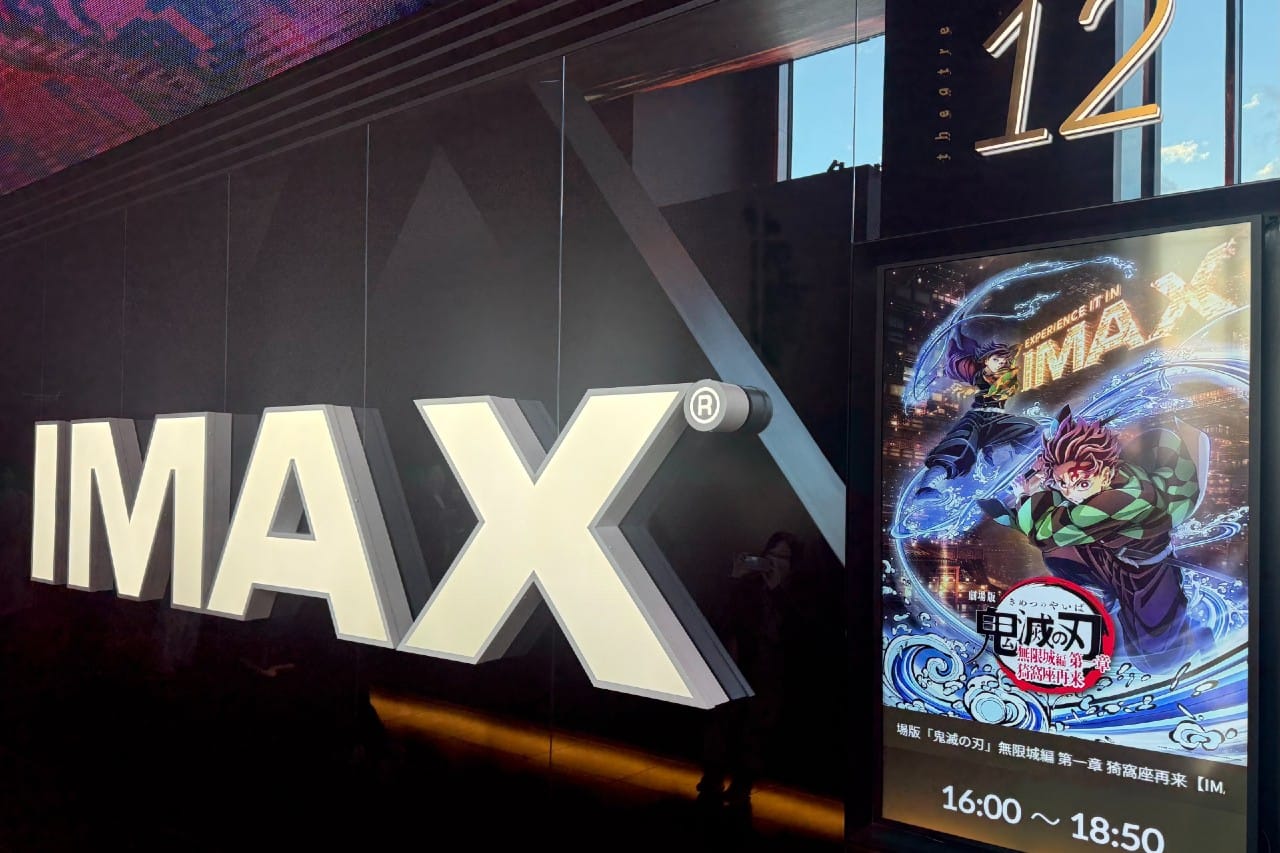
Demon Slayer: Kimetsu no Yaiba — Infinity Castle spent an extraordinary nine months in Japanese cinemas before closing in April 2026. If you’ve been trying to work out where you can actually watch it, whether there are English subtitles, or how cinema tickets work in Japan for the sequel, this guide covers all three.
Chapter 1 is now streaming
Since 28 July 2026, Chapter 1 has been available on Crunchyroll worldwide, with the original Japanese audio and English subtitles as well as the English dub. Netflix carries it across Asia from the same date, though its rollout excludes Japan, Mainland China and India.
It can also be bought or rented digitally through Apple TV, Prime Video, Google Play, YouTube and Fandango, and the Japanese Blu-ray and DVD went on sale on 29 July 2026.
Its cinema run in Japan ended on 9 April 2026, so there are no showtimes to look up for Chapter 1. Chapter 2 does not have a release date yet.
Where to watch Chapter 1
The film was locked to cinemas for close to a year, which is why so much conflicting information circulated about streaming. Here is the actual situation.
| Platform | Where | Language options |
|---|---|---|
| Crunchyroll | Worldwide, from 28 July 2026 | Japanese audio with English subtitles, plus the English dub. Additional subtitle and dub languages vary by region. |
| Netflix | Across Asia from 28 July 2026, excluding Japan, Mainland China and India | Varies by territory |
| Digital purchase or rental | Apple TV, Prime Video, Google Play, YouTube, Fandango | Varies by store and region |
| Blu-ray / DVD | Japan, released 29 July 2026 | Japanese release; check the edition for subtitle tracks |
Japan Pocket Wifi Rental
Japan eSIM : Fast & Easy & UNLIMTED
Japan Travel eSIM
Licensing windows shift. If a platform shows the film as unavailable in your country, check your local app rather than assuming it has been pulled.
If you’re reading this from inside Japan, note that the Netflix rollout skips the Japanese market and home viewing here runs through the disc release and Japanese video-on-demand services instead. Streaming rights inside Japan are handled separately from the international deal, so check the services available to you locally.
Are there English subtitles?
This depends entirely on where you’re watching, and the answer that applies to streaming is the opposite of the one that applies to Japanese cinemas.
Streaming: yes
The Crunchyroll release includes Japanese audio with English subtitles and the English dub that played in cinemas in the United States. Several other subtitle and dub languages are available, though the exact lineup depends on your region.
Japanese cinemas: no
Japanese cinemas show anime in Japanese with no foreign-language subtitles, and Demon Slayer was no exception. This surprises a lot of visitors, so it’s worth being blunt about it: buying a ticket at TOHO Cinemas in Shinjuku for a Japanese animated film means watching it in Japanese, without subtitles of any kind.
You may come across mentions of “subtitled screenings” for Chapter 1. Those were barrier-free screenings with Japanese captions, provided for deaf and hard-of-hearing audiences, and ran at a limited number of cinemas for a few days only. They were not English subtitles.
Foreign films screened in Japan are a different matter — Hollywood releases usually run in two versions, one subtitled in Japanese (字幕, jimaku) and one dubbed into Japanese (吹替, fukikae). Neither of those helps with a Japanese-language film. If following the dialogue matters to you, watching a Japanese anime release in a Japanese cinema is not the way to do it.

How to find showtimes in Japan
Chapter 1 has finished its run, so there is nothing to look up for it right now. The method below is what you’ll need when Chapter 2 opens, and it works for anything else showing while you’re here.
Japan has no single national showtimes site that covers every cinema reliably in English. In practice you go to the chain directly. The major ones are TOHO Cinemas, 109 Cinemas, MOVIX and AEON Cinema, and between them they cover most of the country. In central Tokyo, TOHO Cinemas Shinjuku and Shibuya carry almost every major release; in Osaka, TOHO Cinemas Umeda and Namba play the same role.
Each chain’s site lists films by cinema and by date, with a seat map for every screening. The pages are Japanese-only, but the layout is visual enough that browser translation gets you through. Search for the cinema name plus the film rather than trying to browse a nationwide listing — it’s considerably faster.
One thing to watch for: the same film often runs in several formats at one cinema, and the listings sit next to each other with only a small label to tell them apart. IMAX, Dolby Cinema, 4DX and standard screenings all carry different prices, so check which one you’re booking before you pay.
Buying cinema tickets in Japan
Every cinema in Japan uses assigned seating, and the process is straightforward once you know the conventions. A few of them catch out first-time visitors.
Booking online
Most chains open online booking three days before a screening, and for a title on the scale of Demon Slayer the good seats can go within minutes. Book through the chain’s own site or app.
Payment is where things tend to fail. Online booking generally accepts credit cards or Japanese carrier billing only, with TOHO Cinemas also taking PayPay and Apple Pay. Overseas-issued cards usually work, but 3-D Secure verification sometimes doesn’t. Test your card on an ordinary screening in advance rather than finding out the moment tickets go live.
Also worth knowing: TOHO Cinemas normally gives members early booking access, but for exceptionally high-demand titles the studio can waive that so everyone buys at the same time. That’s exactly what happened with Chapter 1. Don’t assume membership guarantees a head start — check the announcement for the specific film.
Buying at the machine
If your card won’t go through online, the self-service machines near the cinema entrance are a reliable fallback. Choose the film, the screening, your seat, then pay. Payment options are noticeably more flexible than online: cash, credit cards, and transit IC cards including Suica, PASMO and ICOCA all work. With an IC card it’s a single tap.
The catch is that you have to be there in person, and by then the best seats are usually taken. Book online first and treat the machine as insurance.
Popular screenings sell out in seconds, and cinema sites slow to a crawl the moment bookings open. Hotel Wi-Fi drops, and so does your connection on a train or in an underground shopping street. CDJapan Rental’s eSIM runs on the docomo network, which holds up in dense urban areas and underground, and takes about two minutes to set up before you fly — no SIM swap needed.
Premium screens and midnight premieres
IMAX, Dolby Cinema and 4DX all carry a meaningful surcharge, but for a film built on animation quality and sound design most people find it worth paying. Those screens are also the hardest to book.
Chapter 1 additionally had midnight premieres, limited to 24 cinemas across 11 prefectures, with seats released at midnight four days before opening and gone shortly after. If Chapter 2 follows the same format, two things matter: securing an advance ticket, and knowing exactly when your chosen cinema opens seat selection. The second is what decides whether you get into a midnight screening.
Chapter 2: what’s confirmed
As of this update, the official Demon Slayer site, Aniplex and ufotable have not announced a release date for Chapter 2. The release year isn’t confirmed either, and neither is the subtitle or the story range it covers.
Videos and posts claiming the date has been confirmed have no official basis. If you see a specific date quoted, check the official site before planning around it.
This section is updated as soon as the studio announces anything.
Summer 2027 is the most common industry expectation. The reasoning rests on the rebroadcast: Fuji TV began airing the entire anime series in a Sunday-morning slot in April 2026, on a schedule that runs for fifteen months and lands around mid-2027. A rerun of that length reads as a run-up — build momentum, slot in a television premiere of Chapter 1, hand the audience to Chapter 2. That remains inference, not fact.
How Chapter 1 was announced, step by step
The franchise promotes on a consistent schedule, which makes the gaps worth knowing if you’re timing a trip.
After the final episode of the Hashira Training Arc, the Infinity Castle arc is announced as a trilogy of films.
“2025 release” confirmed, with a teaser and key visual. Roughly seven months before opening.
The 18 July date announced at an official fan event, with a 443-screen rollout and simultaneous IMAX release. About four and a half months out.
Advance tickets on sale, less than a week after the date announcement.
Full trailer, subtitle “Akaza Returns” revealed, rollout expanded to 452 screens. Three weeks before release.
Midnight premieres at 24 cinemas across 11 prefectures, then the nationwide opening. Running time 155 minutes, rated PG12.
Cinema run ends after roughly nine months.
Streaming debut on Crunchyroll and Netflix; Japanese Blu-ray and DVD released.
For context on the scale: Chapter 1 passed ¥40 billion at the Japanese box office, only the second film in Japanese cinema history to do so after Mugen Train, and drew 98.52 million admissions worldwide.
Common questions
Can I still see Chapter 1 in a cinema in Japan?
No. The run ended on 9 April 2026. Occasional revival screenings sometimes appear at independent cinemas, but there is no general release to book.
Is it on Netflix?
Across most of Asia, yes, from 28 July 2026 — but the rollout excludes Japan, Mainland China and India. Crunchyroll’s release is worldwide, so it’s the route to check first if Netflix in your country doesn’t have it.
Can I manage a Japanese cinema without speaking Japanese?
For the booking process, yes. Browser translation handles the sites, ticket machines are icon-driven, and entry is a QR code scan. There’s very little you need to say out loud. Following a Japanese-language film without subtitles is the harder part.
Can I turn up and buy a ticket on the day?
You can, but it’s a gamble for anything popular. Weekend showings, evenings and premium screens sell out routinely. Check seat availability on the cinema’s site before setting off.
How do the cinema bonuses work?
Chapter 1 ran through eleven waves of attendance bonuses, each with a different design and each limited in quantity — one later wave was capped at a million copies nationwide. They’re handed out on entry, so there’s no separate queue, but popular waves can run out within days. Distribution dates and quantities are announced in advance.
Is merchandise sold at the cinema?
Larger multiplexes usually set up a stand with film-exclusive items. If you miss out, Animate and JUMP SHOP stores generally carry a wider range.
Planning a trip around Chapter 2
There will be roughly four and a half months between the date announcement and opening day. Almost everything that decides whether you get a good seat happens in the first fortnight of that window, so these are worth doing early.
Signing up means Japanese forms and email verification — not something to attempt on the day tickets go live. Even without member priority, an existing account removes several steps at checkout.
Book an ordinary screening and see whether it clears. If 3-D Secure sends a code by SMS, confirm your phone will receive it while roaming.
Fixating on one venue is how people end up with nothing. Pick three different chains near where you’re staying and open them in separate tabs when sales start.
Rewatching Chapter 1 on Crunchyroll before you fly is the practical fix. Knowing the story going in matters more than knowing the language.
The screening you can actually book may not be the one you’d have chosen. If opening week matters to you, keep half a day movable.
For confirmed information, the official Infinity Castle film site is the source to trust. This article is updated as announcements are made.

Short trip or long stay — we've got you covered
Best for Travelers
Japan eSIM
From ¥2,800 — activate before you land
- Cheaper than airport & convenience store SIMs
- 5-day to 135-day plans; unlimited or data-capped
- No SIM swap needed — ready in 2 minutes
Best for Long Stays
Monthly Pocket WiFi
From ¥5,500/mo — unlimited, no throttle
- Choose WiMAX 5G or SoftBank 4G coverage
- 3 to 12-month contracts — longer means cheaper
- Delivered to your hotel or airport post office


