
A Reader’s Guide to Tokyo
Take one wrong turn in Shimokitazawa and you may end up somewhere else entirely. People have been saying so since 1935.

There is a story people tell about this neighbourhood. On certain nights a haze settles over the streets, the crowds thin out, and someone walking home turns down a lane they have walked a hundred times before and surfaces in a Shimokitazawa from fifty years ago — old shopfronts, old signage, the wrong decade entirely. The story has been on television twice in the past year. Follow it back far enough, though, and it stops being a rumour and becomes something more interesting: a piece of fiction, published in 1935, by a man who lived four minutes from here.
The poet Hagiwara Sakutaro moved to Shimokitazawa in 1931 and two years later built a house of his own design in Daita, just west of the station, where he stayed until his death in 1942. His only work of fiction, Nekomachi — The Town of Cats — follows a walker who takes an unfamiliar side street and emerges into a beautiful town he has never seen, though it stands exactly where his own neighbourhood should be. The streets he was describing are thought to be the ones around Ichibangai, the shopping lane where you now buy secondhand denim. The ground where his house stood is now a complex of independent bookshops.
Which makes Shimokitazawa the useful counterweight to Jimbocho. Jimbocho preserves what bookselling used to be: a hundred and thirty antiquarian shops, largely unchanged, arranged along the same few blocks for a century. Shimokitazawa is where people are still arguing about what a bookshop is for. In the space of a fifteen-minute walk you can buy a beer while you browse, visit a shop that sells nothing but diaries, pay by the hour for silence, and dig through a secondhand stack that has not been reorganised in years.
| If you want | Go to | From the station |
|---|---|---|
| New books, and a beer while you browse | Honya B&B | 7 min — Bonus Track |
| Diaries. Only diaries | Nikkiya Tsukihi | 8 min — Bonus Track |
| Quiet, paid for by the hour | fuzkue | 8 min — Bonus Track |
| Dense, cheap, secondhand | Honkichi / Kosho Bibibi | 2–4 min — east side |
| Art, photography and design, secondhand | Claris Books | 5 min — north, 2F |
Japan Pocket Wifi Rental
Japan eSIM : Fast & Easy & UNLIMTED
Japan Travel eSIM
Bonus Track: A Street That Didn’t Exist in 2019
Three answers to the question of what a bookshop is for
When the Odakyu Line was buried underground, it left behind 1.7 kilometres of empty land running from Higashi-Kitazawa through Shimokitazawa to Setagaya-Daita: the old track bed, suddenly available in one of the most tightly packed corners of Tokyo. Bonus Track, which opened in April 2020, occupies the stretch closest to Setagaya-Daita: fifteen or so small businesses in low wooden buildings around a gravel courtyard, with tables anyone can sit at.
The name works twice over. It is a bonus stretch of track, and it is the hidden extra song at the end of an album. The developers have said they wanted a place where people could do the thing they actually wanted to do, rather than the thing that would obviously pay. Three of the tenants sell books, or something adjacent to books. No two of them agree on what that means.
Honya B&B
本屋B&B — a bookshop that serves beer, and has done since 2012
New booksCafe insideRead-in
The obvious reading is that a new street produced a new bookshop. The opposite is true. B&B opened in Shimokitazawa in July 2012, eight years before Bonus Track existed, and moved in when the street was built. This was an established shop choosing a new address, not a tenant recruited to fill one. Push through the sliding door on the second floor and the first thing you get is the smell of wood. Past the shelf that faces the entrance, the room opens into wall-length runs of shelving and a series of tall wooden islands you can walk all the way around.
The selection is the argument. On the afternoon we spent there, the shelves held books on relationships between men and women, on social movements, novels, short story collections, cats, fairy tales, mathematics and geometry, folklore, kabuki. Beer and soft drinks are served at the counter; magazines sit by the lift on your left as you come in; there is a members’ reading room next door. It is all in Japanese, with no English titles at all, but the shelves are worth walking even if you cannot read a spine, which is not something you can say of most bookshops.

The posted hours are not the real hours. B&B runs author talks most evenings, and on event days it closes early to set up — the sandwich board we found in August 2026 read 13:00–18:00, because a talk was starting at 19:00. It also runs an English conversation class in the early morning. Check the day’s hours on the shop’s site before you make the walk.

Nikkiya Tsukihi
日記屋 月日 — the diary shop
Concept storeCafe insideSNS favorite
Tsukihi sells diaries, and nothing that is not a diary. That splits two ways: published diaries, other people’s days bound into books, and blank ones you could start writing in this evening. The shop opened on 1 April 2020, in the first week of Bonus Track’s life, and it is tiny: one small room, three or four steps across, with the coffee counter on your right as you come in and a staircase immediately on your left. The books sit in the space beneath the stairs, under a single strip light spelling out Diary. Two customers is a crowd.
It has no English stock either, and that matters less than you would expect. A blank diary needs no translation, the shop publishes a quarterly of its own and runs an annual diary festival, and at 9:00 it is one of the only doors in the neighbourhood that is open, since most of Shimokitazawa does not stir until noon. Come early, take a coffee into the courtyard, and you get the street to yourself for a couple of hours.

fuzkue
本の読める店 fuzkue — quiet, sold by the hour
Read-inConcept store
Not a bookshop, but it belongs in this chapter. fuzkue charges you to read: you pay for the seat and the silence, order coffee or something stronger, and nobody will hurry you. It runs on the same instinct as Bunkitsu in Roppongi, which we cover in our Tokyo bookstores guide: in a city this dense, the scarce thing worth selling is undisturbed time rather than the books.
So this street holds a shop that sells books and beer, a shop that sells only diaries, and a shop that sells nothing but the conditions for reading. Three separate answers to the same question, filed within ninety seconds’ walk of each other.
The Old Guard: Books and Theatres on One Street
East of the station, where the neighbourhood was already itself
Walk east from the station instead and the pattern changes. Here the secondhand bookshops and the small theatres are threaded through each other along the same few hundred metres: Honkichi, then Shogekijo B1 in the basement of the ward hall, then Kosho Bibibi, then The Suzunari with its row of bars underneath. This is the older Shimokitazawa, the one that grew rather than the one that was planned, and the mixture is the point. Bonus Track is a recent addition to a neighbourhood that had already worked out what it was.
Honkichi
ほん吉 — steel shelving, yellowed paper, a hundred metres from the theatre
Used booksCheap secondhandEnglish books
Of every shop in this guide, Honkichi is the one that looks its age, and it is the better for it. Old steel shelving, some of it rusting at the joints. Paper gone amber at the edges. Books on both sides of an aisle that was not designed with shoulders in mind, and more books stacked wherever a stack will stand. If you have a picture in your head of what a Japanese secondhand bookshop is supposed to look like, this is the shop that matches it, and not the tidy version.
What tells you most about the place is not the stock but the pavement outside it. We passed Honkichi four times in one afternoon, and each time somebody different was standing at the outdoor shelves, reading. Nobody was being sold anything. They were just there.
There is English here, if you want it: a run of paperbacks along the left wall, top shelf, at the very back. What you find is whatever happened to come through the door that month. The hours are handwritten on a sheet taped to the glass and differ by day, which is worth reading carefully rather than assuming.


Kosho Bibibi
古書ビビビ — two shopfronts, one shop, and a publishing arm
Used booksArt booksFor collectors
Bibibi takes up two frontages: the entrance on the left under its own name, and a full glass wall on the right signed Books & More, behind which the shelves run floor to ceiling. Low shelving inside, a great deal of it, weighted towards art, film and old magazines. The shop also publishes under its own imprint, which is rare enough among secondhand dealers to be worth noting, since most are content to move other people’s books.
Its own window makes the neighbourhood claim directly: the centre of Shimokitazawa, painted across the glass. Given that the theatre next door has been running since the early eighties, it is not an unreasonable thing to say.

A road he had never taken, in a town he had walked for years.
Claris Books
クラリスブックス — second floor, easy to walk past
Used booksArt booksPhotographyEnglish books
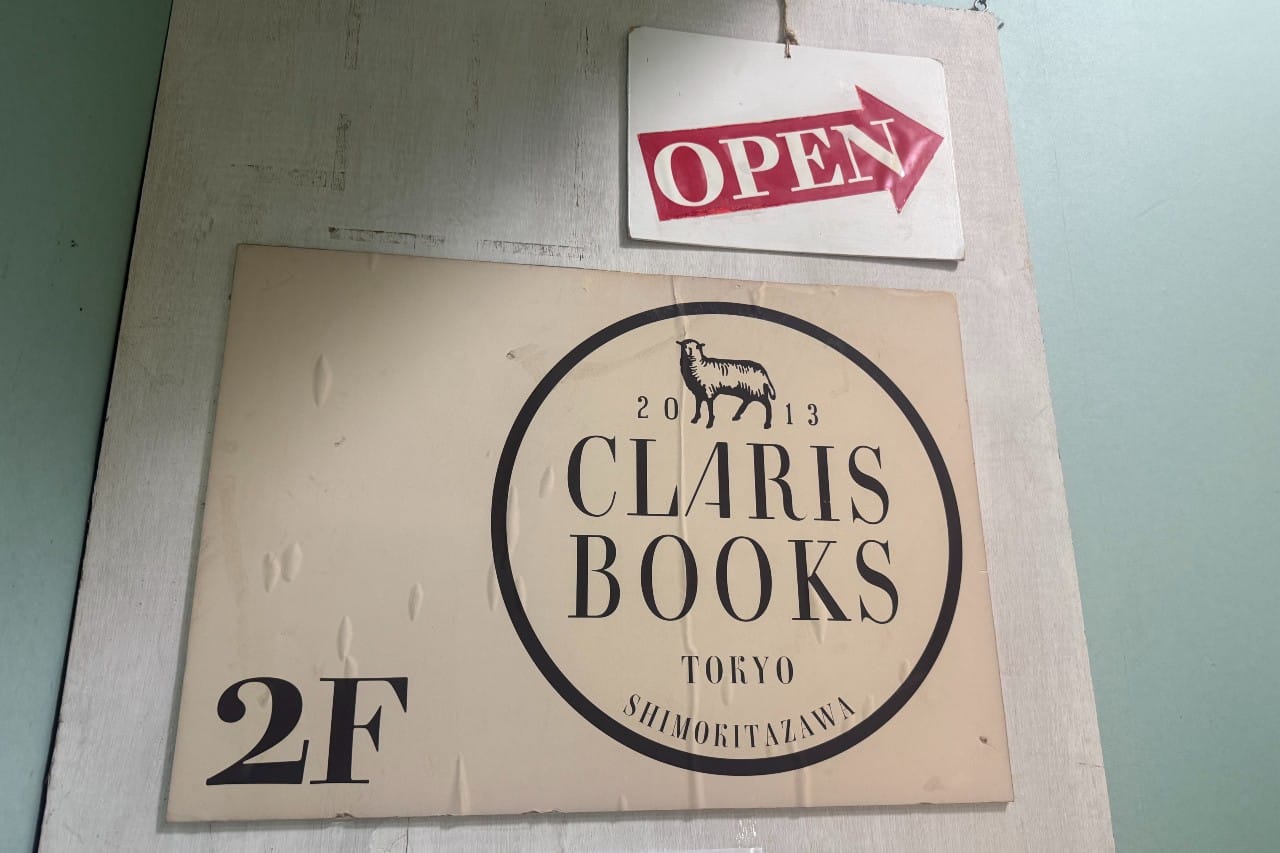
Finding the door is the first task. The ground floor of the building is Gallery HANA Shimokitazawa, a glass-fronted space that runs both its own shows and rentals for anyone who wants to hang something — when we climbed the stairs in August 2026 it was hanging a T-shirt exhibition, and you can walk in and look. Claris Books is directly above it, and the way up is not through the gallery. Follow the display windows to the far end and there is a small door tucked at the side of the building, easy enough to walk past twice. The sign is a circular mark with a sheep in it and the date 2013, mounted on the wall beside a red arrow reading OPEN.
Upstairs the aisles are tight, the shelves are full, and a good number of the books are sleeved in clear protective covers, and you can still read every spine, and the stock is plainly looked after. The strength is philosophy and thought, literature, art, design, photography, fashion, science fiction and subculture. English titles are on a shelf immediately inside the door, the most reliable English stock of any shop in this guide, which is a low bar, but it is the one to try first.
The care is not an accident. The owner spent more than a decade apprenticed to a secondhand dealer in Jimbocho before opening here in December 2013, and the staff came up the same way. Which makes this the one shop in Shimokitazawa that is directly descended from the district in our main bookstores guide — not a reaction to Jimbocho, but a graduate of it, running a Jimbocho-trained eye over a neighbourhood that had no such tradition.
Two sets of hours are posted at the shop and they disagree, so we photographed both. The permanent sign in the window says it closes at 19:00 on Sundays and holidays and is shut on Mondays but open on public holidays; the printed monthly notice beside the door says 18:00 on Sundays and closed on both Mondays and public holidays, with a four-day break in mid-August. Treat the monthly notice as the live one, and check the shop’s site before travelling across town.


Cat Town: The Story Underneath
Where the neighbourhood’s ghost story actually comes from
Nekomachi was published in 1935 and is the only piece of fiction Hagiwara Sakutaro ever wrote — he is remembered as the poet who put modern Japanese verse into ordinary spoken language. The story is short. A man goes walking, takes a turn he has not taken before, and arrives in a town of extraordinary beauty that he does not recognise, though it occupies the exact ground where his own neighbourhood ought to be. The streets he had in mind are generally read as the ones around Ichibangai — the same lane where you now queue for secondhand denim.
He was not the only writer here. Setagaya City keeps an official list of literary residences in and around Shimokitazawa: Sakutaro near the north exit shopping street, Sakaguchi Ango by Daizawa Elementary, Ishikawa Jun, Mori Mari along the Kitazawa River green walk, Yokomitsu Riichi over by Ikenoue. For a few decades in the middle of the last century this was a writers’ quarter, and the fact that it later became a secondhand-clothing district is a coincidence of cheap rent, not a break in character.
The house Sakutaro designed is gone. What survives is a transmission pylon: Komazawa Line No. 61, standing in a residential block in Daita, the last physical trace of where he lived, and now designated a local landscape asset by the ward. The plaque explaining the connection, put up in 2013, is not at the foot of it. It sits below, beside the Kitazawa River green walk, and we had to go down a short but genuinely steep slope to reach it. Look up from the plaque and you can just see the top of the pylon over the hedge. Neither is much to look at. That is more or less the point. The town where the story happens has never been visible.


Our main Tokyo bookstores guide covers two shops built around cats: Anegawa Nyankodo in Jimbocho, and Cat’s Meow Books over in Sangenjaya, staffed by rescues. Shimokitazawa’s cat town is a different order of thing. There is no shop, no cat, and nothing to photograph. It is a name a neighbourhood picked up from a book and never quite put down.
Which Shimokitazawa Bookstores Have English Books?
A short answer, an honest one, and where to go instead
Two of the shops in this guide keep English stock, and neither of them keeps much. If you have come to Shimokitazawa expecting a foreign-language section, adjust the expectation now: this is a district of Japanese independents, and English arrives here the way anything arrives in a secondhand shop, which is to say by accident.
Claris Books is the one to try first. There is a shelf of English titles immediately inside the door at the top of the stairs, and it is the most reliable English stock of any shop covered here. It reflects what the shop is good at rather than what a tourist might want: art, photography, design, fashion, some philosophy. If you collect photobooks, this is worth the climb regardless of language, since a photobook does not need translating.
Honkichi has a run of English paperbacks along the left-hand wall, top shelf, at the very back of the shop. It is genuinely a run rather than a section, and what is in it on any given day is whatever came through the door that month. We found fiction, a few reference titles and some things that had clearly been left behind by a departing resident. Cheap, and worth five minutes if you are already in the building.
Honya B&B and Nikkiya Tsukihi carry nothing in English at all. That matters less at Tsukihi than you would think, because a blank diary needs no translation and roughly half the shop is blank diaries. At B&B it means the shelves are for looking at rather than reading, which is a smaller loss than it sounds: the shop is worth walking for the way it is arranged, and there is beer.
So if you need a specific title, or a proper foreign-language section, Shimokitazawa is the wrong district and no amount of walking will fix that. Go to Jimbocho for antiquarian and academic English, or to one of the large chains for new releases. Both are covered in our Tokyo bookstores guide. Come here for the shops themselves, and treat any English you find as a bonus.
Shimokitazawa Bookstore Opening Hours and Closed Days
What was posted on the doors in August 2026, and why it will not stay that way
Hours are the hardest thing to get right about this neighbourhood, and they are the thing most English guides get wrong, because they copy a website that the shop itself stopped updating. The table below is what we read on the doors and the signboards in August 2026. Check the shop’s own account before you make the walk, and read whatever is taped to the glass when you arrive.
| Shop | Opens | Closes | Closed |
|---|---|---|---|
| Honya B&B | 12:00 weekdays, 11:00 weekends | 21:00, earlier on event days | No fixed day |
| Nikkiya Tsukihi | 9:00 | 19:00 | No fixed day |
| fuzkue | 12:00 | 22:00 | Check the shop’s site |
| Honkichi | 12:00 | 19:00 to 20:00, varies by day | Monday |
| Kosho Bibibi | 12:00 | 21:00 | Tuesday |
| Claris Books | 12:00 | 20:00 weekdays, shorter on Sunday | Monday, plus posted breaks |
Wednesday to Saturday is the safe window. Monday closes Honkichi and Claris Books between them; Tuesday closes Kosho Bibibi. Sunday works but several shops shorten their hours, and the two that do not close at all are the two on the railway street.
Almost nothing opens before noon. Nikkiya Tsukihi at 9:00 is the exception, and Bonus Track’s courtyard is open from 8:00 if all you want is somewhere to sit. An early start in Shimokitazawa means coffee, diaries and a very quiet street, which is a real pleasure but not a bookshop crawl.
Then accept that the posted hours move. B&B closes early on event days, and it runs events most evenings. Claris Books had two contradictory notices up on its own building when we visited, one permanent and one printed for the month; we would trust the monthly one. Honkichi’s closing time changes through the week and is handwritten on a sheet taped inside the glass. None of these shops is being careless. They are small enough that the day’s plan is the day’s plan, and the sheet in the door is more current than anything you can look up.
What to Know Before You Go
Money, manners, and the order to walk it in
Carry some cash, though cards are more widely accepted than they used to be — all the shops in this guide took both when we visited. If you want to top up an IC card for the trip out, our guide to the Welcome Suica covers the version for short-term visitors.
Ask before photographing inside. Shashin, daijobu desu ka? is enough. Most shops will say yes; a few will not, and the secondhand dealers have reasons of their own. Shopfronts and signage are fine.
Walk it from the far end. Get off the Odakyu one stop early at Setagaya-Daita, start at Bonus Track, and follow Senrogai northeast to Shimokitazawa Station, then head east for Honkichi and Bibibi and north for Claris. Doing it in that order means you finish at the station rather than doubling back, and it puts the pylon in Daita at the beginning, which is a five-minute detour from the platform. If you have twenty minutes and no more, there is a Tsutaya Bookstore inside Mikan Shimokita, built into the railway arches at the station itself.

Books are one thread through this neighbourhood, not the whole of it. The same fifteen-minute walk takes in eight small theatres run by a single company, the densest run of secondhand clothing shops in Tokyo, and a railway line that was buried underground to make room for all of it. Our full guide to Shimokitazawa covers how the neighbourhood fits together.
Half the shops in this guide change their hours by the day, and the announcement goes to Instagram rather than to Google. That is a problem you can only solve standing on the street with a working connection. CDJapan Rental’s eSIM runs on the docomo network, so it holds up in the narrow blocks east of the station — buy it online before you fly, scan the QR code, and skip the SIM swap entirely.
Frequently Asked Questions
Are there English books in Shimokitazawa’s bookstores?
Some, but not in the way you might hope. The new independents, B&B and Nikkiya Tsukihi, stock Japanese titles only. The secondhand shops are where English turns up: Claris Books keeps a shelf of it just inside the door, and Honkichi has a run of English paperbacks along the left wall, top shelf, at the back of the shop. What you find is whatever came through the door that month. If you want a specific title, or a reliable foreign-language section, go to Jimbocho or a large chain instead; our Tokyo bookstores guide covers both.
How do I get to Shimokitazawa from Shinjuku or Shibuya?
From Shinjuku, take the Odakyu Odawara Line — about 8 minutes on a rapid express. From Shibuya, take the Keio Inokashira Line, about 5 minutes on an express. Both stop at Shimokitazawa Station. For the walk described here, get off one stop earlier on the Odakyu at Setagaya-Daita and follow Shimokita Senrogai northeast; it puts Bonus Track at the start of your route rather than the end.
Which day of the week is best for bookstore-hopping in Shimokitazawa?
Wednesday to Saturday. Monday closes Honkichi and Claris Books; Tuesday closes Kosho Bibibi. Sundays work, but several shops shorten their hours. Almost nothing opens before noon, with one exception. Nikkiya Tsukihi opens at 9:00, so an early start means coffee and diaries and not much else.
What is Bonus Track in Shimokitazawa?
A low-rise complex of about fifteen small businesses that opened in April 2020, built on the strip of land freed up when the Odakyu Line was moved underground. The name is a double pun: a bonus stretch of track, and the hidden extra song at the end of an album. Three of its tenants sell or serve books: the bookshop B&B, the diary specialist Nikkiya Tsukihi, and fuzkue, where you pay for quiet reading time.
What is the Shimokitazawa cat town story?
Locals tell a story about people taking a wrong turn in Shimokitazawa and surfacing in a version of the neighbourhood from decades earlier. The story traces back to a piece of fiction. The poet Hagiwara Sakutaro moved here in 1931 and built a house in nearby Daita in 1933, where he lived until his death in 1942. His only work of fiction, The Town of Cats (1935), describes a walker turning down an unfamiliar side street and finding himself in a beautiful town he has never seen — thought to be modelled on the streets around Ichibangai. Setagaya City maintains an official list of the neighbourhood’s literary residences.
This article is a deeper look at one section of our complete Tokyo bookstores guide — Jimbocho, concept stores, English-book chains, and more.
Short trip or long stay — we've got you covered
Best for Travelers
Japan eSIM
From ¥2,800 — activate before you land
- Cheaper than airport & convenience store SIMs
- 5-day to 135-day plans; unlimited or data-capped
- No SIM swap needed — ready in 2 minutes
Best for Long Stays
Monthly Pocket WiFi
From ¥5,500/mo — unlimited, no throttle
- Choose WiMAX 5G or SoftBank 4G coverage
- 3 to 12-month contracts — longer means cheaper
- Delivered to your hotel or airport post office


