
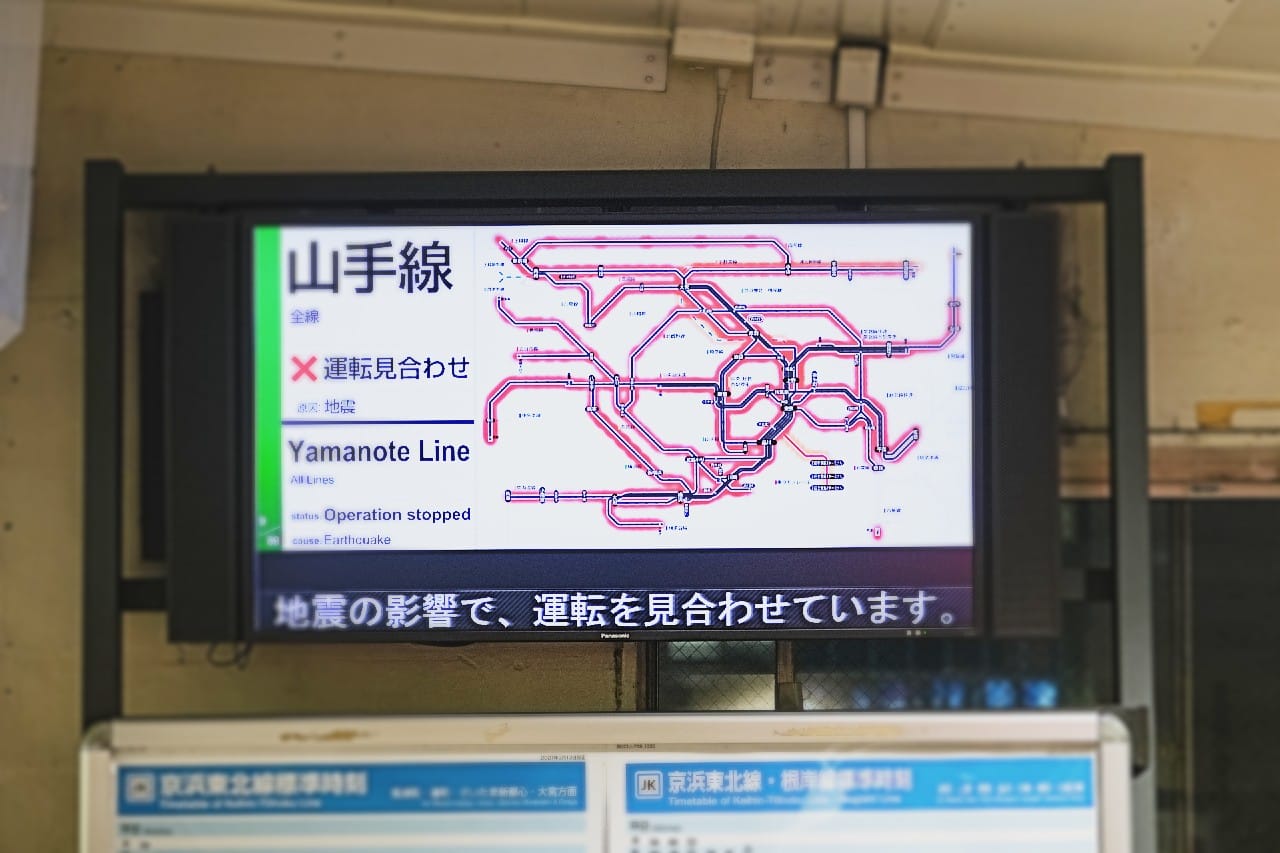
“Is the Suica Penguin Retiring, or is JR East Just Losing Its Mind?” In January 2026, Tokyo’s JR lines suffered major disruptions for three consecutive Fridays. Netizens joked that it was the Suica Penguin’s 20-year “grudge” manifesting as a curse. But jokes aside, for commuters and tourists, this was no laughing matter—with hundreds of thousands affected and hours of gridlock, are you truly prepared for the next one?
The Friday Curse: A Timeline of Three Major Disruptions
Jan 16 (Friday) 03:50 – 13:00: Power Outage at Tamachi Station

This was the most severe of the three incidents. At 3:50 AM, during power restoration after scheduled maintenance near Tamachi Station, an unknown failure caused a massive, prolonged blackout that lasted until noon. The Yamanote and Keihin-Tohoku lines were paralyzed for 8 hours, only fully recovering by 1:00 PM. The Tokaido and Yokosuka lines were also caught in the crossfire. A total of 673,000 passengers were affected, marking one of the worst transit records in recent years.
The chaos that morning was unforgettable. Shinagawa and Tokyo Stations were so packed that movement was nearly impossible, leading to restricted entry at several stations. Fifteen people fell ill due to the overcrowding, and five were hospitalized. One commuter vented on social media: “I’ve been stuck at Shinagawa for nearly two hours and can’t even fight my way to the restroom.”
Jan 23 (Friday) 16:20 – 18:00: A Double Whammy
Japan Pocket Wifi Rental
Japan eSIM : Fast & Easy & UNLIMTED
Japan Travel eSIM

This day brought a rare “double accident.” Around 4:20 PM, a person fell onto the tracks at Ikebukuro Station, suspending several JR lines for about an hour. But the real disaster was yet to come.
Almost simultaneously, a terrifying “scissors incident” occurred on the Saikyo Line. A 17-year-old boy pulled a pair of scissors from his bag near Kita-Jujo and threatened a female passenger in her teens. Passengers alerted the conductor, who made an emergency stop between Jujo and Akabane Stations. The boy was eventually restrained by passengers. Because Akabane is a critical junction for the Keihin-Tohoku, Saikyo, Shonan-Shinjuku, Takasaki, and Utsunomiya lines, the entire network collapsed for nearly two hours. While no one was stabbed, three elderly passengers (ages 60–80) were hospitalized after falling during the emergency stop. The youth was arrested for violating the Law Concerning Punishment of Physical Violence.
During the standoff, some passengers used the emergency door releases to evacuate onto the tracks. The incident caused total stoppages or massive delays across the JR network, affecting approximately 95,000 people.
Jan 30 (Friday) 06:55 – 14:00: Snapped Overhead Wires at Ueno Station
The Friday curse struck a third time. At 6:55 AM, an overhead contact wire snapped inside Ueno Station, causing a massive power failure. The Joban Line was crippled for 7 hours, only recovering by 2:00 PM, while the Tohoku and Takasaki lines faced disruptions until after 8:00 AM. The commutes of 230,000 people were thrown into disarray.
The most heartbreaking scenes involved passengers trapped on stalled trains. Due to the lack of power, multiple trains were stuck between stations, forcing passengers to evacuate and walk along the tracks. One user posted on X (Twitter): “I walked for 20 minutes to get to the next station. My legs are sore, and I almost stepped in a puddle of sludge.” JR East later apologized for the poor evacuation handling.
Is it the “Curse” of the Suica Penguin?
The Story of the Suica Penguin

Born in 2001, the Suica Penguin is the mascot for JR East’s IC card. For over 20 years, this chubby penguin has been the face of Tokyo commuting and travel, becoming an icon of the city. For many, seeing its stoic face is synonymous with life in Tokyo.
However, JR East has decided that this beloved mascot will “graduate” (retire) at the end of 2026. A successor has yet to be announced.
For more on the retirement, read: Suica Penguin to Retire in 2026: Farewell to Japan’s Beloved Suica Card Mascot.
Netizen Comments: The Penguin’s Revenge?
Social media erupted with theories about the “Suica Penguin Curse.”
One user joked: “Three Fridays, three accidents. Suica Penguin: ‘Missing me already, and I haven’t even left yet?'”
Another suggested: “Remote work on Fridays should be a mandatory company policy at this point.”
Some went further: “If it happens again next week, I’m officially a believer in the supernatural.”
While these are jokes, they reflect the frustration and anxiety of Tokyo’s commuters. When rational explanations fail to soothe the public, humor and urban legends become the best emotional outlet. Now, let’s get down to business—what should you do when JR breaks down?
What to Do When JR Trains Fail?
💡 Strategy 1: Essential App Guide
Yahoo! Norikae Annai (Highly Recommended)

This is the favorite transit app for locals and my top recommendation. it provides real-time delay info, automatically avoids accident zones, and offers multiple alternative routes.
Using the “Avoid Suspended Lines” feature is simple. After entering your destination, tap “Search Conditions” (検索条件). Under “Lines to Use,” uncheck the broken JR lines or select “Avoid Suspended Routes” (運行見合わせ路線を回避). The system will automatically suggest alternatives.
Pro-tip: Set up the “Notification” feature for your regular routes to get instant alerts. You can also compare 3-4 routes simultaneously to find the fastest or cheapest option.
Google Maps (Tourist-Friendly)

Google Maps is great for its English interface and integration with walking navigation. Switch to “Transit” mode, and it will usually reroute you around paralyzed lines.
However, be warned: Google Maps is often 5–10 minutes slower to update than Yahoo! and its labeling of specific train exits isn’t as precise. Use both apps to cross-reference for the best results.
JR East App (Most Accurate Official Info)

The official “JR East App” provides real-time “Alternative Transport” (Furikae Yuso) info and estimated recovery times. Register your frequent lines (like the Yamanote or Chuo) to receive push notifications in Japanese and English.
The downside? The interface is primarily Japanese, but for official confirmation, it’s an essential tool.
💡 Strategy 2: What is “Furikae Yuso” (Alternative Transport)?
When JR is paralyzed, passengers with a valid JR ticket can transfer to other railway companies’ lines for free. This is a brilliant feature of the Japanese system, but many tourists are unaware of it!
How to Use It?
First and most importantly: If you find JR is suspended, DO NOT exit the gate with your IC card! Once you tap out, you usually cannot claim Furikae Yuso. Stay inside the station and look for “Furikae Yuso” signs or ask staff: “Furikae Yuso wa doko desu ka?”
Show your physical paper ticket or commuter pass (Teikiken) to the staff at the transfer gate. They will either give you a special ticket or wave you through.
Free routes usually include the entire Tokyo Metro and Toei Subway networks, and major private lines like Tokyu, Keio, Odakyu, Keisei, Keikyu, Seibu, and Tobu. Sometimes you can even take the Shinkansen (Non-reserved seats) using the price of a local ticket during major crises.
Important Warnings
Not everyone can use Furikae Yuso.
You must have a ticket that shows a specific boarding section or amount. This includes Monthly Passes (Teikiken) or paper tickets. Standard Suica/PASMO cards (including Welcome Suica) are generally NOT eligible for free alternative transport. If you use an IC card, you must pay the fare for the alternative line yourself.
On Jan 16, smart commuters walked from Shinagawa to Sengakuji Station (Toei Asakusa Line) to bypass the mess. On Jan 30, Joban Line passengers switched to the Chiyoda Line or the Tsukuba Express (though Tsukuba Express often requires a fare adjustment as it isn’t always part of Furikae Yuso).
Useful Japanese Phrases
- “Furikae yuso wo tsukaitai desu” = I want to use alternative transport.
- Point to your destination on your phone and say “Koko made” = To here.
💡 Strategy 3: Alternative Route Cheat Sheet
When Yamanote East (Ueno – Shinagawa) is Down
| Original JR Segment | Recommended Alternative | Pros | Cons |
|---|---|---|---|
| Ueno → Tokyo | Tokyo Metro Ginza Line | Direct, frequent | Extremely crowded |
| Tokyo → Shinagawa | Ginza Line to Ginza → Hibiya Line to Higashi-Ginza → Toei Asakusa Line | Covered by Furikae Yuso | One transfer needed |
| Akihabara → Shimbashi | Tokyo Metro Hibiya Line | Direct | Slightly slower |
When Yamanote West (Shinjuku – Shibuya – Shinagawa) is Down
| Original JR Segment | Recommended Alternative | Pros | Cons |
|---|---|---|---|
| Shinjuku → Shibuya | Tokyo Metro Fukutoshin Line | Direct, cheap | Crowded at peak |
| Shibuya → Shinagawa | Ginza Line → Asakusa Line (transfer at Shimbashi) | Furikae Yuso applicable | Transfer needed |
When Central/Chuo Line (Shinjuku – Tokyo) is Down
| Original JR Segment | Recommended Alternative | Pros | Cons |
|---|---|---|---|
| Shinjuku → Tokyo | Tokyo Metro Marunouchi Line | Direct, frequent | Packed at peak |
| Kichijoji → Shinjuku | Keio Inokashira Line to Meidaimae → Keio Line to Shinjuku | Fast | One transfer |
When Narita Airport Access is Blocked
If you have a flight to catch, a JR failure is a nightmare!
| Original JR Route | Recommended Alternative | Time | Price |
|---|---|---|---|
| Narita Express (N’EX) | Keisei Skyliner (to Nippori/Ueno) | ~41 mins | ¥2,570 |
| Narita Express | Keisei Main Line Limited Express | ~70 mins | ¥1,270 |
| Narita Express | Airport Bus (to Tokyo/Shinjuku) | 60-90 mins | ¥1,300-3,200 |
💡 Strategy 4: High-Risk Junctions to Avoid
According to our analysis of the January incidents, these stations are the “Domino Hubs”:
1. Akabane Station (The Danger Zone)
Akabane connects five JR lines. If an accident happens here—like the Jan 23 “Scissors Incident”—the entire northern Tokyo network collapses. If you are traveling on a Friday, have an alternative ready: Use the Toei Mita Line or Namboku Line to bypass Akabane entirely.
2. Ueno Station
The gateway to Narita and the north. If Ueno fails, don’t just wait for JR. Familiarize yourself with the Chiyoda, Ginza, and Hibiya Metro lines. For airport runs, always leave 2 hours early on Fridays.
3. Shinagawa Station
The critical Shinkansen hub. The Jan 16 accident caused such overcrowding here that people were hospitalized. If Shinagawa is blocked, walk to Sengakuji Station for the Toei Asakusa/Keikyu lines.
💡 Strategy 5: Safety During Transit Emergencies
The “Scissors Incident” on Jan 23 reminds us that safety comes first.
Dealing with Suspicious Persons
If you see something dangerous, press the Emergency Button (非常ボタン – hijō botan) located next to the doors. Do not try to be a hero. Move to another carriage and call 110 (Police) or 119 (Fire/Medical). Even if you don’t speak Japanese, they have multilingual support. State your line and current location.
Evacuating Stalled Trains
If a train stops between stations, stay calm. Never open the doors or jump onto the tracks yourself—the third rail or adjacent tracks carry lethal high-voltage electricity. Wait for staff instructions. On Jan 30, over 7,000 people had to walk along the tracks. Wear comfortable shoes and keep a jacket handy in winter.
Crowd Safety
In a crush, keep your arms crossed in front of your chest to maintain breathing space. Follow the flow of the crowd—never go against it. If you feel dizzy, signal for help immediately; station staff will prioritize those in medical distress.
💡 Practical Strategy 6: Essential Tools and Resources
Accessing Real-time Information
JR East’s official service information website (https://traininfo.jreast.co.jp/train_info/kanto.aspx) provides both Japanese and English interfaces, displaying delay status, estimated recovery times, and alternative transport (Furikae Yuso) information. The Tokyo Metro service information site (https://www.tokyometro.jp/) is available in English, Japanese, and Chinese; while the subway rarely experiences major accidents, it is always safer to double-check. The Toei Subway service info site (https://www.kotsu.metro.tokyo.jp/) supports multiple languages and includes Toei Bus information, which is a lifesaver if even the subways are paralyzed.
Social media is also an excellent channel for real-time updates. By searching Twitter (X) for hashtags like “#JR運行情報,” “#山手線,” “#京浜東北線,” “#中央線,” “#電車遅延” (Train Delay), and “#振替輸送” (Alternative Transport), you can find live photos and updates posted by people on the ground. These are often faster than official announcements and may include alternative route suggestions from other passengers. However, keep in mind that social media info can be inaccurate, so always cross-reference with official websites.
NHK News broadcasts “Breaking News” during major transit accidents via TV, radio, and their website simultaneously. Their website (https://www3.nhk.or.jp/news/) has an English version available.
What to Do if You Don’t Speak Japanese?
The camera translation feature of the Google Translate app is a total game-changer. Simply open the app, select “Camera” mode, and point it at Japanese signs or screens for instant translation into English. This is particularly useful for reading “運転見合わせ” (Service Suspended) notices, alternative route maps, and scrolling subtitles during emergency broadcasts. Remember to download the “Japanese” offline translation pack in advance in case of poor connectivity, and take screenshots of important information (like detour maps) as a backup.
Survival Japanese Phrases (Save to your phone)
Basic Inquiries:
- 「〇〇駅はどこですか?」(Where is 〇〇 Station?)
- Pronunciation: 〇〇 eki wa do-ko de-su ka?
- 「振替輸送はどこですか?」(Where is the alternative transport?)
- Pronunciation: fu-ri-ka-e yu-so wa do-ko de-su ka?
- 「〇〇駅まで行きたいです」(I want to go to 〇〇 Station.)
- Pronunciation: 〇〇 eki ma-de i-ki-ta-i de-su
Emergency Situations:
- 「助けてください」(Please help me.)
- Pronunciation: ta-su-ke-te ku-da-sa-i
- 「救急車を呼んでください」(Please call an ambulance.)
- Pronunciation: kyu-kyu-sha wo yon-de ku-da-sa-i
- 「気分が悪いです」(I feel unwell.)
- Pronunciation: ki-bun ga wa-ru-i de-su
Inquiring about the Status:
- 「いつ復旧しますか?」(When will service be restored?)
- Pronunciation: i-tsu fu-kyu shi-ma-su ka?
- 「他の路線はありますか?」(Is there another route?)
- Pronunciation: ho-ka no ro-sen wa a-ri-ma-su ka?
Useful Flashcards (Screenshot these)
I want to use alternative transport to ___ Station.
振替輸送を利用して___駅まで行きたいです。

I feel unwell and need help.
気分が悪いので、助けてください。

When will service resume?
いつ運転再開しますか?

Is there another route to get to ___ Station?
___駅まで行ける他の路線はありますか?
Other Practical Tools
A power bank is a non-negotiable essential, as losing battery means losing access to all your navigation and traffic info. A capacity of 10,000mAh or more is recommended, as you could be stuck for several hours during a major incident. Carrying 3,000-5,000 yen in cash is also vital; some alternative routes may require separate tickets, or you may need to top up your IC card in an emergency. Finally, don’t forget snacks and water—having something to eat while trapped in a station or carriage will help maintain your energy and stay calm. Chocolate, crackers, or energy bars are great choices. Bringing a charging cable is also wise; some stations have charging spots, or you can use power bank rental services found in most convenience stores.
Why Fridays? The Real Reason
Is it really a curse? JR East points to a few logical factors. Thursday nights are often used for heavy maintenance. If a mistake is made—as seen on Jan 16—it blows up during the Friday morning rush. Furthermore, Friday has the highest passenger volume as everyone heads out for the weekend, meaning a small delay spirals out of control much faster.
Typical Reasons Trains Delay in Tokyo
The Ministry of Land, Infrastructure, Transport and Tourism has officially warned JR East to improve. But as an expert “Tokyo JR Incident Survivor,” your best bet is to stay informed.
Keep this guide saved, share it with friends, and remember: Deep breath, check Yahoo!, find a detour, and maybe—just maybe—blame the Suica Penguin.
Safe travels to everyone in Tokyo!
Short trip or long stay — we've got you covered
Best for Travelers
Japan eSIM
From ¥2,800 — activate before you land
- Cheaper than airport & convenience store SIMs
- 5-day to 135-day plans; unlimited or data-capped
- No SIM swap needed — ready in 2 minutes
Best for Long Stays
Monthly Pocket WiFi
From ¥5,500/mo — unlimited, no throttle
- Choose WiMAX 5G or SoftBank 4G coverage
- 3 to 12-month contracts — longer means cheaper
- Delivered to your hotel or airport post office


