
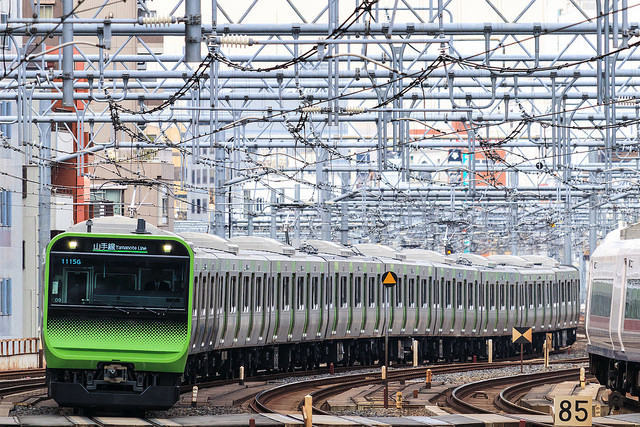
The board flips from green to orange. An announcement starts. The English line reads Customer fall.
Nobody on the platform looks up.
That reaction is the hard part to read, not the sign. Half the people standing around you already know roughly how long this will take, whether the other line is worth the walk, and whether it will cost them anything. You don’t, because the display told you a fact and none of the things you actually need.
Our office is in Nihonbashi and the people who write this blog ride these lines to work every day. Here is what that crowd knows.
About the photos here
Japan Pocket Wifi Rental
Japan eSIM : Fast & Easy & UNLIMTED
Japan Travel eSIM
They come from different days, different lines, ordinary commuting — a paper certificate from one month, an app screenshot from another. We have put each one next to the situation it illustrates rather than dressing them up as a single bad morning.
“Delayed” means three different things
JR East only calls a line delayed in its public service information once trains are running 30 minutes or more behind. Tokyo Metro used a 15-minute bar until March 2026, then dropped it to five minutes. Delay certificates are issued from around five minutes almost everywhere.
So your train can be eight minutes late — late enough for a certificate, late enough to lose your connection — while JR East’s service page shows nothing at all.
That gap is the whole reason visitors get caught out. The official page is not a live feed of how your morning is going. It is a threshold alarm, and the threshold is high.
What the English on the display actually means
Japan has added a lot of English signage in the past decade. The operating-status strings are the part that aged worst — they are literal translations of internal railway vocabulary, accurate and nearly useless at the same time.
| English display | Japanese | What it actually means |
|---|---|---|
| Passenger injury | 人身事故 | The one that matters. Someone has been hit by a train. Lines close, then reopen into a backlog. Budget an hour, often more. |
| Congestion | 混雑 | The train is too full to load in the time the timetable allows. Usually clears in 10 to 15 minutes. |
| People relief | 急病人救護 | Someone has fallen ill on board, often fainting in a packed carriage. The train holds at a station while staff help. |
| Car inspection | 車両点検 | Something on the train needs checking. Could be two minutes, could mean swapping the train out. |
| Door inspection | ドア点検 | A door won’t close, usually because the carriage is too full. |
| Confirmation of safety | 安全確認 | A deliberately vague catch-all. Staff are checking something before anything moves. |
| Confirmation | 異音の確認 | An unusual noise was reported and has to be traced along the track. |
| Person entry | 人立ち入り | Someone has walked onto the tracks. |
| Customer fall | お客様転落 | Someone has fallen from the platform. Most common late at night. |
| Signal trouble | 信号故障 | Signalling failure. Hits a whole section, not one train. |
| Rain / Wind | 大雨/強風 | Weather limits. Trains slow down or stop — common on elevated lines like the Keiyo. |
| Fallen tree | 倒木 | A tree is on the track. We have also seen “fallen bamboo”. |
| Deer collision | 鹿と衝突 | A deer — or, on the Chuo Line, often a boar — has been struck. Rare downtown, routine on rural stretches. See below for how long that can take. |
The timings above are our impression from riding these lines. Operators don’t publish a per-cause average, so treat them as a way to decide whether to wait — not as data.
Wait, or walk to another line?
The platform display gives you a cause and stops there. The operator apps give you the two things that actually decide it: how far behind the trains are, and where they physically are on the line right now.
The JR East app has a train-location view for exactly this. You can see whether trains are crawling or parked. Crawling means wait. Parked means go. Tokyo Metro’s app does the same for its network and lets you set your own alert threshold, down to one minute. If you’d rather not install anything, Yahoo! Transit covers every operator in one browser page.

Then there is the part the app doesn’t show you.

Switching lines is a good idea shared by four thousand people at once. Ten minutes of it goes into the gates and the stairs. Factor that in before you commit to the walk.
All of which assumes you are standing on a platform. On a long-distance train stopped between two stations — which happens more often than you’d think — there is no decision to make at all. We come back to that below.
A delay is when you need data most
Live train positions, a maps app, a message to whoever is waiting — all from an underground concourse with no Wi-Fi and a few thousand people on the same towers. CDJapan Rental’s eSIM runs on the docomo network, which tends to hold up in exactly those places, and it activates before you land.
The free detour you probably can’t use
When a line stops, operators arrange furikae yusō (振替輸送). Your ticket becomes valid on a competing route, often another company’s line, at no extra charge. It is a genuinely good system and it is the fastest way out of a stopped line.
It almost never applies to visitors.
In the Tokyo area, substitute transport covers paper tickets, commuter passes — including Suica and PASMO commuter passes, within the section they cover — and most day passes. It does not cover journeys paid from the stored balance on a Suica or PASMO. Which is how nearly every visitor travels.
The reason is mechanical. When you tap in with a stored-balance card, your journey doesn’t exist yet; the fare is only worked out when you tap out at the other end. There is no purchased route for a second company to honour. Stop early and you simply pay for what you rode.
What that means at the gate
On a stored-balance IC card: don’t join the substitute-transport queue. Tap out, walk to the other line, pay again. In central Tokyo that is a few hundred yen, and it buys the thing queuing doesn’t — movement.
On a paper ticket or a qualifying pass: use the staffed gate, never the automatic one. Tapping deducts the fare and ends your journey. Show the ticket and say furikae. That one word is enough.

If you’re still choosing what to travel on, our guide to the Welcome Suica covers what these cards do and don’t get you.
If you have a flight or a Shinkansen to catch
In June 2025 one of us was on an Azusa heading back to Shinjuku when it stopped a few minutes out of a station in Yamanashi, and stayed there.
A boar had been struck further up the line, and had survived it. Then a deer wandered onto the track. Police, JR staff and members of the local hunting association spent the next two hours getting the animals clear — the injured boar fought them, and the commotion drew more boar toward the line.
We sat between two stations for all of it, then ran through to Shinjuku more than two hours behind schedule.
On paper, that is a refund. On limited express trains and the Shinkansen, arriving two hours or more late means JR returns the limited express fee in full. Not the base fare — you did travel. Not the Green Car or GranClass supplement. And the line is enforced strictly: one hour fifty gets you nothing.
We got nothing anyway.
We were travelling on a JR Tokyo Wide Pass, and JR East’s conditions for it are blunt: once the pass is in use, there is no refund and no extension for cancellations, delays or any other reason. The same sentence appears in the terms for the Japan Rail Pass and most regional passes. The two-hour rule protects the limited express fee on an ordinary ticket. It does not protect the pass most visitors are actually holding — something we worked out long after the fact.

If you are on an ordinary ticket, keep it. A paper reserved-seat ticket comes back to you at the gate stamped instead of being swallowed, and that stamped ticket is what you hand over at a station window. You have one year from the day after the delay. Book through EX or a Shinkansen e-ticket on an IC card and the refund is usually handled automatically at the gate.
All of which is the consolation prize, and for pass holders not even that. The real answer is slack: an hour before a Shinkansen departure, and airport train times treated as a floor rather than a plan. Our guides to riding the Shinkansen, reserving seats and getting to Narita on the N’EX all assume you have it. In rush hour a fifteen-minute delay becomes forty with depressing reliability.
The paper slip everyone takes and almost nobody needs
A delay certificate (遅延証明書 / chien shōmei sho) is a free slip confirming that a line ran late on a given morning. JR East issues them from roughly five minutes late, and most operators use the same mark. Staff hand them out at the gates, and commuters take one without breaking stride.

Note that last part. The certificate proves the line was late. It does not prove you were on it.
Paper is disappearing, too. Tokyo Metro stopped handing out slips on 31 March 2026; since 1 April its website and app version is the certificate. Toei and JR East still print them, and both also post them online, which is more useful than paper ever was — JR East keeps about 45 days of Tokyo-area certificates up, Toei keeps each one for 35 days.
| Operator | Where to get it | How far back |
|---|---|---|
| JR East | Paper at gates, plus website | About 45 days |
| Toei Subway | Paper at gates, plus website | 35 days |
| Tokyo Metro | Website and app only, since April 2026 | 35 days |
Unless an insurer, a tour operator or an employer is asking for proof, though, the slip does nothing for you. It isn’t compensation and it isn’t a refund. Outside the two-hour rule above, a delayed commuter train in Japan comes with an apology over the loudspeaker and that’s the end of it.
Common questions
How common are delays in Tokyo?
Five to ten minutes is an ordinary morning on a busy line — that’s why the certificate system exists at all. Hour-long disruptions are much rarer and usually mean a passenger injury, severe weather or a signal failure.
Do I get a refund if my train is delayed?
Not on ordinary lines, however long you wait. Limited express and Shinkansen services arriving two hours or more late refund the limited express fee — but rail passes are excluded. The JR Tokyo Wide Pass, the Japan Rail Pass and most regional passes state that once the pass is in use, no delay refunds are made at all.
Can I use my Suica for substitute transport?
Not on the stored balance, which is how most visitors travel. Commuter passes, paper tickets and most day passes qualify. On a balance, tap out and pay the other line.
Can I get a delay certificate in English?
No — they’re issued in Japanese only. If you need one for an insurer or employer abroad, download the web version and attach your own translation of the line, date and delay length.
What does “Passenger injury” mean?
Someone has been struck by a train. It’s the status most likely to close a line for a long stretch. If it appears on your route, switch early.
Back on the platform
The board is still orange. The announcement is still running. The difference is that you now know it’s a fall, not a fatality, so the line will move again shortly; that your IC card won’t get you onto the Keio for free; and that none of this touches your flight, because you left three hours of room.
So you do what everyone around you is doing. You don’t look up.
If you want the other half of riding trains here — the unwritten rules that keep these platforms working at all — that’s Japanese train etiquette.
Short trip or long stay — we've got you covered
Best for Travelers
Japan eSIM
From ¥2,800 — activate before you land
- Cheaper than airport & convenience store SIMs
- 5-day to 135-day plans; unlimited or data-capped
- No SIM swap needed — ready in 2 minutes
Best for Long Stays
Monthly Pocket WiFi
From ¥5,500/mo — unlimited, no throttle
- Choose WiMAX 5G or SoftBank 4G coverage
- 3 to 12-month contracts — longer means cheaper
- Delivered to your hotel or airport post office


