
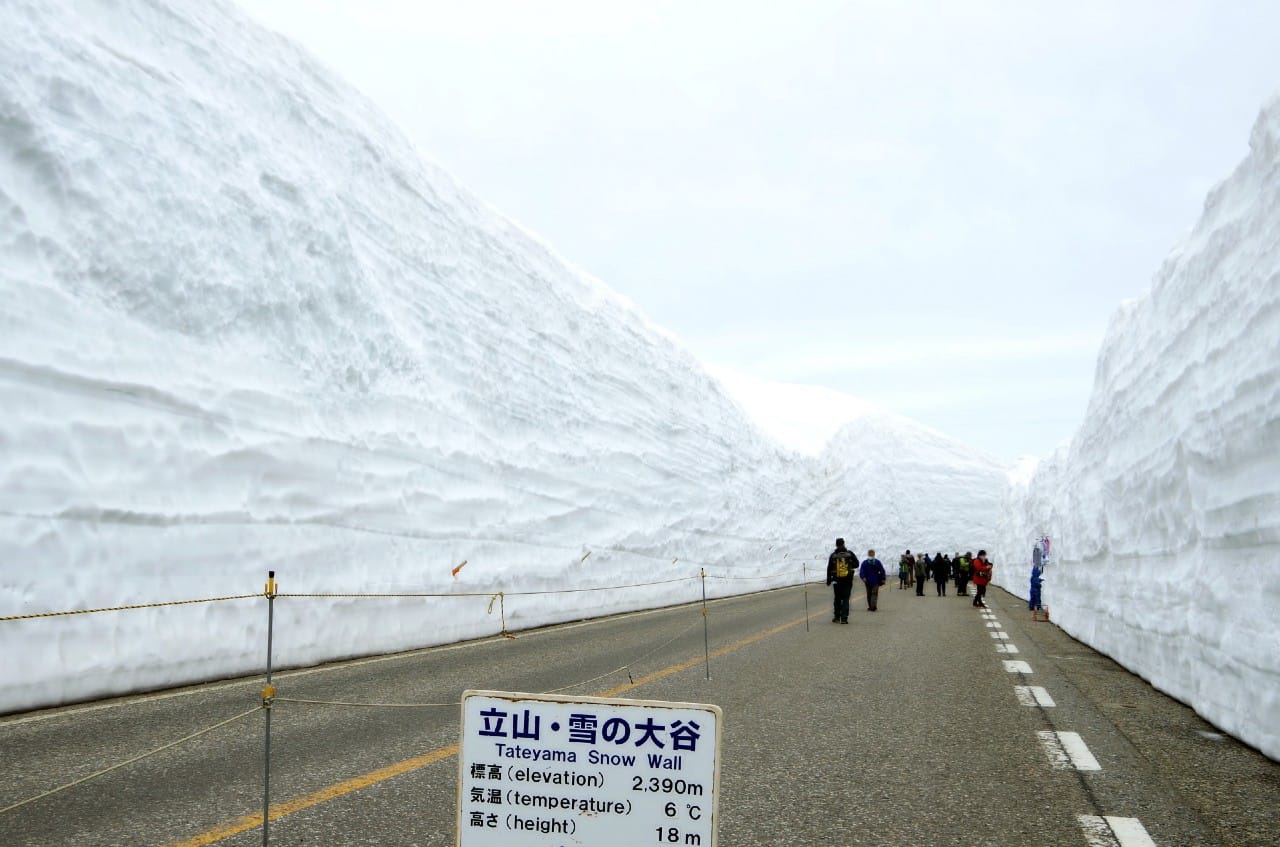
Six vehicles, two prefectures, and a two-kilometre climb that ends with you standing in a corridor of snow taller than a four-storey building.
The Tateyama Kurobe Alpine Route is not a road trip. Private cars are banned along its central section, which means the only way across is to hand yourself over to a chain of cable cars, buses and a ropeway and let them pass you up the mountain one leg at a time. You start in a cedar forest at 475 metres. Four transfers later you step out at Murodo, 2,450 metres up, into air that is roughly ten degrees colder than where you began — and in spring, into the Yuki-no-Otani snow corridor, where ploughs carve a road through drifts that routinely exceed fifteen metres.
It is one of the more expensive days out in Japan, and one of the most logistically fiddly. It is also, on a clear morning in late April, genuinely unlike anywhere else on earth. This guide covers what the six vehicles actually are, when the snow wall is open, what tickets cost, the reservation rule that catches most first-timers, and how to get there from Tokyo, Nagoya or Kanazawa.

What the Alpine Route actually is
The name covers two things, which is where confusion starts. In the broad sense, the Tateyama Kurobe Alpine Route is the roughly 90-kilometre corridor between Dentetsu-Toyama in Toyama Prefecture and Shinano-Omachi in Nagano Prefecture. In the sense that matters for ticketing, it is the 37-kilometre section between Tateyama Station and Ogizawa — the part closed to private vehicles, and the part your through-ticket covers.
That 37 kilometres is split across six vehicles, plus one stretch you cover on foot across the top of Kurobe Dam. Each vehicle exists because of the terrain it crosses: a funicular where the slope is too steep for wheels, a ropeway where there is nowhere to put support towers, tunnels bored straight through the mountain where there is no surface at all. Reading the route as an engineering sequence rather than a bus timetable makes the whole day considerably more interesting.
Japan Pocket Wifi Rental
Japan eSIM : Fast & Easy & UNLIMTED
Japan Travel eSIM
One footnote for transport nerds: both tunnel sections used to run trolleybuses, drawing power from overhead wires. The Kanden Tunnel converted to battery electric buses in 2019, and the Tateyama Tunnel followed at the end of the 2024 season — which retired the last trolleybus line operating anywhere in Japan. Older guidebooks and blog posts still describe them as trolleybuses. They are not, any more.
Do you actually need all six?
Only if you are crossing all the way through. Plenty of visitors — arguably most — are not. If the snow wall is what you came for, you are going to Murodo and coming back the same way, and the number of vehicles involved depends entirely on which side you enter from.
From the Toyama side, Murodo is two vehicles away: the Tateyama Cable Car, then the Highland Bus. From the Nagano side it is four, plus the walk across the dam, because you have to climb over the mountain rather than up one face of it. That asymmetry is the single most useful thing to know before booking anything — it explains why a Tateyama–Murodo round trip costs ¥7,380 while the same round trip from Ogizawa costs ¥12,300, and it is why anyone whose main goal is the snow wall should be looking at Toyama, not Nagano.
The short version. Coming for the snow wall only? Enter from Tateyama Station, take two vehicles up, come back down the same two. Want the Kurobe Dam, the ropeway and the tunnels as well? Then you are doing the full crossing, and the six-vehicle sequence above is your day.
The snow wall: what you actually see
Yuki-no-Otani is a natural bowl just below Murodo where wind funnels snow into a deep accumulation. Each spring, ploughs cut a road through it, leaving vertical white faces on both sides. For the Snow Wall Walk, roughly 500 metres of that road is closed to buses and handed over to pedestrians, so you can walk the corridor with traffic diverted elsewhere.
Height is the thing everyone asks about and the thing most articles get wrong, because it is measured fresh every year and it varies a great deal. Most seasons land somewhere between thirteen and twenty metres at the tallest point; lighter winters produce noticeably lower walls, and the figure is published once the route opens. Whatever the number, the wall shrinks steadily from opening day onwards, so the last two weeks of April and the first days of May are when it is at its most dramatic — and, inevitably, when it is busiest.
Don’t plan around a specific height. The tallest point is announced after the route opens each April and can differ by seven metres or more between years. Treat any number you read in advance — including in a tour brochure — as last year’s figure until the current season’s is published.
Murodo has more going on than the corridor itself. The terminal building sits on a plateau with marked walking loops that emerge from the snow as the season progresses, a sulphur-fed onsen, and views across Jigokudani, the volcanic “hell valley” that stays fenced off because of gas. Later in the walk season, temporary attractions such as a snow maze or a slide are usually set up beside the corridor. In summer the plateau turns into an alpine meadow and Mikuri-ga-ike pond reflects the peaks; in early October the autumn colour arrives here weeks before it reaches the valleys.

When to go
The route runs roughly mid-April to the end of November and closes completely for winter. A shorter section on the Toyama side, from Dentetsu-Toyama up to Midagahara, sometimes opens a few days ahead of the full crossing. Within the open season, the four periods below feel like four different destinations.
| Period | What it’s for | Conditions at Murodo | Crowds |
|---|---|---|---|
| Mid-Apr – early May | The snow wall at maximum height | Deep snow, around 0–5°C, severe glare | Heaviest of the year, especially Golden Week |
| Mid-May – late June | Snow wall still standing but shrinking; fewer people | Snow underfoot, 5–10°C | Moderate; weekdays are comfortable |
| July – August | Alpine flowers, hiking loops, dam water release | Roughly 10–20°C, cool even in a heatwave | Busy mid-August |
| Late Sep – Oct | Autumn colour, which starts here before anywhere else | Cold mornings, near freezing by late Oct | Busy on early-October weekends |
Kurobe Dam’s scheduled water release — a 186-metre plume that throws rainbows on sunny afternoons — runs from late June through mid-October, which is worth knowing if the dam rather than the snow is your reason for coming.
Getting to either end
The route has two gateways and you can start from either. Tateyama Station on the Toyama side is the more common choice for visitors coming from Tokyo or the Hokuriku region; Ogizawa on the Nagano side suits anyone arriving from Nagoya or Matsumoto. Crossing from Toyama to Nagano also means you climb into the snow wall earlier in the day, before the light flattens out.
| From | Route | Time | Notes |
|---|---|---|---|
| Tokyo (Toyama side) | Hokuriku Shinkansen to Toyama → Toyama Chiho Railway to Tateyama | About 2 hr 10 min + 60 min | The most common approach. Overnighting in Toyama lets you catch an early cable car |
| Tokyo (Nagano side) | Hokuriku Shinkansen to Nagano → express bus to Ogizawa | About 1 hr 30 min + 1 hr 45 min | Fastest rail leg, but the bus runs a limited daily timetable |
| Nagoya | Ltd. Exp. Shinano to Matsumoto → JR Oito Line to Shinano-Omachi → bus to Ogizawa | About 4 hr total | Natural pairing with Matsumoto or Kamikochi |
| Kanazawa | Hokuriku Shinkansen to Toyama → Toyama Chiho Railway to Tateyama | About 20 min + 60 min | Easiest same-day approach of the lot |
| Osaka / Kyoto | Ltd. Exp. Thunderbird to Tsuruga → Hokuriku Shinkansen to Toyama → Tateyama | About 3 hr + 60 min | Realistically an overnight in Toyama rather than a day trip |
Whichever end you start from, book the shinkansen leg in advance if you are travelling in Golden Week or mid-August, when reserved seats on the Hokuriku line sell out days ahead — our guide to reserving shinkansen seats walks through the options. Suica, ICOCA and the rest of the IC card family will get you to Toyama or Nagano perfectly well, but stop being useful the moment you reach the Alpine Route itself.
Driving? Private vehicles cannot cross between Tateyama Station and Ogizawa. You either park at one end and come back the same way, or use one of the private car-forwarding services that drive your vehicle around to the far side while you cross. Free parking exists at Tateyama Station; Ogizawa has a mix of free and paid spaces that fill early in peak season.
Tickets, fares and the reservation rule
This is where the old advice circulating online is most out of date. It used to be true that no reservations were needed unless you were a group. That is no longer how it works.
Two of the six legs — the Tateyama Cable Car departing Tateyama Station, and the Kanden Tunnel Electric Bus departing Ogizawa — now run on designated departure times. Whichever end you start from, your very first vehicle has a time printed on the ticket, and that time determines the shape of your whole day. The remaining legs are first-come, first-served; on busy days staff hand out numbered boarding tickets to manage the queue.
You can still turn up and buy a same-day ticket at the counter, and plenty of people do. But web tickets are sold online only — they are never available at the window — and during the opening weeks in late April and early May, Golden Week, mid-August and early October, same-day sales for some departures can be restricted once capacity fills. Booking online in advance is the difference between choosing your departure time and accepting whatever is left.
The reservation trap in one line: nothing forces you to book, but the first vehicle of the day has a fixed departure time and limited capacity. In peak season, arriving without a booking means queuing at Tateyama Station before dawn and still possibly missing your intended departure.
How buying a ticket actually works
It is one ticket, not six — but it is not a whole-route ticket either. When you buy, you specify a departure station and an arrival station, and the fare is calculated for that pair. Tateyama to Murodo and back is a valid combination; so is Tateyama to Ogizawa, or Ogizawa to Kurobedaira. Whichever you choose, the single ticket covers every vehicle inside that section, and there is no scenario where you queue at each vehicle to buy another fare. What you do not do is buy the full crossing when you are only going halfway.
What you are choosing when you book online is the departure time of your first vehicle, and only that. Every subsequent leg is boarded on arrival, in order, with no reservation possible and none needed. On the way back down, the same applies: the queue for the afternoon cable car at Bijodaira is the one people underestimate, so leave more slack in the descent than feels necessary.
There is no phone reservation line for individual travellers. Web tickets are sold on the official site only, by credit card, and are never available at station windows — and conversely, a web ticket has to be exchanged for a physical ticket at the web ticket counter at least fifteen minutes before your designated departure. If you want someone else to handle the logistics, the alternative is a packaged tour rather than a phone call. Groups of fifteen or more are handled separately through the operator’s group desk.
What it costs
There is no single ticket price, because almost everyone travels a different combination of segments. The figures below cover the most common patterns for the current season. Fares are revised periodically, so treat these as a planning baseline and confirm the current numbers on the official site before you buy.
| Section | Type | Adult fare |
|---|---|---|
| Tateyama ⇄ Ogizawa (full crossing) | One way | ¥10,940 |
| Dentetsu-Toyama ⇄ Ogizawa | One way | ¥12,170 |
| Tateyama ⇄ Murodo | Round trip | ¥7,380 |
| Ogizawa ⇄ Murodo | Round trip | ¥12,300 |
| Tateyama ⇄ Kurobeko | Round trip | ¥16,480 |
Note the gap between the two Murodo round trips: ¥7,380 from Tateyama versus ¥12,300 from Ogizawa, for the same destination. You are paying for the extra two vehicles it takes to get over the mountain from the Nagano side.
Children aged six to eleven pay roughly half; under-sixes travel free. Payment for web tickets is by credit card only, and your ticket stays valid for five days, so you can break the journey and stay overnight at Murodo or Midagahara if you want the mountain to yourself at dawn. What no Alpine Route ticket allows is backtracking — each segment can be used once, in one direction.
Several rail passes cover the route, including the JR Central Alpine-Takayama-Matsumoto Area Tourist Pass, which makes sense if you are approaching from Nagoya and pairing the Alpine Route with Takayama or Matsumoto. Pass coverage and pricing change from year to year, so check the current terms rather than trusting a comparison table written two seasons ago. Note also that none of the route’s own vehicles take IC cards, and cash still smooths things over at mountain kiosks — worth factoring into how much cash you carry for the trip.
One way or round trip — and what to do with your luggage
The crossing takes about six hours of moving time, which becomes a full day once you allow for stops. Most people cross one way and continue onward from the far side, because doubling back means seeing the same six vehicles twice and cuts your time at Murodo roughly in half. A round trip only really makes sense if you are based in Toyama and want a straightforward there-and-back day, in which case Tateyama to Murodo and returning is the efficient version.
If you are crossing one way, the obvious problem is your suitcase. Hauling a large bag through six transfers, up steps and across a dam is miserable, and there is nowhere to leave it at the top. The route operator runs a baggage forwarding service between Tateyama Station and Ogizawa, so you check your bag in at the start and collect it at the other end. Bags must be handed over by a cutoff time in the morning to arrive the same day, and pricing is per piece — both are posted at the counters, and the cutoff is early, so plan to arrive with time to spare rather than sprinting for the first cable car.

What to wear, and the altitude
Murodo sits at 2,450 metres, and the temperature there runs roughly fifteen degrees below Toyama city on the same day. In late April that means near-freezing air with snow underfoot; even in August it rarely climbs far past twenty. People arrive in spring wearing what worked in Tokyo and spend the whole visit shivering in the terminal building rather than outside where the snow wall is.
For the snow season, a proper winter jacket, gloves, a hat and waterproof shoes with grip are the minimum — the corridor floor is packed snow and ice, and trainers will be soaked within ten minutes. Sunglasses matter more than people expect: the glare off a fifteen-metre white wall at altitude is fierce, and sunburn at 2,450 metres happens fast even on a cold day. In summer and autumn, layers plus a windproof shell will cover most conditions.
The altitude itself is manageable for most people — you arrive by bus rather than on foot, so there is no exertion involved — but some visitors feel mild lightheadedness or breathlessness in the first half hour at Murodo. Moving slowly, drinking water and not sprinting up the terminal stairs handles it. Weather at that height also changes fast, and the route occasionally suspends sections for wind or snow, so build slack into any onward connection rather than booking a tight evening shinkansen.
Every leg of this route runs to a schedule, and the last departures are earlier than most travellers assume. Being able to pull up the current timetable, check whether a section has been suspended for weather, or reroute your evening train from a ropeway station is worth a lot. CDJapan Rental’s eSIM runs on the docomo network, which has the best reach of any carrier through the Tateyama valleys — and you buy it online, scan a QR code, and land already connected, with no SIM swap.
Timetables, current fares, live operating status and the web ticket booking system all live on the official Tateyama Kurobe Alpine Route site, which is worth checking the morning you travel as well as when you book.
Frequently asked questions
When can you see the snow wall at Tateyama?
How tall is the snow wall?
Do you need to book Alpine Route tickets in advance?
How long does it take to cross the Alpine Route?
Can you use Suica or other IC cards on the Alpine Route?
Fares, operating dates and service details reflect the current season and are revised periodically. Confirm current information on the official Tateyama Kurobe Alpine Route website before travelling.
This guide was originally published in 2015 and completely rewritten in 2026. Fares, operating dates and service details reflect the current season and are revised periodically. Confirm current information on the official Tateyama Kurobe Alpine Route website before travelling.
Short trip or long stay — we've got you covered
Best for Travelers
Japan eSIM
From ¥2,800 — activate before you land
- Cheaper than airport & convenience store SIMs
- 5-day to 135-day plans; unlimited or data-capped
- No SIM swap needed — ready in 2 minutes
Best for Long Stays
Monthly Pocket WiFi
From ¥5,500/mo — unlimited, no throttle
- Choose WiMAX 5G or SoftBank 4G coverage
- 3 to 12-month contracts — longer means cheaper
- Delivered to your hotel or airport post office


