
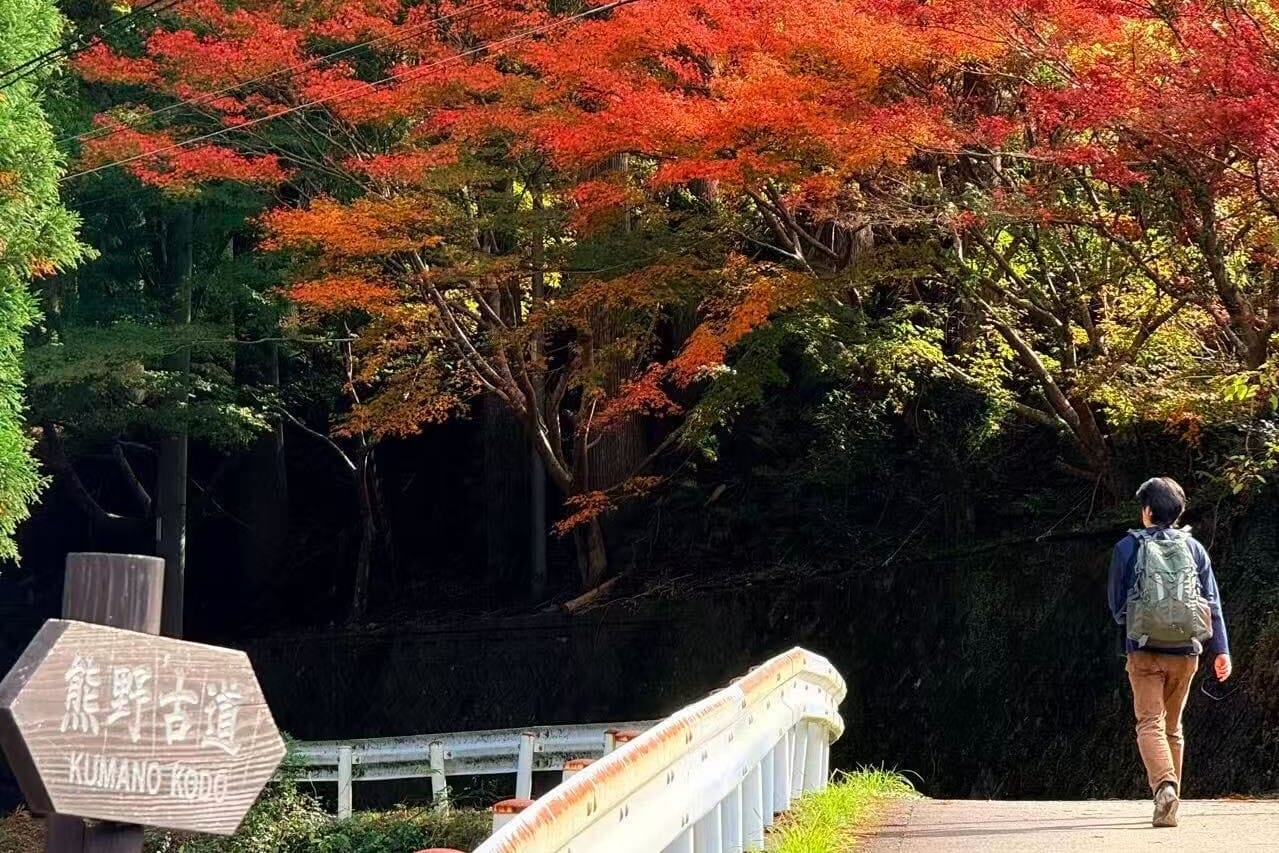
If you’ve walked the Camino de Santiago, you know the feeling: setting foot on a path that millions have walked before you over a thousand years, where every step feels like a conversation with history. Japan has a trail that does exactly the same thing — and most Western travellers have never heard of it.
The Kumano Kodo is one of only two pilgrimage routes in the world recognised as a UNESCO World Heritage Site. The other is the Camino. This guide is written for first-time visitors: what the Kumano Kodo actually is, which trail to walk, how to plan three days from Osaka — and how, if you’ve already done the Camino, you’re already halfway to becoming a certified Dual Pilgrim.
Japan Pocket Wifi Rental
Japan eSIM : Fast & Easy & UNLIMTED
Japan Travel eSIM
The Basics
A pilgrimage trail walked for a thousand years
The Kumano Kodo is not a single path but a network of ancient mountain trails on the Kii Peninsula in southern Japan (Wakayama Prefecture and parts of Mie Prefecture), all converging on the same destination: the Kumano Sanzan — three ancient grand shrines.
Since the Heian period (from around 794 AD), emperors, aristocrats, samurai, and ordinary people alike have walked these trails. The crowds were so vast that the journey came to be described as Ari no Kumano-mōde — “pilgrimages to Kumano like a procession of ants.” Historical records show that retired emperors walked the route over a hundred times in a span of three and a half centuries, each time accompanied by retinues of three to eight hundred people.
What makes the Kumano Kodo remarkable is not just its age. It brought together Japan’s native Shinto beliefs and Buddhism introduced from the continent, creating a uniquely inclusive spiritual space — one where gods and Buddhas shared the same forest. That openness persists today: the vast majority of people who walk these trails are not pilgrims in the religious sense. They come to step into a forest that has been alive for a thousand years.
You don’t need to follow any religion to walk the Kumano Kodo. You just need to be willing to leave the city behind and let the trail take you into a forest with a thousand years of memory.
In 2004, the Sacred Sites and Pilgrimage Routes in the Kii Mountain Range — with the Kumano Kodo at its heart — was inscribed as a UNESCO World Cultural Heritage Site. It was Japan’s first successful World Heritage nomination for a road.
Only two pilgrimage routes in the world hold UNESCO World Heritage status — the Kumano Kodo is one of them
Kumano Kodo
Camino de Santiago
Both routes took shape around the 10th century, both carry over a thousand years of pilgrimage tradition, and both are now officially designated Sister Pilgrimage Routes
The Destination: Kumano Sanzan
Where all the trails lead: the Kumano Sanzan
Every trail in the Kumano Kodo network ultimately leads to the same sacred destination — the Kumano Sanzan, three grand shrines each with a distinct character:
Kumano Hongu Taisha
The senior shrine of the three, enshrining Kumano’s highest deity and considered the spiritual heart of the pilgrimage. The shrine itself is solemn and imposing, but a short walk away lies Oyunohara — the original site of the grand shrine before it was relocated in 1889. Standing in that open field before Japan’s largest torii gate (33 metres tall) is one of the most quietly powerful moments on the entire trail.
Kumano Nachi Taisha
Set on a mountain slope, this shrine is inseparable from Nachi Falls — at 133 metres, Japan’s tallest waterfall — which is venerated as the shrine’s divine embodiment. The approach along the mossy stone-paved Daimonzaka path through towering cedar trees, with the red shrine and three-storey pagoda framing the falls, is the most photographed image in the entire Kumano region.
Kumano Hayatama Taisha
Situated at the mouth of the Kumano River in Shingu city — right by the sea — this shrine has a more relaxed, welcoming atmosphere. Its vermillion halls enshrine the deity of marriage and relationships, and the grounds contain a nagi tree (a species of podocarpus) estimated to be a thousand years old, designated a National Natural Monument.
Choosing Your Route
Which Kumano Kodo trail should I walk?

Source:Shingu City Tourist Association
The Kumano Kodo comprises six main trail systems approaching the Kumano Sanzan from different directions. Choosing the right route is the most important decision you’ll make before the trip.
Nakahechi Route
Tanabe → Kumano Hongu Taisha → Kumano Nachi Taisha → Kumano Hayatama Taisha (Shingu) · approx. 84–133 km total
The main trunk route of the Kumano Kodo, linking all three Kumano Sanzan shrines from Tanabe to Shingu — the official imperial pilgrimage road since the Heian period. The full route runs approximately 84–133 km depending on starting point and section choices, and can be broken into shorter day or multi-day segments. The final approach — Haatari-oji to Hongu Taisha (approx. 7 km) — is gentle enough for trail runners or sturdy sneakers and is the ideal entry point for first-timers. The mountain crossing between Hongu and Nachi (Kumo-tori-goe) is a more demanding multi-day challenge. The route is the best documented of all six, with the most reliable bus connections.
Kohechi Route
Koyasan → Kumano Hongu Taisha · approx. 70 km
Starts from the Buddhist sacred site of Koyasan and crosses three mountain ridges above 1,000 metres. The full route takes 4–5 days, involves steep and remote terrain, and is suited to experienced hikers. Facilities along the way are sparse; accommodation must be booked well in advance.
Ohechi Route
Tanabe → Nachi · approx. 120 km
Follows the southern tip of the Kii Peninsula along the coast, passing bamboo groves, rice paddies, and sweeping views of the Pacific. A favourite of travellers who prefer scenery over mountain terrain. The Ohechi can also qualify for Dual Pilgrim status, but the requirements are more involved than other routes: you must collect stamps at two designated sites in Tanabe city centre, two or more specified points along the Ohechi, and visit all three Kumano Sanzan shrines. Check the official Dual Pilgrim page for the full stamp list before setting out.
Daimonzaka → Nachi Taisha
Nakahechi branch · approx. 1.2 km · 45 minutes
The single most iconic visual of the Kumano Kodo: mossy stone-paved steps flanked by towering cryptomeria cedars. The walk is short and accessible for all fitness levels, ending at Nachi Taisha and the 133-metre Nachi Falls — Japan’s tallest single-drop waterfall.
Magose-toge Pass
Iseji Route · Owase City, Mie · approx. 2 km of stone paving
One of the best-preserved sections on the Iseji route, where ancient stone slabs disappear into a fern-carpeted cypress forest — a path that seems frozen in time. Already a UNESCO World Heritage designated section. Ideal for travellers approaching from Nagoya or Ise Jingu.
Matsumoto-toge Pass
Iseji Route · Kumano City, Mie · approx. 1 km
Stone steps climb to a ridge with sweeping views of Shichiri Mihama — a rare straight black-sand beach stretching along the Pacific coast. Adjacent to Oni-ga-jo (a UNESCO World Heritage geological site), making it easy to combine with broader Kumano City sightseeing.
The other three routes: Kiiji, full Iseji, and Omine Okugakemichi — Kiiji runs south along the western coast from Osaka or Kyoto to Tanabe; it was the imperial starting point but most of it has been absorbed by modern roads. The full Iseji (approx. 160 km) runs from Ise Jingu to Kumano, flourishing during the Edo period when pilgrimages to Ise were at their peak; the Magose-toge and Matsumoto-toge sections above are its most celebrated surviving segments. The Omine Okugakemichi is an entirely different proposition: an 80-kilometre ridge walk along the Omine mountain range from Yoshino in Nara to Hongu, reaching elevations of 1,000–1,900 metres, with a cumulative ascent of over 7,700 metres. Sections of the trail impose a nyonin kinzei (prohibition for women); the full route is intended for experienced mountaineers and Shugendo practitioners — not recommended for general tourists.
Of the six routes, designated sections of the Nakahechi, Kohechi, Ohechi, and Iseji are inscribed as UNESCO World Heritage. For the Dual Pilgrim certification, the most straightforward qualifying routes are the Nakahechi and Kohechi (which have complete stamp station networks). The Ohechi also qualifies under a specific fifth method, which requires stamps at two designated sites in Tanabe city centre, two or more specified Ohechi sites, and visits to all three Kumano Sanzan shrines — see the official Dual Pilgrim page for the full stamp list.
Suggested Itinerary
Three days from Osaka: a complete beginner’s itinerary
The itinerary below is designed for first-time visitors — one shrine per day, no backtracking, covering the ancient trail walk, a traditional river boat journey, all three Kumano Sanzan shrines, and a proper onsen soak. No hiking experience required.
This is a pilgrimage itinerary, not a hiking challenge. The actual trail walking is limited to approximately 7 km on Day 1 (Haatari-oji to Hongu Taisha) and 1.2 km on Day 3 (Daimonzaka). The rest of the time is spent on JR express trains, mountain buses, or a traditional wooden river boat. The aim is to experience the full spiritual circuit of Kumano Sanzan at a comfortable pace, with time left over for hot springs and photography.
1
Trail walk → Kumano Hongu Taisha
Leave Osaka early and take the JR Kuroshio limited express to Kii-Tanabe, then connect to the Ryujin bus to Haatari-oji — the most accessible starting point on the Nakahechi. Walk the 7-kilometre trail through moss-covered stone paths and ruins of ancient rest houses to Kumano Hongu Taisha, the senior shrine of the three. Afterwards, visit the nearby Oyunohara — the original shrine site before the 1889 flood — where Japan’s largest torii gate (33 metres) stands alone in an open field. In the evening, soak in one of the nearby onsen: Yunomine Onsen features the Tsuboyu, the world’s only bathing facility that is itself a UNESCO World Heritage Site (30-minute sessions, expect a queue). Or try Kawaya Onsen, where you can dig your own outdoor bath in the riverbed. Don’t miss picking up a hot spring egg from the stalls — a snack pilgrims have been enjoying for centuries.
🚌 Kii-Tanabe → Haatari-oji: Ryujin Bus, approx. 75 minutes (very few departures — check timetable in advance)
🥾 Haatari-oji → Hongu Taisha: approx. 2.5–3 hours walking, low difficulty, trail runners/sneakers fine
🏨 Stay: guesthouses or ryokan near Hongu, Yunomine Onsen, or Kawaya Onsen
2
Kumano River boat → Kumano Hayatama Taisha (Shingu)
Today the journey itself is the experience. Board the Kumano-gawa River Boat (川舟下り) in the morning and drift downstream along the Kumano River for approximately two hours to Shingu — the same route used by retired emperors returning from their pilgrimages a thousand years ago. Watching the mountain walls slowly pass from a low wooden boat is a perspective no road trip can replicate. On arrival in Shingu, Kumano Hayatama Taisha is a short walk from the dock — a relaxed vermillion shrine enshrining the deity of relationships, with a thousand-year-old nagi tree (National Natural Monument) in the grounds. If energy allows in the afternoon, climb the 538 stone steps to Kamikura Shrine for panoramic views over Shingu and the coast.
🏨 Stay: Shingu city centre or Kii-Katsuura onsen ryokan
3
Kumano Nachi Taisha + Nachi Falls → return
Give the whole day to Nachi. Take the bus from Kii-Katsuura Station to Daimonzaka and walk up the trail’s most iconic section: towering cedars on both sides, mossy stone steps climbing for 45 minutes to Kumano Nachi Taisha. Continue to Seiganto-ji Temple, where the famous view of the three-storey pagoda framing 133-metre Nachi Falls makes for the definitive image of the Kumano region. Then descend to Hiryū Shrine, where the falls themselves are venerated as a deity — standing at the base looking up puts a thousand years of nature worship into immediate perspective. Shops on the mountain close around 16:00; take the last sensible bus down at 15:44, and catch the Kuroshio express back to Osaka from Kii-Katsuura. The last train departs around 21:23, giving you ample time.
🚂 Kii-Katsuura → Osaka: JR Kuroshio limited express, approx. 3 hrs 20 min · last departure approx. 21:23
Bus frequency is the number one logistical challenge in the Kumano area. Mountain routes may run only 3–4 times a day, and some services don’t run on holidays. Check timetables in advance at Ryujin Bus and Kumano Gobo Nankai Bus (two separate companies covering different zones) and download the PDF timetables for offline use.
The Dual Pilgrim Programme
Done the Camino? You’re one trail away from Dual Pilgrim status
Two UNESCO World Heritage pilgrimage routes —
you can walk both
Complete the Camino de Santiago (any official route) and a qualifying section of the Kumano Kodo, then register with the Tanabe City Kumano Tourism Bureau or the Santiago de Compostela Tourist Office to receive:
Handmade washi paper certificate (issued only in Kumano, Japan) · Limited-edition badge (scallop shell meets three-legged crow) · Dual Pilgrim credential booklet
Santiago de Compostela lies at the far western edge of Europe — where the sun sets. Kumano lies at the eastern edge of Asia — where the sun rises. Two routes, connected by the sun.
UNESCO World Heritage
pilgrimage routes
Dual Pilgrims certified
as of May 2025
Year the Sister
Routes pact was signed
The programme is jointly run by the Tanabe City Kumano Tourism Bureau and the city of Santiago de Compostela, and was formally launched in 2015. After completing both routes and registering at a designated point, you can collect your washi certificate at the Kumano Hongu Heritage Centre or the Tanabe City Tourism Office in Japan, or at the Santiago Tourist Office in Spain.
There are five qualifying methods on the Kumano side. The three most commonly used are: walking the full Nakahechi from Takijiri-oji to Hongu Taisha (approx. 38 km); walking between Nachi Taisha and Hongu Taisha in either direction (approx. 30 km); or walking from Haatari-oji to Hongu Taisha (approx. 7 km — the Day 1 walk in this guide), provided you also visit Kumano Hayatama Taisha and Kumano Nachi Taisha. This means the three-day itinerary in this article (Day 1 trail walk + Day 2 Hayatama + Day 3 Nachi) fully satisfies the third qualifying method — you can apply the moment you finish. The Daimonzaka path (1.2 km) is not a standalone qualifying section, but as the approach to Nachi Taisha it forms part of the full circuit.
Before You Go
Seven things to know before you visit
Essential tips for the Kumano Kodo
Best time to visit
Spring (March–May) and autumn (October–November) offer the most comfortable temperatures and spectacular scenery. Summer is hot and humid but the waterfalls are at peak volume. The rainy season (mid-June to July) brings heavy rainfall — best avoided. Winter is serene but mountain paths can be slippery.
Footwear and kit
Trail runners or sturdy sneakers are fine for the Haatari-oji section and Daimonzaka. Hiking boots are advisable for longer routes. Ancient stone paths become dangerously slippery when wet — sandals and flat-soled shoes are not safe. Pack a lightweight rain jacket; mountain weather changes fast.
Book accommodation early
Accommodation in the mountain area is mainly minshuku (family-run guesthouses, usually with meals included) and ryokan, with limited rooms available. Book 2–3 months ahead for spring and autumn peak seasons. Some properties don’t accept online reservations — a phone call (or your hotel asking on your behalf) is sometimes necessary.
Carry enough cash
Many minshuku, small restaurants, and rural buses in the mountains don’t accept credit cards or IC cards like Suica or ICOCA — so withdraw enough yen at a convenience store ATM in Kii-Tanabe or Shingu before heading into the mountains. — there are no convenience stores along the trail.
Download offline maps
Mobile signal is unreliable deep in the mountains. Download offline maps for the Kumano area on Google Maps before you leave. The official paper trail maps — available free from the Tanabe City Tourism Bureau — are worth carrying as a backup.
Pilgrim credential and stamps
Pick up a Kumano Kodo pilgrim passport at the Tanabe City Tourism Bureau or the Takijiri-oji trailhead information office and collect stamps at the Oji sites and shrines along the way. At Hongu Taisha, show this credential — alongside your Camino credencial if you have one — to apply for the Dual Pilgrim certification.
The onsen are part of the pilgrimage
Kawaya Onsen (dig your own outdoor bath in the riverbed) and Yunomine Onsen (the world’s only bathing facility that is also a UNESCO World Heritage Site — the Tsuboyu, 30-minute sessions) have been used by pilgrims for ritual purification for over a thousand years. Building them into your itinerary isn’t indulgence — it’s tradition.
Season rating
Mild temperatures, azalea season, clear skies — the most popular time to visit
Hot and humid; rainy season in June–July; waterfalls at peak volume, lush green forest
Autumn foliage, comfortable temperatures, superb scenery — ties with spring as the best season
Quiet trails, peaceful mountain atmosphere; paths can be slippery, some guesthouses close
Getting There
How to get to the Kumano Kodo
There is no Shinkansen to the Kumano area — and that is, in part, why it has remained so unspoiled.
From Osaka (most common starting point)
Take the JR Kuroshio limited express from Osaka or Tennoji Station. Journey time is approximately 2 hours to Kii-Tanabe and 3.5 hours to Shingu. The national JR Pass covers the Kuroshio (seat reservation recommended). Without the national pass, four JR West regional rail passes include the full Kuroshio line — choose based on your wider itinerary: Kansai Wide Area Pass, Kansai-Hiroshima Area Pass, Kansai-Hokuriku Area Pass, and the JR West All Area Pass. Each covers a different geographic range and is priced differently — the right one can work out cheaper than the national pass.
From Nagoya
Take the JR Nanki limited express to Shingu or Kumano City in Mie Prefecture — the natural gateway for the Iseji route. The national JR Pass is accepted. JR Central also offers the Nanki Kumano Kodo Free Kippu, which includes a return Nanki express ticket and unlimited rides on designated bus sections — a good option if you don’t hold a JR Pass.
Local buses in the Kumano area are run by two separate companies: Ryujin Bus covers the western zone (Tanabe → Hongu), while Kumano Gobo Nankai Bus covers the eastern zone (Hongu → Shingu → Nachi). Timetables must be checked separately for each operator. Pick up a consolidated printed bus schedule at the Tanabe City Tourism Bureau — it’s far easier than switching between two websites on a mountain with intermittent signal.
FAQ
Frequently asked questions about the Kumano Kodo
What is the Kumano Kodo?
The Kumano Kodo is a network of ancient pilgrimage trails on the Kii Peninsula in Wakayama Prefecture, Japan, leading to the three grand shrines known as the Kumano Sanzan. In 2004, it was inscribed as a UNESCO World Heritage Site — one of only two pilgrimage routes in the world to hold this status. The other is the Camino de Santiago in Spain.
How is the Kumano Kodo related to the Camino de Santiago?
Both the Kumano Kodo and the Camino de Santiago are UNESCO World Heritage pilgrimage routes with over a thousand years of continuous tradition. They were formally designated “Sister Pilgrimage Routes” in 1998. Pilgrims who complete both routes can apply for the Dual Pilgrim certification, receiving a handmade washi paper certificate and a limited-edition badge. Over 10,000 people had been certified as of May 2025.
Which Kumano Kodo trail is best for first-time visitors?
The Nakahechi route is the most beginner-friendly and popular trail. The section from Haatari-oji to Kumano Hongu Taisha (approximately 7 km) is manageable in trail runners or sturdy sneakers, takes around 2.5–3 hours, and is well-served by local buses. It is the ideal entry point for first-time hikers.
How many days do I need for the Kumano Kodo?
Three days from Osaka is enough to complete all three Kumano Sanzan shrines and walk the most scenic trail sections. Day 1: hike from Haatari-oji to Kumano Hongu Taisha and soak in Yunomine or Kawaya Onsen. Day 2: board a traditional wooden boat down the Kumano River to Shingu and visit Hayatama Taisha. Day 3: walk Daimonzaka to Nachi Taisha, see Nachi Falls, then return to Osaka from Kii-Katsuura by express train.
How do I get to the Kumano Kodo from Osaka?
Take the JR Kuroshio limited express from Osaka or Tennoji Station — approximately 2 hours to Kii-Tanabe and 3.5 hours to Shingu. The national JR Pass and several JR West regional passes cover the Kuroshio line. From Kii-Tanabe, connect to local mountain buses — frequency is very low (3–4 per day), so always check the timetable in advance.
Do I need hiking boots for the Kumano Kodo?
For the most popular beginner sections — Haatari-oji to Hongu Taisha and Daimonzaka to Nachi Taisha — trail runners or supportive sneakers are sufficient. The ancient stone paths become extremely slippery when wet; sandals and flat-soled shoes are unsafe. Carry a light rain jacket, as mountain weather can change quickly. Full hiking boots are only needed for more demanding routes such as the Kohechi.
What hot springs are near the Kumano Kodo?
Three exceptional onsen sit close to Kumano Hongu Taisha. Yunomine Onsen features the Tsuboyu — the world’s only bathing facility that is also a UNESCO World Heritage Site (30-minute sessions, queue expected). Kawaya Onsen lets you dig your own outdoor bath in the riverbed. Wataze Onsen is a larger resort-style facility well suited to families. All three have served as pilgrims’ purification baths for over a thousand years.
What is the Dual Pilgrim certification and how do I apply?
The Dual Pilgrim programme recognises people who complete both the Camino de Santiago (any official route) and the Kumano Kodo (specified sections). Register at the Tanabe City Kumano Tourism Bureau or the Santiago de Compostela Tourist Office to receive a handmade washi certificate, a limited badge, and a dual credential booklet. The most accessible Kumano qualifying method is walking from Haatari-oji to Kumano Hongu Taisha (approx. 7 km) and also visiting Hayatama Taisha and Nachi Taisha — which is exactly what this article’s 3-day itinerary covers.
You don’t need to be an experienced hiker to walk a thousand-year-old trail
The Kumano Kodo has never had a fitness requirement. The same mountain paths that Heian-era court ladies climbed are the ones you’ll walk today in your trail runners. How far you go, how fast you move — that’s entirely up to you.
If you’ve walked the Camino, you know that feeling: somewhere along the long dusty Spanish road, you forget you’re trying to get anywhere, and the walking becomes its own point. The same magic exists in the cedar forests of Kumano — just swap the Spanish earth for mossy stone, the church bells for mountain shrine bells, and the pilgrim hostel for a ryokan with a hot spring waiting at the end of the day.
Further reading: [Japan Onsen Guide for First-Time Visitors]
Header photo: Xiaohua
Short trip or long stay — we've got you covered
Best for Travelers
Japan eSIM
From ¥2,800 — activate before you land
- Cheaper than airport & convenience store SIMs
- 5-day to 135-day plans; unlimited or data-capped
- No SIM swap needed — ready in 2 minutes
Best for Long Stays
Monthly Pocket WiFi
From ¥5,500/mo — unlimited, no throttle
- Choose WiMAX 5G or SoftBank 4G coverage
- 3 to 12-month contracts — longer means cheaper
- Delivered to your hotel or airport post office
