
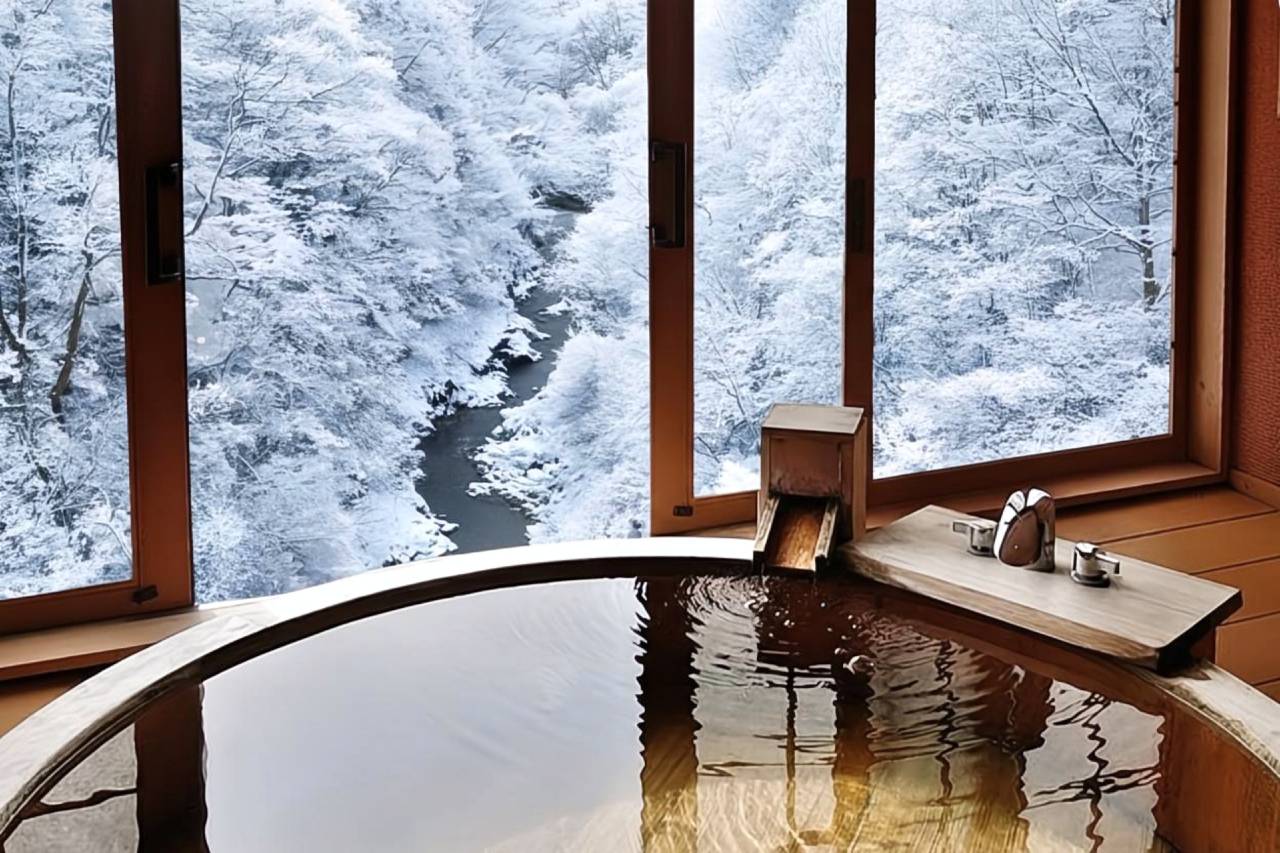
Tattooed and dreaming of a Japanese onsen? You’re not alone — and the good news is you have more options than you think. Here’s everything you need to soak without stress. ♨
Picture this: you’ve spent thousands of dollars flying to Japan, booked a gorgeous ryokan, changed into your yukata — and then you see it. A sticker on the entrance to the hot spring bath. A stylized arm, circled in red with a line through it. No tattoos.

Source: KOMOREBI
Japan Pocket Wifi Rental
Japan eSIM : Fast & Easy & UNLIMTED
Japan Travel eSIM
That sinking feeling is real, and it happens to more visitors than you’d expect. Whether you have a small wrist script or a full sleeve, the prospect of being turned away from one of Japan’s most iconic cultural experiences is genuinely anxiety-inducing — especially when you’ve planned your whole trip around it.
But here’s the thing: in 2026, having a tattoo is no longer a death sentence for your onsen dreams. Restrictions still exist, and understanding them matters. But with the right knowledge and a little planning, the steam will always have a place for you.
The short answer: There are three solid strategies — choosing tattoo-friendly public bathhouses, using waterproof cover patches for smaller tattoos, or booking a fully private bath. Read on to find the one that fits you.
Why Do Onsens Ban Tattoos? The Short (and Honest) Explanation
The tattoo ban in Japanese bathing facilities has roots in a very specific historical context. For much of the 20th century, visible tattoos in Japan were strongly associated with the yakuza — organized crime syndicates whose members used elaborate full-body tattoos as a mark of membership and identity. To make regular customers feel safe, public bathhouses and hot spring facilities began prohibiting tattoos as a practical crowd-management policy.
The thing is, that context has never really applied to foreign visitors. A tourist from Austin or Amsterdam with a floral forearm piece has absolutely nothing to do with Japanese organized crime — and the bathhouse industry knows it. In recent years, with inbound tourism reaching record highs, the Japan Tourism Agency has actively encouraged onsen operators to reconsider blanket bans and make accommodations for cultural differences among international guests.
Change is happening, though slowly. Some facilities have already updated their policies; others maintain strict bans; many fall somewhere in between. This is precisely why having a clear strategy — rather than just hoping for the best — makes all the difference.
Go to a Sento — Public Bathhouses Are Often More Welcoming
Budget-friendly
Authentic local experience
Most visitors don’t realise there’s an important distinction between two types of bathing facilities in Japan — and that distinction can be a game-changer if you have tattoos.
- Onsen (温泉) — Uses natural geothermal spring water drawn from the earth. Usually attached to a ryokan or resort, commercial in nature, and often subject to stricter tattoo policies set by the facility’s management.
- Sento (銭湯) — A heated public bathhouse using regular tap water. Regulated under local public health ordinances rather than private business rules. Historically a community fixture — think neighbourhood laundromat, but for bathing — and frequently far more relaxed about tattoos. Many explicitly welcome inked guests.
In cities like Tokyo and Osaka, neighbourhood sentos have experienced something of a cultural revival, attracting a younger, artistically inclined crowd where tattoos are entirely unremarkable. Some have become outright famous as tattoo-friendly onsen Tokyo alternatives — offering a genuinely local experience that most tourists never discover.
When searching, try the keywords “tattoo-allowed sento” or “刺青OK 銭湯” along with your destination city. Review sites, travel forums, and dedicated tattoo-friendly Japan directories (see Strategy section below) are your best starting point.
Waterproof Cover Patches — The Easy Fix for Smaller Tattoos
Low cost
Access most standard onsen
If your tattoo is relatively small — think a wrist piece, ankle script, or anything roughly the size of a business card — covering tattoos in Japan with waterproof adhesive patches is a widely accepted and practical solution. These are skin-toned, opaque, waterproof bandages specifically designed for tattoo coverage in bathing environments.
Where to buy them in Japan
- Matsumoto Kiyoshi / WELCIA / other drug stores — Japan’s ubiquitous pharmacy chains. Look in the skincare or first-aid aisle. Search for タトゥー隠し (tattoo cover) or 防水テープ (waterproof tape).
- Don Quijote (Donki) — The giant discount variety store found in most major cities. Check the health and beauty section. Open late, often 24 hours.
- Amazon Japan — Order before you leave home and have them delivered to your accommodation. Search: タトゥーカバー テープ 防水. Look for multi-pack options in various skin tones.
The unspoken rule that most facilities operate by: if it’s covered and invisible, it doesn’t exist. The goal of tattoo policies isn’t to punish tourists — it’s to maintain the visual comfort of other bathers. A well-applied waterproof patch takes care of that concern entirely.
Book a Private Bath — The Zero-Stress Option for Any Tattoo
Maximum privacy
No rules, no worries
If your tattoos are large — full back pieces, sleeves, chest work — or you simply don’t want to deal with any of this, the cleanest solution is to take the shared bath out of the equation entirely. Japan has two excellent options for completely private bathing:
貸切風呂 — Kashikiri Buro (Private Rental Bath)
Many ryokans and hot spring facilities offer time-slot rentals of a small, self-contained private bath — usually 45 minutes to one hour. The space is exclusively yours (and whoever you bring). No other guests, no staff hovering, no policy to navigate. Prices typically range from ¥1,500 to ¥3,000 for the slot. Reserve at check-in or in advance — these fill up quickly at popular properties.
露天風呂付き客室 — Room with Private Open-Air Bath
The crown jewel of Japanese accommodation: a guest room with its own private outdoor hot spring on the terrace or in a garden enclosure. Entirely separate from the communal baths. No shared anything. You soak on your own schedule, as many times as you like, in genuine geothermal spring water. It’s the most expensive option — expect to pay 30–80% more than a standard room — but it’s also, hands down, the most relaxing way to experience an onsen in Japan regardless of whether you have tattoos or not.
Private and bookable baths are your most reliable option, and some of them are destinations in their own right. On the Kumano Kodo pilgrimage route in Wakayama, Yunomine Onsen’s Tsuboyu is booked in 30-minute private slots — a two-person wooden tub inside a hut on the riverbank, and the only bathing facility on earth that holds UNESCO World Heritage status. Kawayu Onsen, a few minutes away, lets you dig your own bath in the riverbed, which sidesteps the question entirely. Both are covered in our Kumano Kodo guide.
Quick Comparison: Which Strategy Is Right for You?
| Strategy | Tattoo Size | Typical Cost | Uses Communal Bath | Effort Required |
|---|---|---|---|---|
| A — Sento | Any | ¥500–¥1,200 | ✓ Facility-dependent | Low (research in advance) |
| B — Cover Patches | Business-card size or under | ¥500–¥2,000 | △ Policy-dependent | Low (buy patches) |
| C — Private Bath | Any (including large) | ¥¥¥ (higher) | ✗ Private only | Low (just book ahead) |
Pro Tips: Don’t Guess — Just Check
The single most effective thing you can do is confirm the facility’s policy before you go. Japan’s onsen landscape is genuinely varied — some places that look strict are surprisingly welcoming; others that seem tourist-friendly have firm rules. Here’s how to find out:
- Search dedicated resources: Sites and community threads aggregating tattoo-friendly Japan facilities are your best starting point. Search your destination city + “tattoo friendly onsen 2026” to find recently updated lists and first-hand reports.
- Email or call the facility directly: Found a ryokan you love? Just ask. Something like: “I have a tattoo — is it possible to use the onsen?” Most places have English-speaking staff or can communicate via email. A quick yes/no now saves real disappointment later.
- Ask your hotel concierge: If you’re staying in a hotel, the front desk is an invaluable local resource. Ask them to check nearby sentos or onsens on your behalf — they often know the neighbourhood policies better than any website.
- Check the FAQ on facility websites: Many properties now address tattoo policies explicitly in their FAQ or house rules page. Look for the Japanese phrase タトゥー・刺青について (regarding tattoos) if you’re browsing a Japanese-language site.
- Can I go to an onsen with a small tattoo? Often yes — especially with cover patches, or at tattoo-friendly sentos. The key is always to verify the specific facility rather than assume either way.
♨ Onsen Etiquette — Tattoo-Friendly Doesn’t Mean Rules-Free
Even at the most welcoming facilities, onsen etiquette is non-negotiable. Following these rules is basic respect for other bathers — and frankly, tattooed visitors who demonstrate impeccable manners make it easier for facilities to stay open-minded about their policies.
- Shower thoroughly before entering the bath — Sit on the small wooden stool, use the provided soap and showerhead, and wash your entire body before approaching the pool. This is the single most important rule.
- Keep your towel out of the water — Your small modesty towel goes on the edge of the bath or folded on your head. It never, ever goes in the water.
- No swimwear — Onsens are entered completely nude. Swimwear is not permitted in traditional communal baths (private baths may differ — check facility rules).
- Keep hair out of the water — Tie long hair up. It shouldn’t touch the surface of the bath.
- Keep noise low — Onsens are spaces for quiet relaxation. Loud conversation, splashing, or running are off the table.
- Don’t soak if you’re unwell — Open wounds, contagious illness, or heavily intoxication are all reasons to skip the bath that day.
Your Tattoo Isn’t the Obstacle — Lack of Planning Is
The idea that tattooed visitors simply can’t experience Japanese onsens is, in 2026, genuinely outdated. Between tattoo-friendly sentos in every major city, the quiet effectiveness of waterproof cover patches for smaller work, and the total freedom of a private kashikiri bath or room with an en-suite rotenburo — there is a path to the steam for everyone.
What it takes is a little homework before you go. Check the policies, send a quick email, buy the patches, or simply upgrade your room. Japan’s onsen culture is one of the most genuinely relaxing things you can experience anywhere in the world, and it would be a shame to miss it over something entirely solvable.
Respect the culture, follow the etiquette, do your research — and then sink into that hot water and let the trip properly begin.
Know a Great Tattoo-Friendly Onsen or Sento?
If you’ve found a place in Japan that made you feel genuinely welcome — inked and all — share it in the comments below. Your tip could be exactly what a fellow traveller needs to plan their trip with confidence. ♨
Short trip or long stay — we've got you covered
Best for Travelers
Japan eSIM
From ¥2,800 — activate before you land
- Cheaper than airport & convenience store SIMs
- 5-day to 135-day plans; unlimited or data-capped
- No SIM swap needed — ready in 2 minutes
Best for Long Stays
Monthly Pocket WiFi
From ¥5,500/mo — unlimited, no throttle
- Choose WiMAX 5G or SoftBank 4G coverage
- 3 to 12-month contracts — longer means cheaper
- Delivered to your hotel or airport post office


