
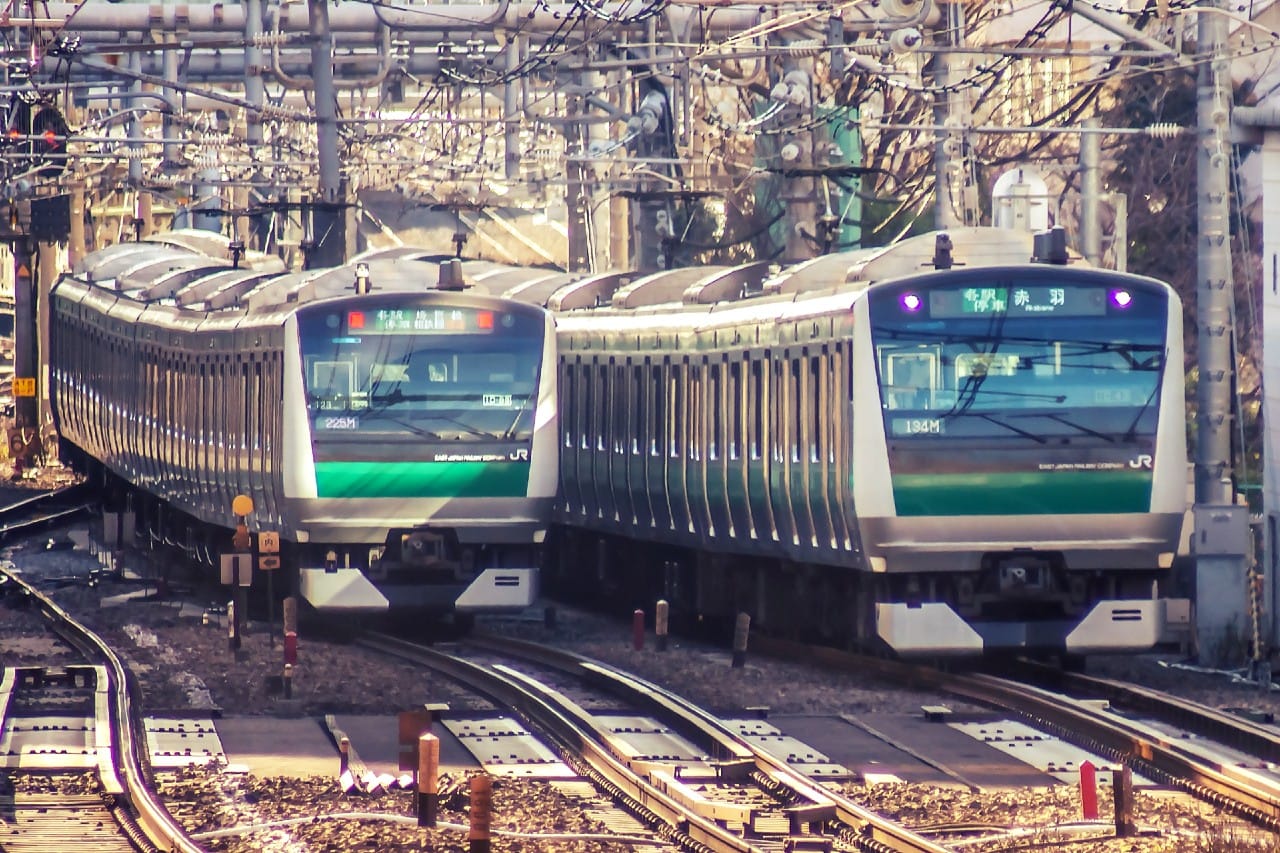
It’s pretty common to see people on social media asking things like, “I don’t get how to transfer trains in Japan,” “Am I supposed to change trains here? Why does the transfer app say no transfer needed?” or “We pass so many stations—why don’t we get off?”
Take the example below—you’re taking a train from Nishi-Nippori to Shimokitazawa, and next to Yoyogi-Uehara station there are two little characters: 「直通」「乗換不要」「降車不要」, meaning “through” and “no transfer needed.” In English, it might say “remain on board.” But the line color clearly changes here—so do you need to transfer or not?
This is where a unique feature of Japan’s train system comes into play: inter-company through service (直通運転).

What Is Inter-Company Through Service?
Japan Pocket Wifi Rental
Japan eSIM : Fast & Easy & UNLIMTED
Japan Travel eSIM
Through service means that trains from different railway companies are connected, allowing you to ride a train from one company’s line directly to another’s without changing trains. This setup makes travel via Shinkansen, subways, or other trains smoother—no need to hop off and re-buy tickets when switching companies.
For instance, if you’re traveling from Ikebukuro in Tokyo to Chinatown in Kanagawa, some railway companies collaborate so that you can ride the same train the whole way. No need to transfer or switch platforms—just sit back and enjoy the ride. Like in this example: no transfers at Shibuya or Yokohama; just ride straight through to Chinatown.

Through service is especially common in metro areas like Tokyo and Osaka, allowing you to smoothly cross over between different companies’ systems. You can even ride from Narita Airport to Haneda Airport without getting off or transferring. Here’s a real-world example:

Why Through Services Exist
Many private and subway lines operate through services. Originally, trains only ran on their own company’s tracks, but constant transfers weren’t great for passengers—and it wasn’t efficient for companies either if trains only ran short distances.
So companies started collaborating. For example, Company A’s trains might run on Company B’s tracks, and vice versa. This increases each train’s operating range, improves company revenue, and gives passengers a more seamless journey. It’s a win-win-win.
Fares, however, don’t change. Before through service, you’d pay A + B fare. After through service, you still pay A + B. But the convenience of skipping transfers—and potentially keeping your seat the whole time—makes it totally worth it.
Common Through Service Routes in Tokyo
Here are some major lines and companies that commonly offer through service within the Tokyo area:
- Keikyu Line (Keikyu Main Line, Keikyu Airport Line, etc) – Sengakuji Station – Toei Asakusa Line – Oshiage Station – Keisei Line (Main, Oshiage, Access)
- Tokyo Metro Hibiya Line – Kita-Senju Station – Tobu Skytree Line – Nikko Line
- Chuo Line (Local) – Nakano Station – Tokyo Metro Tozai Line – Nishi-Funabashi Station – JR Sobu Line (Local)
- Tama Line/Odakyu Line – Yoyogi-Uehara Station – Tokyo Metro Chiyoda Line – Ayase Station – JR Joban Line (Local)
- Tobu Tojo Line – Wako-shi Station – Tokyo Metro Yurakucho/Fukutoshin Lines – (Fukutoshin) Shibuya Station – Tokyu Toyoko Line (which continues into Minatomirai Line in Kanagawa, ending at Motomachi-Chukagai Station)
- Tokyu Den-en-toshi Line – Shibuya Station – Tokyo Metro Hanzomon Line – Oshiage Station – Tobu Skytree Line – Tobu Isesaki/Nikko Lines
- Tokyu Meguro Line – Meguro Station – Tokyo Metro Namboku Line / Toei Mita Line
But here’s the catch—not all trains operate as through-service trains. Only “some” trains do. So, be sure to double-check the destination of your train to see if it’s actually running through. This is especially important on the Asakusa Line—many travelers unfamiliar with Tokyo’s rail system get tripped up there.
Sample Route: Asakusa to Narita Airport
Let’s say you’re heading from Asakusa Station to Narita Airport. Google Maps might suggest the following route:

At first glance, it looks like you ride two subway stops, switch to JR at Oshiage, switch again at Aoto, then again at Keisei-Takasago…?
But if you understood the concept of through service from earlier—this route is way more convenient than it looks. In fact, you don’t need to transfer at all. Just hop on at Asakusa and ride all the way to Narita Airport.
Q1: Why are Oshiage and Aoto shown with a slash mark between blue lines? Does that mean you have to transfer?
A1: Nope, you don’t have to transfer!
The route from Oshiage to Aoto, and Aoto to Keisei-Takasago, is all operated by Keisei Railway—hence the blue line. But the section names differ. From Oshiage to Aoto, it’s the “Keisei Oshiage Line,” and from Aoto to Takasago, it’s the “Keisei Main Line.” Same train, different line names—so a slash mark is used to separate them.
Actually, the same train changes names three times between Asakusa and Narita Terminal 2. It goes: Toei Asakusa Line → Keisei Oshiage Line → Keisei Main Line → Keisei Narita Access Line (Access Express). Even though it’s the same train, each section has a different name.
In Japan, train “lines” don’t technically have names—the tracks don’t, anyway. What’s named is the service/train that runs on those tracks.
Q2: If I’m using the Tokyo Metro 24/48/72-hour pass, do I need to exit and re-enter the station at Oshiage, Aoto, or Keisei-Takasago?
A2: Yes—you’ll need to exit at Oshiage if you’re using a Tokyo Metro subway pass.
The 24/48/72-hour Tokyo Metro Pass only works on Tokyo Metro and Toei Subway trains. From Oshiage onward, the train is considered part of Keisei’s system—even if the train itself doesn’t change. That means your Metro pass won’t cover the fare from Oshiage to Narita.
Apps like Google Maps won’t factor in whether you’re holding a special pass. Routes are shown based on the assumption that you’re paying with individual tickets or IC cards like Suica. So be sure to cross-check any suggested routes against your pass conditions.
That said, if you forget or mess up and just ride all the way to Narita, no big deal—you can just pay the fare difference when you get off.
Related Articles:
Short trip or long stay — we've got you covered
Best for Travelers
Japan eSIM
From ¥2,800 — activate before you land
- Cheaper than airport & convenience store SIMs
- 5-day to 135-day plans; unlimited or data-capped
- No SIM swap needed — ready in 2 minutes
Best for Long Stays
Monthly Pocket WiFi
From ¥5,500/mo — unlimited, no throttle
- Choose WiMAX 5G or SoftBank 4G coverage
- 3 to 12-month contracts — longer means cheaper
- Delivered to your hotel or airport post office


