
Tourist Pasmo · 2026
You roll your suitcase out of the Haneda arrivals hall and there it is: a wall of ticket machines and the logos of several different railway companies. This is exactly the moment a single tap-and-go card saves you a lot of grief.

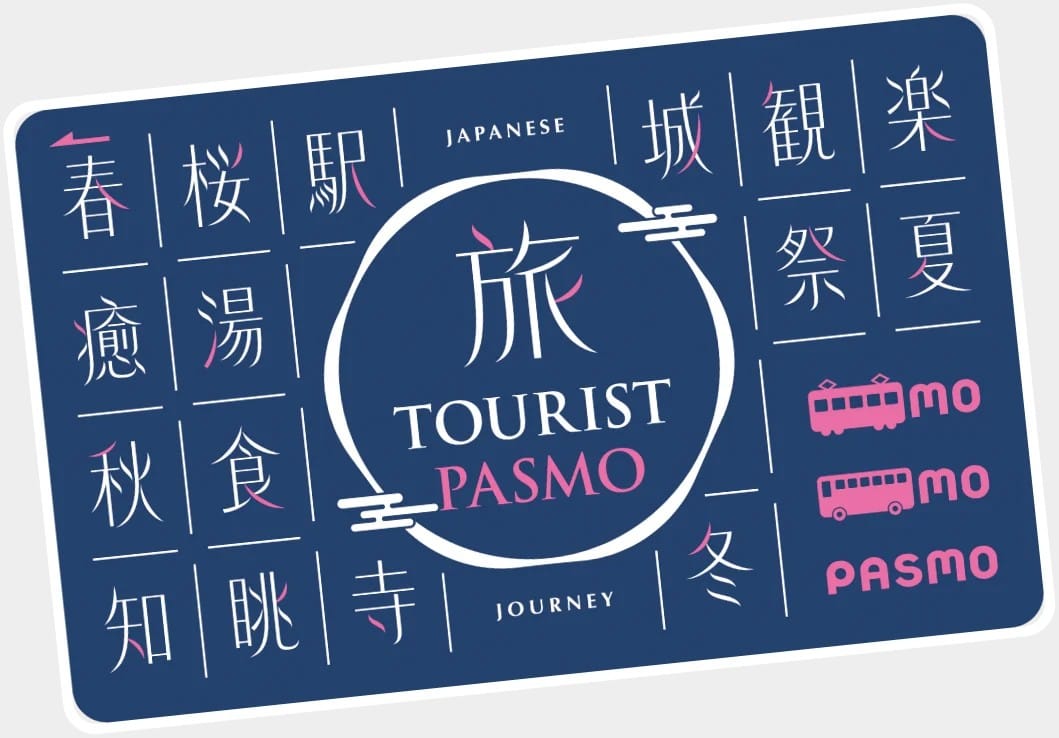
On May 20, 2026, Pasmo launched a transit card made specifically for international visitors: the Tourist Pasmo. It is the successor to the PASMO PASSPORT, which was discontinued in 2024. This time the cartoon-character look is gone, replaced by a modern, type-led design themed around kanji — a big character for “travel” (旅) in the middle, surrounded by characters tied to the seasons and to getting around. The card is meant to be kept as a souvenir once your trip is over.
For anyone here on a short trip, the appeal is simple: you can pick one up the moment you land, tap a single card on almost every train and bus in Japan, and use it as a wallet for small purchases. Here’s the full picture — price, where to buy it, how it works, and how it stacks up against the other cards.
Japan Pocket Wifi Rental
Japan eSIM : Fast & Easy & UNLIMTED
Japan Travel eSIM
May 20, 2026
28 days from issue
None
No refund on balance
Nationwide IC network
Narita & Haneda rail stations
01What is the Tourist Pasmo?
In short, it’s a short-stay version of the regular Pasmo. It does everything the Suica, ICOCA and Pasmo cards you may have heard of do — it’s part of Japan’s family of transit IC cards, so you tap it to ride trains, subways and buses, and you can also use it as an electronic wallet at convenience stores, drugstores and restaurants. Load cash onto it and you can reuse it again and again. If you want the fuller picture of how these cards work, see our guide to the Welcome Suica and Japan’s IC cards.
What makes it different is that it’s built for short-term visitors: no deposit, a validity window locked to 28 days from the date of issue, and no refund on the leftover balance. In exchange, it’s meant to go home with you as a keepsake. That’s the mirror image of a regular Pasmo, which charges a 500-yen deposit, stays usable for years, and refunds your balance when you return it. For someone here for a week or two, the Tourist Pasmo’s trade-off is actually the cleaner one — you skip the deposit and the return trip to a counter.
How is it different from the old PASMO PASSPORT?
The PASMO PASSPORT ran from 2019 to 2024 and leaned on Sanrio characters like Hello Kitty, with a 500-yen handling fee at purchase. The Tourist Pasmo swaps the characters for a kanji design and drops the handling fee, landing closer to a plain, deposit-free stored-value card. If you used the old PASSPORT, think of this as a stripped-down upgrade.
02Price and where to buy it
For now, the Tourist Pasmo is sold only at railway stations inside Narita Airport and Haneda Airport — at the station ticket windows or vending machines. The two airports price it a little differently:
| Where | Available amounts | Stored value included | Deposit |
|---|---|---|---|
| Narita Airport | 2,000 yen (one fixed option) | 2,000 yen | None |
| Haneda Airport | 1,000 / 2,000 / 3,000 / 4,000 / 5,000 / 10,000 yen (pick one) | Equal to the price paid | None |
The key point: the price equals the balance — there’s no separate card fee or deposit on top. Buy a 3,000-yen card at Haneda and all 3,000 yen is yours to spend. Narita currently offers only the single 2,000-yen option, while Haneda gives you more flexibility.
03How to use it, and where it works
Using it is no different from any other IC card: tap the card on the reader at the gate as you enter, then tap again as you exit, and the system deducts the correct fare automatically — no need to work out prices or transfer rules. On buses, you tap once on boarding or alighting, depending on the route.
Coverage is nationwide. Although it’s a Pasmo, issued by the Kanto-based PASMO Council, it belongs to Japan’s mutually compatible IC-card network, so it isn’t limited to Tokyo. In Osaka, Kyoto, Nagoya, Fukuoka, Sapporo and elsewhere, any IC-compatible train, subway or bus will take it. For shopping, any store displaying the transit IC e-money logo will let you pay with it — handy for a quick drink or a convenience-store run. If you’ll be spending much of your time on JR West lines, it’s also worth understanding the Suica vs. ICOCA picture, though for a Tourist Pasmo the practical answer is that it simply works in both regions.
If you prefer paying by phone, note that Japan’s QR-code payment apps (like PayPay) are a separate system from IC cards. The Tourist Pasmo is contactless IC — no app, no connection needed, just tap and go — which is a big part of why it suits short-trip travelers so well.
04Tourist Pasmo vs. Welcome Suica vs. regular Pasmo
The question most people get stuck on is “which card do I actually buy?” For short-term visitors, the Tourist Pasmo and JR East’s Welcome Suica are near-twins with identical functions; the real contrast is with a regular Pasmo. The table makes it clearest:
| Feature | Tourist Pasmo | Welcome Suica | Regular Pasmo |
|---|---|---|---|
| Issuer | PASMO Council | JR East | Pasmo |
| Deposit | None | None | 500 yen |
| Validity | 28 days from issue | 28 days from first use | 10 years from last use |
| Balance refund | No | No | Yes (fee applies) |
| Where to get it | Narita & Haneda rail stations | Airport vending machines, JR East Travel Service Centers | Stations across greater Tokyo |
| Best for | Short trip, want a keepsake | Short trip, JR-heavy routes | Frequent or long visits |
The logic is straightforward. If you’re here once and won’t be back soon, either the Tourist Pasmo or the Welcome Suica fits nicely — no deposit, take it home, no special trip to reclaim 500 yen. Choosing between the two? Grab whichever is easier to find at your arrival airport, and let the card design break the tie (one’s kanji, the other has Suica’s penguin).
On the other hand, if you visit Japan often or are staying longer than 28 days, a regular Pasmo (or regular Suica) is the better value: yes, there’s a 500-yen deposit, but it stays valid for ten years, refunds your balance, and has no 28-day clock.
05Who is the Tourist Pasmo for?
Boiled down to one line: the Tourist Pasmo is for the short, single, keep-it-simple trip.
If your itinerary runs around two weeks, you’re flying in and out of Narita or Haneda, you’d rather not deal with deposits and returns, and you happen to like the kanji design, it’s almost made for you. For a first-time visitor staring down a bank of ticket machines, buying one on arrival and tapping through the rest of the trip is the lowest-stress option there is.
But if any of these apply, reconsider: you’re staying longer than 28 days, you’ll be back within the year, or you’re arriving through Kansai or another airport (the Tourist Pasmo is currently sold only at Narita and Haneda). In those cases, a regular IC card or a locally issued tourist card may suit you better.
06Practical tips and common pitfalls
The one thing to burn into memory: the balance is non-refundable, even if you never tapped it once. So your “top-up strategy” is everything — add what you’ll use, and don’t lock a big lump of cash inside the card.
A word on cash: Japan has gone cashless fast, but rural shops, some buses and traditional markets still run mostly on cash, and IC cards aren’t accepted everywhere. On a first trip it’s wise to carry some yen as backup. Let the Tourist Pasmo handle the heavy lifting of transit and city spending, and let cash cover the corners it can’t reach.
Finally, prices, sales locations and rules above follow official announcements and may change, so check the official Pasmo website for the latest before you travel.
Tap with IC, navigate with dataThe Tourist Pasmo handles your fares, but checking transfers, finding the right station exit and pulling up Google Maps for your next stop all need a stable connection. CDJapan Rental’s eSIM runs on the docomo network with nationwide coverage — buy it online before you fly, scan a QR code to activate on arrival, and skip the physical SIM swap entirely. Like the Tourist Pasmo, it’s ready the moment you land.
07Frequently asked questions
What is the Tourist Pasmo and how is it different from a regular Pasmo?
Where can I buy the Tourist Pasmo and how much does it cost?
Can I use the Tourist Pasmo all over Japan?
Should I get the Tourist Pasmo or the Welcome Suica?
What happens to the leftover balance on a Tourist Pasmo?
Short trip or long stay — we've got you covered
Best for Travelers
Japan eSIM
From ¥2,800 — activate before you land
- Cheaper than airport & convenience store SIMs
- 5-day to 135-day plans; unlimited or data-capped
- No SIM swap needed — ready in 2 minutes
Best for Long Stays
Monthly Pocket WiFi
From ¥5,500/mo — unlimited, no throttle
- Choose WiMAX 5G or SoftBank 4G coverage
- 3 to 12-month contracts — longer means cheaper
- Delivered to your hotel or airport post office


